
Organon & Philosophy
Organon and Philosophy is the fundamental tool for Homoeopathic practice. it teaches us that how the tool can be use.
36 articles
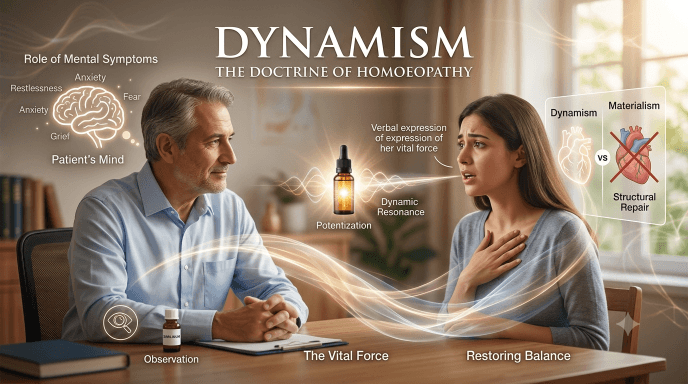
Doctrine of Homoeopathy: From Vitalism to Healing
The doctrine of Homoeopathy is inseparably bound with the principle of dynamism. It does not aim at repairing the material body in isolation, but rather seeks to restore the vital force—the dynamic essence that animates life. Disease, in this philosophy, is not merely a structural defect or chemical imbalance; it is a disturbance on the dynamic plane, a disharmony of the spirit‑like energy that governs sensation and function. Homoeopathic medicine, therefore, is not material in its curative action. Prepared through potentization, it transcends crude substance and becomes a dynamic remedy, capable of resonating with the disturbed vital force. Cure is achieved not by suppressing symptoms or altering tissues directly, but by stimulating the inner harmony, allowing the body to reorganize itself from within outward. Thus, the true aim of Homoeopathy is not to treat the corporeal frame, but to re‑establish balance in the living dynamis, from which health naturally flows into the material body.
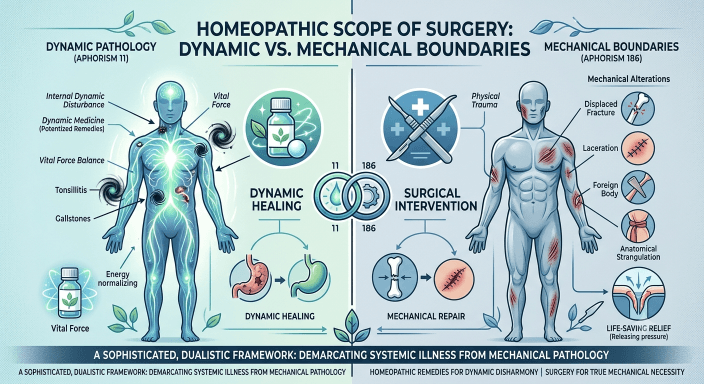
Surgical Intervention in Homoeopathy: Necessity, Limits, and Integration
Surgery represents one of the most decisive acts in medical practice—an intervention that seeks immediate relief by removing or altering diseased tissue. Yet, within the philosophy of homoeopathy, surgery is not regarded as a primary mode of cure but rather as a necessary measure when the natural laws of healing cannot be invoked. Homoeopathy emphasizes restoration through the vital force, aiming to correct internal imbalance rather than mechanically excising its manifestations. The scope of surgery in homoeopathy lies in emergencies, irreparable structural damage, or conditions where mechanical obstruction threatens life. Its limitations, however, are evident when surgery is employed as a substitute for true cure, ignoring the deeper dynamic disturbance that gave rise to pathology. Thus, surgery may save life or prevent immediate danger, but it cannot address the underlying susceptibility that homoeopathy seeks to harmonize. In this way, surgery and homoeopathy are not adversaries but complementary disciplines. Surgery provides mechanical aid where necessary, while homoeopathy ensures the restoration of health by addressing the vital force. The ethical challenge lies in discerning when surgical intervention is indispensable and when reliance on the body’s healing potential, guided by homoeopathic remedies, is sufficient.
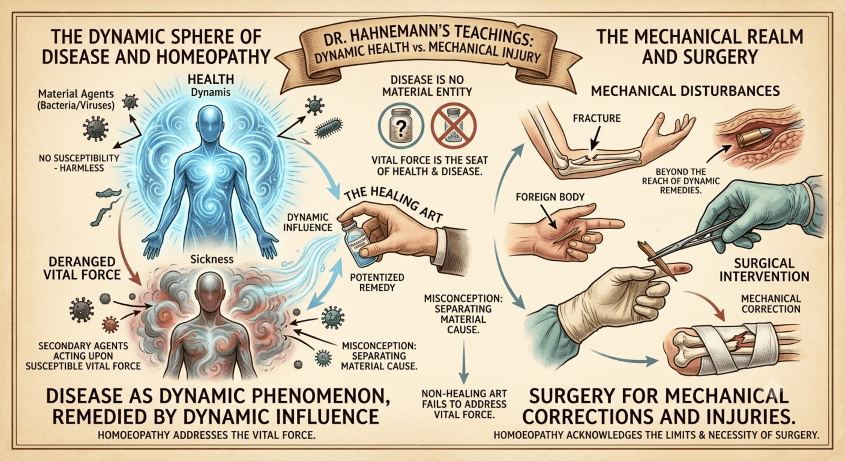
Aphorism - 13, limitation of medicine and scope for surgery in Homoeopathy.
Disease is not a material thing lodged in the body but a dynamic disturbance of the vital force, the invisible principle that sustains life. When this vital force is in harmony, health prevails; when disturbed, it manifests as altered sensations and functions that we call disease. Thus, disease is not a foreign substance but an immaterial imbalance, and cure lies in restoring the vital force to its natural equilibrium.
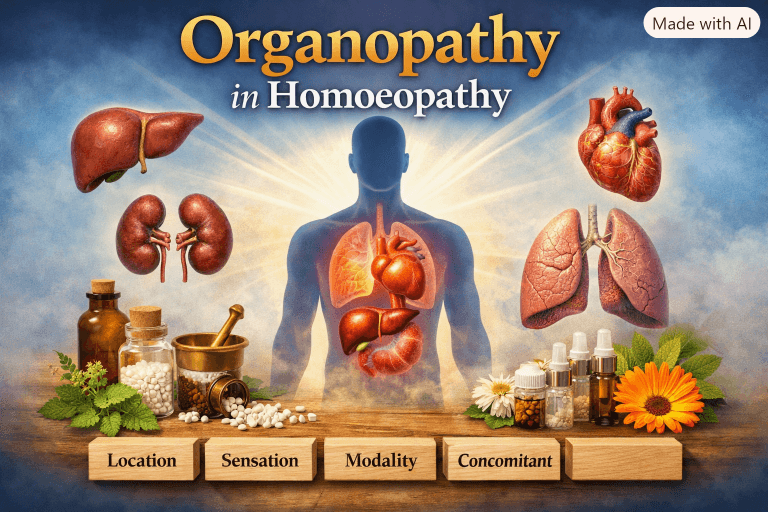
Organopathy in Homoeopathy: Bridging Organ Affinity and Classical Cure.
In the course of homoeopathic practice, many physicians have observed that certain remedies display a marked affinity for particular organs. This organ‑specific action has given rise to the concept of Organopathy, where medicines are employed not merely for their general symptom similarity but for their targeted influence upon vital organs and systems. At first glance, such prescriptions may appear to contradict the fundamental principle of treating the patient rather than the disease. Yet, when examined more closely, they reveal themselves as a natural extension of homoeopathic philosophy. Every medicine, in its proving, demonstrates a distinct relationship to certain tissues or organs, and this affinity cannot be ignored in clinical application. Organopathy, therefore, does not stand apart from homoeopathy but rather complements it, offering a practical method of prescription that emphasizes location and organ involvement while remaining grounded in the totality of symptoms. It is a refinement of practice, reminding us that the organ is not the disease itself but the stage upon which the disturbance of the vital force manifests.
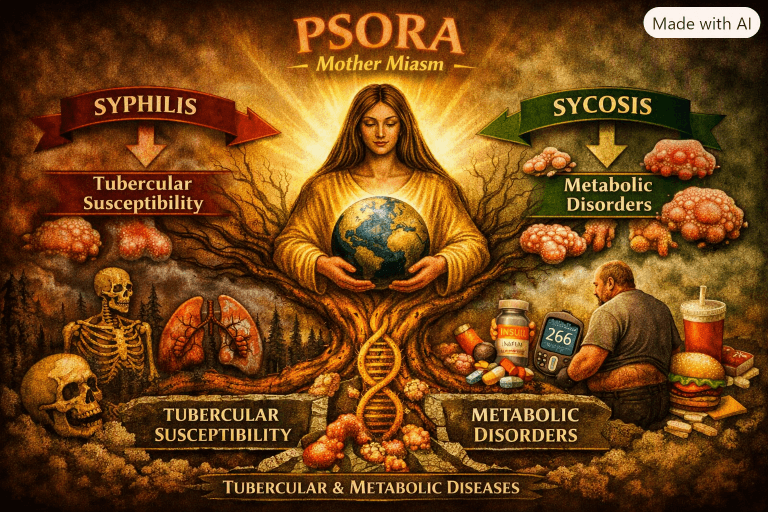
Sycotic Miasm: The Third Pillar in the Triad of Complex Diseases.
The Sycotic miasm, rooted in the gonorrheal taint, represents the principle of excess and infiltration within the chronic disease triad. Unlike Psora, which reflects deficiency, and Syphilis, which embodies destruction, Sycosis manifests through overgrowth, hyperplasia, and hidden accumulation. Clinically, it reveals itself in warty excrescences, fibrous nodules, rheumatic tendencies, and catarrhal discharges. On the mental plane, it is marked by secretiveness, suspicion, and suppressed emotions, mirroring its tendency to conceal within the organism. As the third pillar of Hahnemann’s miasmatic framework, Sycosis completes the understanding of chronic disease by showing how the vital force, when disturbed, may express itself not only through lack or decay but also through pathological excess.
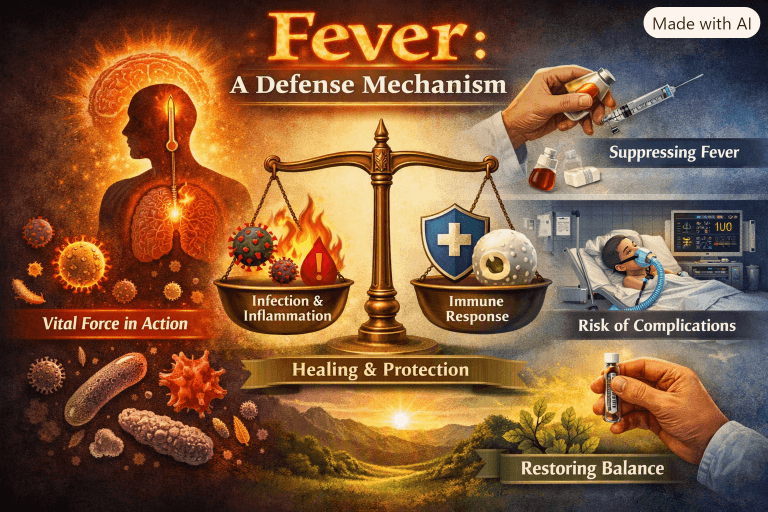
Fever: An Expression of vital force and Dynamic Resonance.
Fever is not just a rise in body temperature. It shows that the body’s inner life force is at work. In homoeopathy, fever is seen as the body’s way of responding and trying to bring itself back into balance. Instead of treating fever as something harmful to be stopped, it can be understood as the body’s way of speaking—showing its effort and strength. Fever activates the body’s defenses, makes us more aware of our condition, and proves that the body can regulate itself. When we see fever as a kind of resonance, we realize it is not random. The heat, restlessness, and changes we feel are part of a natural plan to help healing.
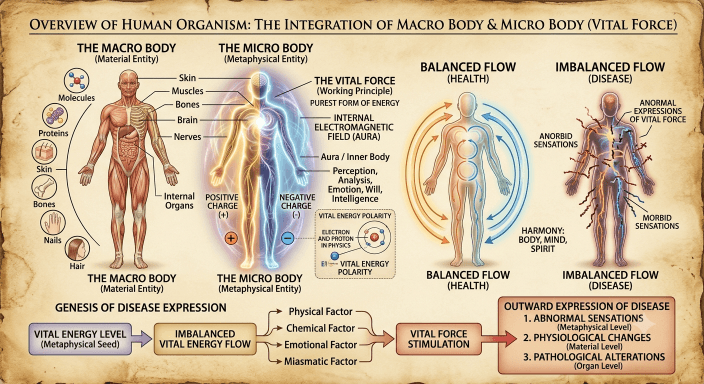
Vital Force in Operation: Perspectives on Health and Disease.
The vital force expresses itself through various manifestations—some reflecting health, others indicating disease. Life itself is an expression of the vital force; without it, an organism is considered dead. Between life and death, the vital force reveals itself through different operations from time to time, which are termed vital operations. An organism is visibly composed of material parts that form the outer framework called the material body; yet the material body does not represent the organism as a whole. There exists a working principle, termed the vital force, which animates the material body. It provides the power of perception, analysis, and emotion; will and intelligence are reflections of this vital force. From time to time, the vital force expresses itself through distinct manifestations, known as vital expressions. In this discussion, we shall explore in detail the various types of vital operations—certainly beyond the scope of chemistry and physics
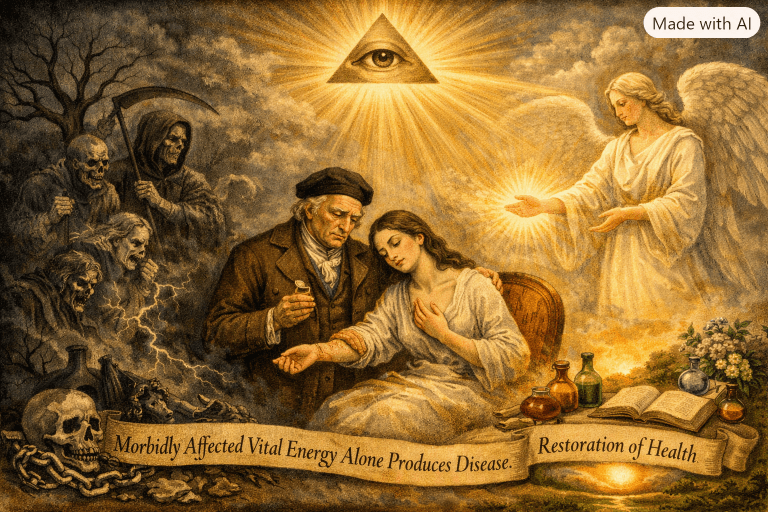
Aphorism -12: Healing Beyond Pathogenesis — The Homoeopath’s Capability to Cure Without Exact Knowledge of Disease Mechanism.
Aphorism 12 is intimately connected with the footnote of Aphorism 1 and with Aphorism 8; in fact, it serves as a complement to both. A crucial question raised by Dr. Hahnemann here is: “Is it the morbidly affected vital energy alone that produces disease?” In response, Hahnemann explains how the vital force gives rise to morbid symptoms—how disease originates. Yet he firmly emphasizes that such knowledge holds no practical utility for the physician. Speculation on the inner origin of disease belongs to theoretic medicine and will forever remain concealed, more a matter of prophecy than of healing practice. The physician’s duty is not to waste time and talent in investigating hidden mechanisms within the interior of man. His sole moral responsibility is to remove the disease in its entirety. Since all disease phenomena reveal themselves only through perceptible signs and symptoms, the removal of these signs and symptoms as a whole must be regarded as the removal of the disease itself. By stating this, Dr. Hahnemann effectively closed the door to modern speculative investigation, reminding physicians that cure lies not in abstract theorizing but in the faithful observation and removal of symptoms.
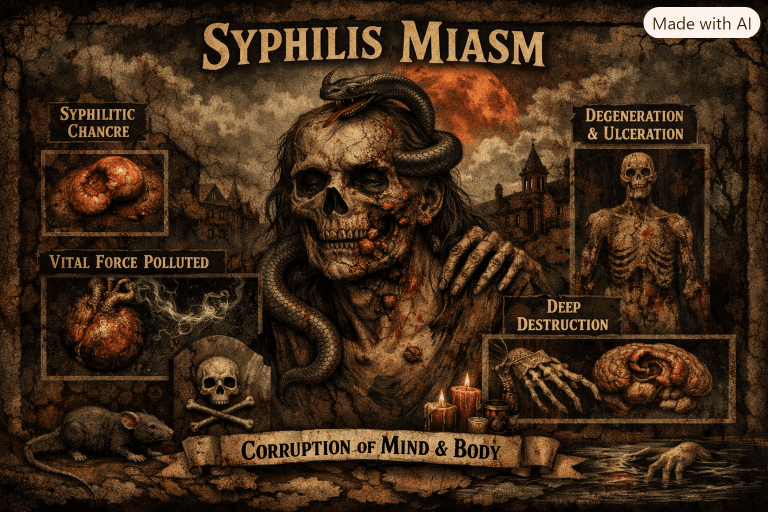
Syphilitic Miasm: A Companion of Psora and Its Destructive Process.
The destructive influence of Syphilis extends far beyond its primary lesions, insidiously undermining the very foundations of vitality. Its action upon the bones produces caries, softening, and deformities such as a narrowed chest, thereby preparing the ground for pulmonary tuberculosis. In the oral cavity, syphilitic ulcers with indurated margins stand as diagnostic hallmarks, while acrid, corrosive discharges from the nose and ears erode the delicate bones of these passages. The scrofulous diathesis, born of psoro‑syphilitic susceptibility, reveals the hidden presence of latent syphilis through glandular enlargement and endocrine disturbances. Thus, the syphilitic miasm manifests as a relentless process of degeneration—corroding tissues, impairing organs, and symbolizing the inward disintegration of vitality itself.
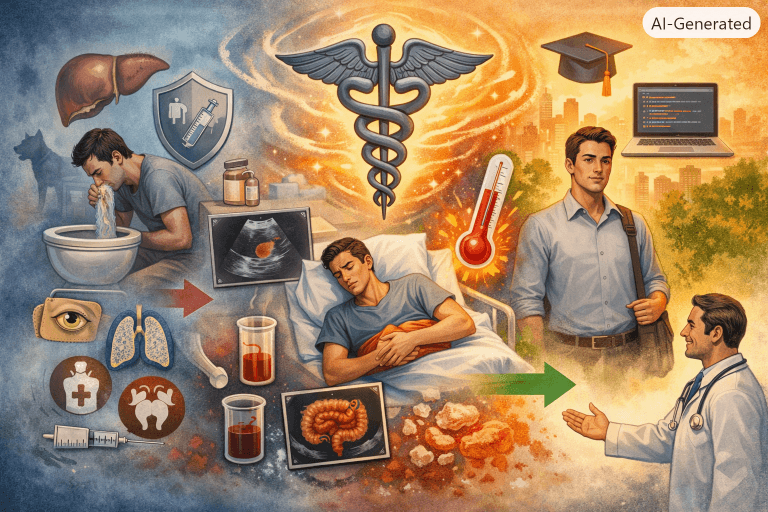
Dynamic Disease Unveiled: A Chronic Case of G.I.T. tract Cured by Arsenic Album
Disease is the dynamic derangement of the Vital Force — a timeless statement well evidenced by the study of this case. On 10/09/2023, I received a 22‑year‑old male patient suffering from persistent vomiting for the past 15 days, accompanied by tenderness in the lower abdominal region. General weakness was the distinguishing feature of the case. On investigation, a history of abdominal pain was revealed, which had begun gradually, worsened over time, and eventually culminated in vomiting — a condition that had first appeared 15 years earlier.
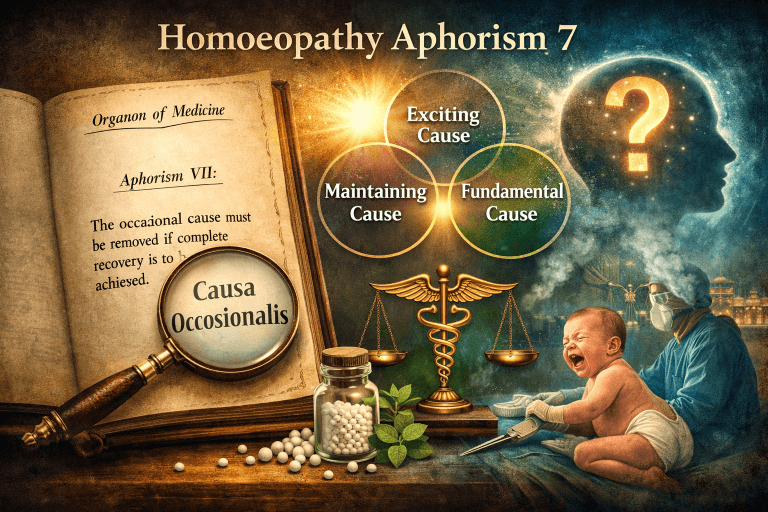
Causa Occasionalis: The Distinct Cause Beyond Exciting, Maintaining, and Fundamental cause.
Homoeopathy is often viewed as a system based solely on symptoms, yet Aphorism 7 of the Organon of Medicine reveals a deeper truth. Cure cannot be achieved without addressing the underlying cause—whether exciting, maintaining, or fundamental. Beyond these, Hahnemann introduces the concept of Causa Occasionalis, an occasional or external factor that obstructs recovery unless removed. From foreign bodies and congenital deformities to occupational irritants, these causes highlight the essential role of surgical or corrective measures alongside homoeopathic treatment. Aphorism 7 thus broadens the scope of practice, reminding physicians that lasting cure demands more than symptomatic prescription—it requires eliminating the true obstacle to healing.
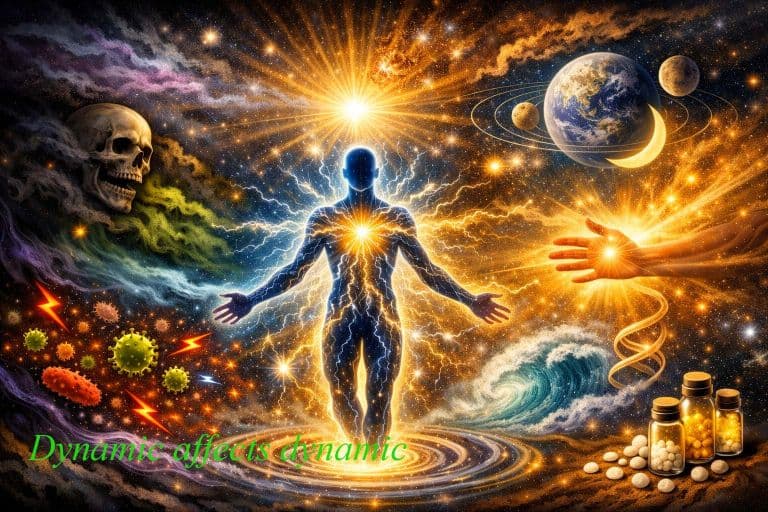
Aphorism - 11, (Threadless Transmission: The Vital Force and Disease)
The living principle within us, the vital force, does not require any physical thread or material pathway to be affected by disease. The disturbance of health occurs through an immaterial influence—a dynamic interaction between the diseased cause and the vital force. Just as a magnet acts invisibly upon iron, so too does the morbid agent act upon our life force, producing imbalance without direct physical contact. This explains why illness is not merely a mechanical injury but a dynamic alteration of harmony, transmitted without tangible connection. The physician must therefore recognize disease as a non-material disturbance of the vital force, not as a purely structural defect.