HomeoEra
Back to Blogs

Aphorism - 13, limitation of medicine and scope for surgery in Homoeopathy.

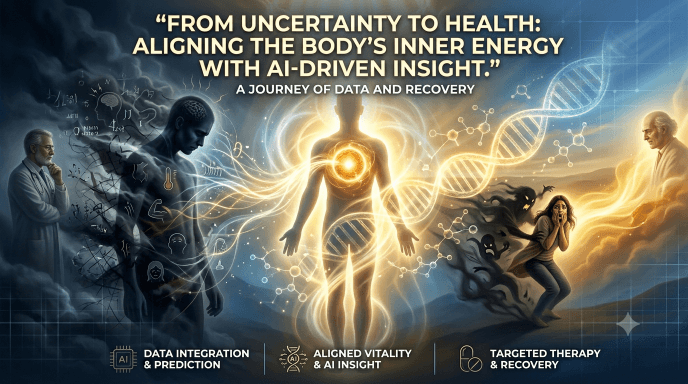
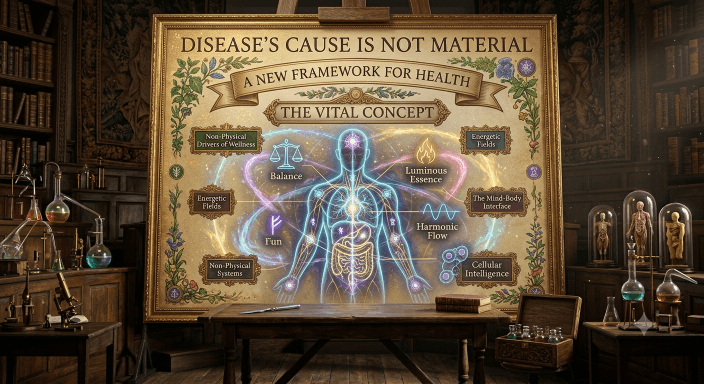
Disease is not a material thing lodged in the body but a dynamic disturbance of the vital force, the invisible principle that sustains life. When this vital force is in harmony, health prevails; when disturbed, it manifests as altered sensations and functions that we call disease. Thus, disease is not a foreign substance but an immaterial imbalance, and cure lies in restoring the vital force to its natural equilibrium.

H

HomeoEra Journal Editorial Team

Updated 2 min read162 views
Aphorism - 13, limitation of medicine and scope for surgery in Homoeopathy.

Disease is not caused by a separate material thing but from dynamic, spiritual vital force.


Aphorism - 13

"Therefore disease (that does not come within the province of manual surgery) considered, as it is by the allopathists, as a thing separate from the living whole, from the organism and its animating vital force, and hidden in the interior, be it of ever so subtle a character, is an absurdity, that could only be imagined by minds of a materialistic stamp, and has for thousands of years given to the prevailing system of medicine all those pernicious impulses that have made it a truly mischievous (non-healing) art."

Explanatory note:

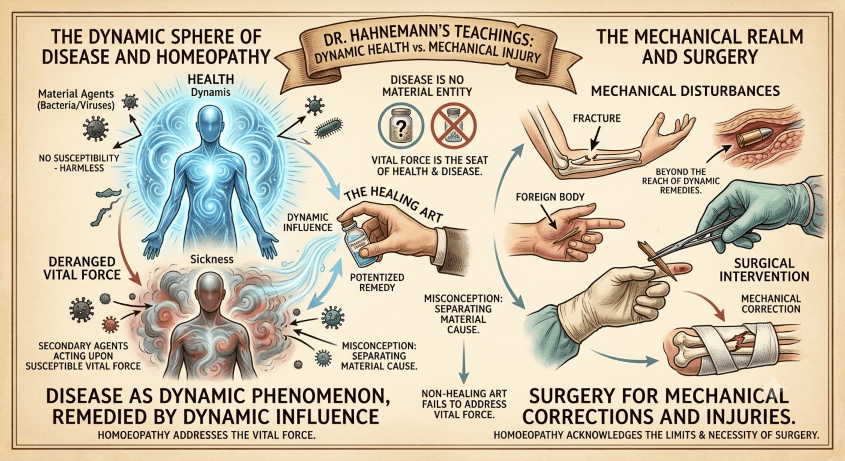
According to this aphorism, Dr. Hahnemann emphasizes that disease and health are entirely dynamic phenomena, governed by the vital force rather than by any separate material entity. Whether this entity is living or non‑living—including bacteria, viruses, or any other organism—it does not mean that such agents do not exist in the world. Rather, they cannot harm an individual until the vital force has first been deranged in the interior. Consequently, it can be said that bacteria and viruses are not the primary cause of disease, but secondary agents acting upon a susceptible vital force.

However, this principle does not apply to diseases that originate purely in a manual or mechanical way, such as injuries, fractures, or the insertion of foreign bodies like splinters or bullets. Such conditions must be treated mechanically, through surgical intervention. Dr. Hahnemann’s statement in Aphorism 13 therefore opens the door for surgery, acknowledging its necessity in cases where dynamic treatment alone cannot suffice. Thus, homoeopathy does not oppose the role of surgery but rather defines its proper limits—medicine for dynamic disturbances of the vital force, and surgery for mechanical corrections beyond the reach of remedies.

On the other hand, in diseases that are purely of dynamic origin, the attempt to separate and isolate a material cause of disease is nothing but nonsense. Such conditions arise from disturbances of the vital force itself and cannot be explained by attributing them to any external, tangible substance. To regard disease as a separate material entity is a misconception that obscures its true dynamic nature. Dr. Hahnemann described such misguided attempts as a non‑healing art, since they fail to address the vital force—the true seat of health and disease.
Word meaning and Explanation:


Have a Question?
Ask HomeoEra Journal Editorial Team about "Aphorism - 13, limitation of medicine and scope for surgery in Homoeopathy. " and get a personalized response directly to your email.

0/500 characters

0 characters (minimum 10 required)

🔒 Privacy Notice: Your information will only be used to respond to your query and won't be shared with third parties.

Aphorism 18: The Totality of Symptoms as the Fundamental Basis for Remedy Selection
Organon & Philosophy

Aphorism 18: The Totality of Symptoms as the Fundamental Basis for Remedy Selection

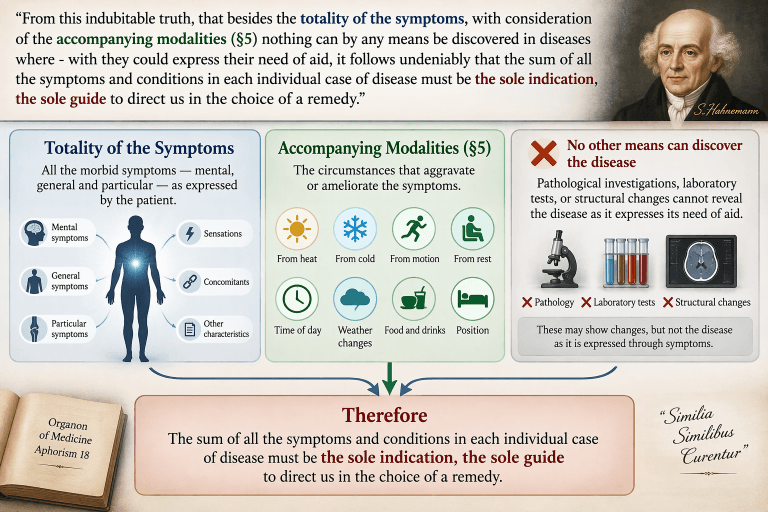
Aphorism 18 establishes that the totality of symptoms, together with their accompanying modalities, is the only reliable means of understanding disease and selecting the appropriate remedy. According to Hahnemann, disease cannot be perceived directly; it is known only through the signs and symptoms by which the disturbed vital force expresses itself. Therefore, every deviation from health has diagnostic and therapeutic significance.The physician must consider not only the symptoms themselves but also the circumstances that modify them, such as aggravations and ameliorations from motion, rest, weather, time, position, food, and other conditions. These modalities individualize the case and help distinguish one remedy from another.Hahnemann further teaches that pathological findings and structural changes may reveal the effects of disease, but they do not disclose the dynamic disturbance as clearly as the symptom totality. Consequently, the complete symptom-picture of the patient, rather than the disease name alone, must guide treatment.Thus, Aphorism 18 conveys two central truths: the totality of symptoms is the sole means of perceiving disease, and the same totality is the sole guide for selecting the curative remedy. It remains the foundation of individualization and successful homoeopathic prescribing.

HHomeoEra Journal Editorial Team
2m21
The Role of Autopsy in Investigating the Cause of Disease: A Homoeopathic Perspective
Organon & Philosophy

The Role of Autopsy in Investigating the Cause of Disease: A Homoeopathic Perspective

If disease originates primarily in the dynamic sphere of the living organism, then the true beginning of the disease process lies beyond the reach of post-mortem examination. An autopsy is performed upon the material body after the departure of the vital principle; therefore, it can reveal only the structural changes left behind by the disease and not the original dynamic disturbance that gave rise to them. It may demonstrate the location, extent, and pathological consequences of disease, but it cannot directly disclose the nature of the vital derangement from which those changes arose. In this sense, autopsy is invaluable for understanding the material effects and terminal expressions of disease, yet it remains limited as a means of investigating the primary dynamic cause. It informs us about the footprints of disease rather than the invisible force that first set the pathological process in motion

HHomeoEra Journal Editorial Team
6m18
Concomitant Symptoms: A Conceptual Perspective and Practical Utility - A Broad-Spectrum Analysis
Organon & Philosophy

Concomitant Symptoms: A Conceptual Perspective and Practical Utility - A Broad-Spectrum Analysis

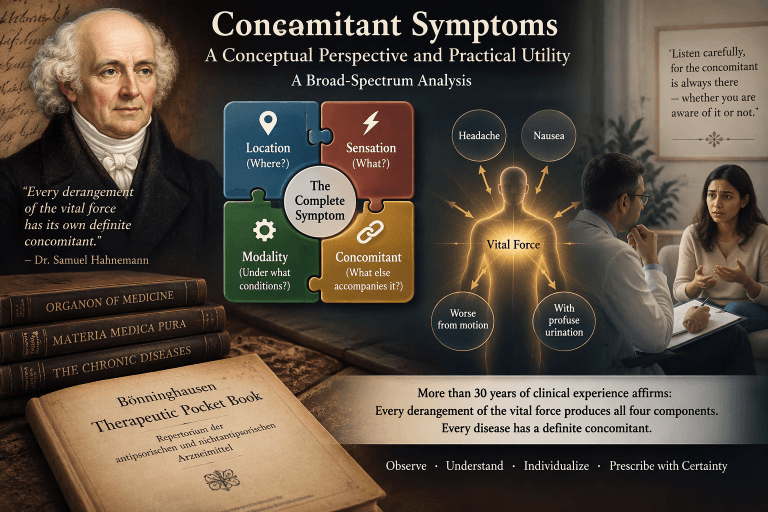
Concomitant symptoms occupy a unique position in homoeopathic philosophy and practice. While Bönninghausen regarded concomitants as the fourth indispensable element of the complete symptom, their practical application has often been misunderstood. A careful study reveals that concomitants are not merely incidental symptoms accompanying a chief complaint, nor can they be identified by a simple linguistic cue such as the word “with.” Rather, they represent definite manifestations arising from the same underlying derangement of the vital force. Drawing upon both Bönninghausen's theoretical framework and decades of clinical observation, this analysis explores the conceptual foundation, practical utility, and philosophical significance of concomitant symptoms. It argues that every genuine disease state possesses its own definite concomitant, whether readily recognized or not, and that the accurate perception of these accompanying symptoms remains one of the most important keys to individualization and successful remedy selection.

HHomeoEra Journal Editorial Team
7m22
Aphorism - 17, mission of the physician, continuation of the first aphorism: exclusion of the totality of disease.
Organon & Philosophy

Aphorism - 17, mission of the physician, continuation of the first aphorism: exclusion of the totality of disease.

Aphorism 17 emphasizes that disease can only be known through the totality of its perceptible signs and symptoms. Since the inner nature of disease is hidden from direct observation, the physician must carefully study the outward manifestations presented by the patient. These symptoms constitute the only reliable guide to understanding the disorder and selecting the appropriate remedy. Thus, successful treatment depends not upon speculative theories regarding the nature of disease, but upon an accurate appreciation of the complete symptom picture.

HHomeoEra Journal Editorial Team
6m25

Comments (0)

Sign in or sign up to join the discussion

No comments yet. Be the first to share your thoughts!

Newsletter

Stay Updated with Latest Research

Get weekly digests of new articles, case studies, and homeopathic insights delivered to your inbox

By subscribing, you agree to our Privacy Policy. Unsubscribe anytime.