
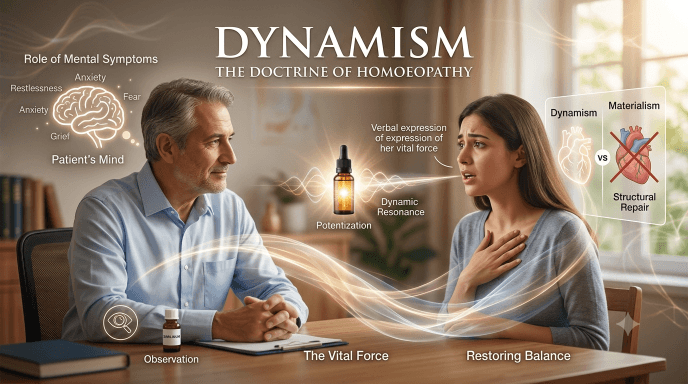
Dynamism the Doctrine of Homoeopathy:
The doctrine of Homoeopathy is profoundly rooted in the principle of dynamism. Its central aim is not to repair or manipulate the material body, but to restore balance within the vital force—the dynamic essence that governs life and health. Disease, in this philosophy, is understood as a derangement of this vital energy, not merely a defect in tissues or organs.
For the student of Homoeopathy, the true foundation of learning lies in grasping this dynamic concept. While subjects of medical science such as Anatomy, Physiology, Pathology, and Surgery provide valuable background knowledge, they do not hold a primary role in the study of Homoeopathy. The art of healing in this system depends entirely on understanding the dynamic plane of disease and cure.
Homoeopathic remedies, prepared through the process of potentization, transcend crude material substance. They act not by chemical or mechanical means, but by resonating with the disturbed vital force, thereby stimulating the organism to reorganize itself from within outward. This dynamic resonance is the essence of cure, distinguishing Homoeopathy from materialistic approaches that focus on structural repair alone.
Thus, to truly learn and practice this great science of healing, one must embrace the doctrine of dynamism—seeing beyond the corporeal frame and recognizing health as the harmony of the living energy that animates the body. In this manner, a thorough study of vital expression in both disease and health becomes indispensable for the student of Homoeopathy.
The vital expressions—abnormal sensations, altered functions, and dynamic disturbances—are the only true indicators of disease on the immaterial plane. They serve as the language of the vital force, guiding the physician toward the similimum remedy. Unlike material sciences such as Anatomy, Physiology, Pathology, or Surgery, which primarily analyze the structural and mechanical aspects of the body, Homoeopathy rests upon the recognition of these dynamic signs.
For the student of Homoeopathy, therefore, mastery lies not in dissecting tissues or cataloguing lesions, but in perceiving the subtle manifestations of the vital force. The art of cure depends on understanding how health expresses itself in balance, and how disease reveals itself through dynamic disharmony. Only by cultivating this perception can one grasp the true essence of Homoeopathy and apply its principles with precision.
Role of mental symptoms:
Although Homoeopathy is equally effective for all organisms—human beings, animals, and plants—among them, the human being possesses a unique ability: the power of speech. This is our great fortune, for whenever any alteration occurs in the interior of man, it can be directly expressed through voice.
Such verbal expression provides the Homoeopathic physician with invaluable insight into the vital disturbances that cannot be measured or observed materially. While animals and plants also respond dynamically to Homoeopathic remedies, their inability to articulate inner changes makes human testimony a privileged source of understanding. Thus, the study of Homoeopathy finds its richest field in the human being, where the language of symptoms becomes the direct reflection of the vital force in both health and disease. That is why it is essential for a Homoeopathic physician to listen to the patient carefully during their interaction. The key to success may be hidden in the patient’s mind. Perhaps this was the reason Dr. Hahnemann gave extraordinary importance to mental symptoms.
Such verbal expression provides the Homoeopathic physician with invaluable insight into the vital disturbances that cannot be measured or observed materially. While animals and plants also respond dynamically to Homoeopathic remedies, their inability to articulate inner changes makes human testimony a privileged source of understanding. Thus, the study of Homoeopathy finds its richest field in the human being, where the language of symptoms becomes the direct reflection of the vital force in both health and disease. That is why it is essential for a Homoeopathic physician to listen to the patient carefully during their interaction. The key to success may be hidden in the patient’s mind. Perhaps this was the reason Dr. Hahnemann gave extraordinary importance to mental symptoms.
The next key to success in prescribing may be found in the behavior of the patient. When the derangement of the vital force reaches its extreme, it often manifests itself through the patient’s outward expression. In such cases, verbal communication is not always necessary. A physician endowed with sufficient power of perception can discern the inner disturbance directly through observation alone.
For example, the physician does not need to ask the patient, “Are you restless?” because restlessness can be seen in the patient’s movements, posture, or facial expression. Similarly, irritability or agitation is often self-evident without verbal confirmation. The true art of perception lies in recognizing these subtle yet powerful signs, which reveal the dynamic state of the patient beyond words.
Thus, the physician’s success depends not merely on collecting verbal symptoms but on cultivating a refined perceptive faculty—an ability to grasp the living portrait of disease as it expresses itself through behavior, gestures, and expressions. This higher level of observation elevates clinical practice, allowing the physician to connect directly with the vital disturbance without relying solely on spoken descriptions.
How the pathological investigations are helpful:
Pathology is not the disease itself, but rather the end result of the disease process. It represents the consequence of an abnormal flow of vital energy—whether excessive or deficient. In this sense, pathology is a manifestation, not the essence, of disease.
Therefore, in Homoeopathy, pathology is not the direct subject of treatment. The physician’s aim is not to suppress or merely address pathological changes, but to restore harmony in the vital force that animates the organism. Pathology may serve as a marker of disturbance, but it does not guide the true curative prescription.
If the physician wishes to understand the severity or progress of the disease, modern investigations—such as laboratory tests and imaging—become necessary. These tools provide valuable information about the extent of tissue damage, the stage of disease, and the prognosis. However, they rarely assist in the selection of the appropriate homoeopathic remedy. The remedy is chosen based on the totality of symptoms, the dynamic portrait of the patient, and the peculiarities of individual expression.
At best, investigations may reveal the side affinity of the disease—that is, the organ or system most affected. This knowledge can help the physician appreciate the targeted site of pathology, but it remains secondary to the holistic perception of the patient’s dynamic state. Homoeopathy treats the living disturbance, not the dead product of disease.
Conclusion:
The doctrine of Homoeopathy is entirely rooted in the principles of dynamism and vitalism. It is an energy‑based, dynamic phenomenon that defines both disease and health on the dynamic plane, rather than on the material plane.
Pathological findings do not provide true insight into the disease process; they merely indicate the end result of a deeper disturbance. In this respect, Allopathy and Homoeopathy represent two distinct medical sciences, each operating on fundamentally different planes.
Homoeopathy works on the dynamic plane, addressing the disturbance of the vital force, while Allopathy functions on the material plane, focusing on structural and biochemical changes. Because their foundations are philosophically and practically divergent, one cannot truly practice both systems simultaneously. Each demands its own integrity of approach.