Sycotic Miasm: The Third Pillar in the Triad of Complex Diseases.
The Sycotic miasm, rooted in the gonorrheal taint, represents the principle of excess and infiltration within the chronic disease triad. Unlike Psora, which reflects deficiency, and Syphilis, which embodies destruction, Sycosis manifests through overgrowth, hyperplasia, and hidden accumulation. Clinically, it reveals itself in warty excrescences, fibrous nodules, rheumatic tendencies, and catarrhal discharges. On the mental plane, it is marked by secretiveness, suspicion, and suppressed emotions, mirroring its tendency to conceal within the organism. As the third pillar of Hahnemann’s miasmatic framework, Sycosis completes the understanding of chronic disease by showing how the vital force, when disturbed, may express itself not only through lack or decay but also through pathological excess.
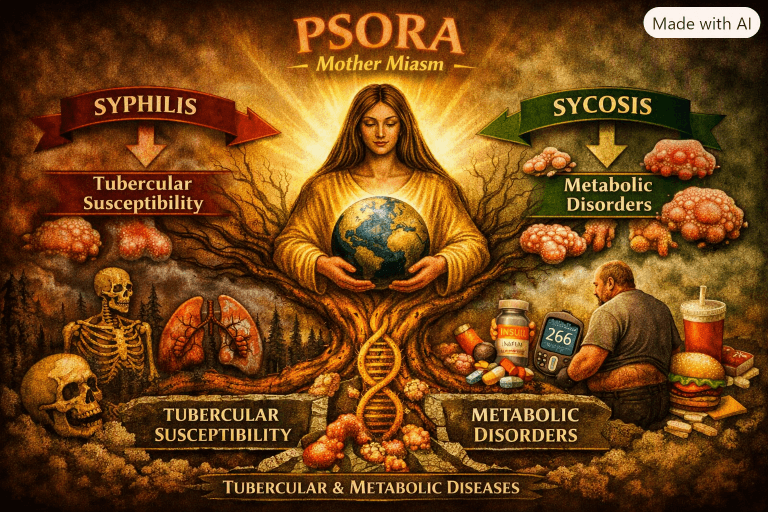
Sycosis is another venereal miasm, distinct from Syphilis, and likewise transmitted through sexual contact. Although its pathogenesis exhibits certain parallels with Syphilis, it originates from a different source, constituting a unique dynamic disturbance within the chronic miasmatic framework. It is also recognized as the gonorrhoeal miasm, reflecting its historical association with gonorrheal infection. with the association of Psora and syphilis it forms complex diseases. bonding between Psora, syphilis and Sycosis gives origin of Tubercular susceptibilities, more difficult to cure.
Pathogenetic Nature:
Origin: Rooted in gonorrheal infection, producing condylomata, warts, and infiltrative growths.
Dynamic Disturbance: Unlike Syphilis (destructive) and Psora (functional), Sycosis manifests through Proliferative and infiltrative tendencies, leading to fibrous nodules, rheumatic affections, and chronic catarrhal states.
Complex Interactions:
When Sycosis interacts with Psora and Syphilis, the disease manifestations become more complex and multidimensional:
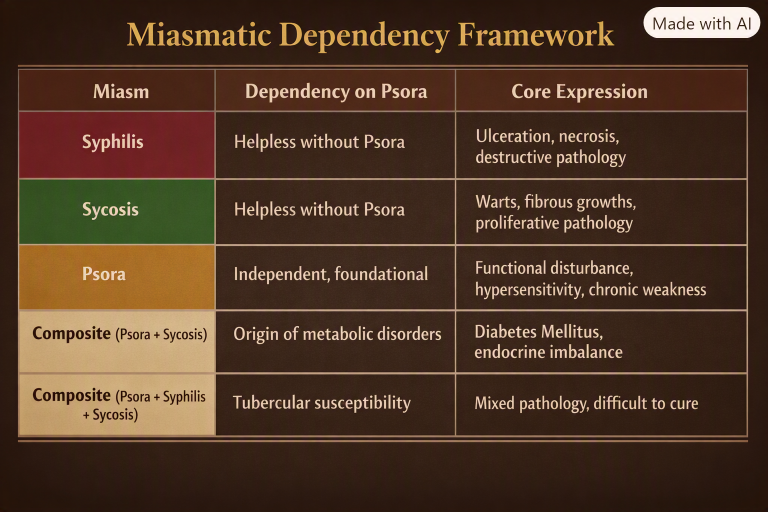
1. Psora + Sycosis: Functional disturbance compounded with proliferative tendencies.
2. Syphilis + Sycosis: Destructive pathology interwoven with infiltrative growth.
3. Triadic Bonding (Psora, Syphilis, Sycosis): This union gives rise to Tubercular susceptibilities, marked by alternating deficiency, destruction, and proliferation. Such cases are more difficult to cure, as the vital force is entangled in conflicting pathological directions.
Note: It must be emphasized that without the active support of Psora, both Syphilis and Sycosis lose their functional capacity. Psora provides the fertile soil upon which the destructive force of Syphilis and the proliferative tendency of Sycosis can manifest. Hence, Psora must rightly be considered the mother of all miasmatic diseases.
Psora as the Root:
1. Psora’s Role: The fundamental disturbance of Psora lies in functional imbalance, hypersensitivity, and chronic susceptibility. it makes weak and sets fire within the organism.
2. Syphilis & Sycosis Dependency: Neither Syphilis nor Sycosis can fully express their destructive or proliferative tendencies without Psora’s groundwork.
3. Philosophical Insight: Psora is the primordial miasm, the underlying dynamic disorder that sustains and amplifies the other venereal miasms.
Clinical Implications:
1. Metabolic Disorders: Many chronic metabolic conditions—including Diabetes Mellitus—originate from the interplay of Psoric weakness with Sycotic susceptibility.
2. Psora + Sycosis: This combination produces a fertile ground for metabolic dysregulation, manifesting as insulin resistance, obesity, and endocrine imbalance.
3. Psora + Syphilis + Sycosis: When all three converge, the result is Tubercular susceptibility, marked by alternating deficiency, destruction, and proliferation—often resistant to cure.
Philosophical Significance:
The bonding of Psora, Syphilis, and Sycosis illustrates the complexity of chronic disease evolution. Tubercular susceptibility emerges as a hybrid miasmatic state, reflecting the struggle of the vital force against multiple, intertwined disturbances. This explains why tubercular cases often present with mixed symptomatology and demand careful, individualized management
Conclusion:
In the grand schema of chronic miasmatic pathology, Psora stands as the primordial and sustaining force—the dynamic foundation upon which Syphilis and Sycosis depend for their expression. Without Psora’s active participation, these venereal miasms remain inert, unable to manifest their destructive or proliferative tendencies. Thus, Psora is rightly regarded as the “Mother of Miasmatic Diseases.”
The interplay between Psora and Sycosis gives rise to metabolic disorders, notably Diabetes Mellitus, where functional imbalance (Psora) merges with proliferative tendencies (Sycosis), disturbing the vital economy. When Psora, Syphilis, and Sycosis unite, they generate Tubercular susceptibility—a complex, hybrid state characterized by alternating deficiency, destruction, and proliferation, often resistant to cure.
This triadic relationship reflects the philosophical depth of Hahnemann’s miasmatic theory, portraying disease not merely as a physical disorder but as a dynamic conflict within the vital force, demanding individualized, holistic treatment to restore harmony.
Have a Question?
Ask HomeoEra Journal Editorial Team about "Sycotic Miasm: The Third Pillar in the Triad of Complex Diseases." and get a personalized response directly to your email.
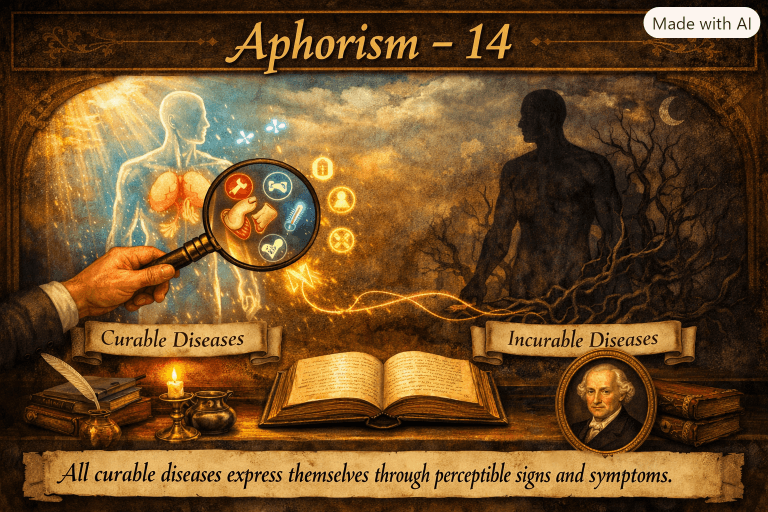
In this aphorism, Dr. Samuel Hahnemann elucidates a fundamental law of observation in medicine: that every curable disorder within the human organism necessarily reveals itself through perceptible signs and symptoms. Nothing curable remains hidden from the discerning physician, for the divine order has ordained that disease must express its presence outwardly to invite cure.
Thus, the physician’s art depends entirely upon the faithful interpretation of these manifestations. The morbid phenomena are not mere disturbances but the visible language of Nature, guiding the healer toward restoration. Those affections that grow silently within, without perceptible symptoms, belong to the realm of the incurable; for where no sign is given, no curative response can be awakened.
In essence, Hahnemann reminds us that symptoms are the thread of cure—the only bridge between the inner disorder and the physician’s understanding. To grasp that thread is to hold the possibility of healing; to lose it is to stand before disease without remedy.
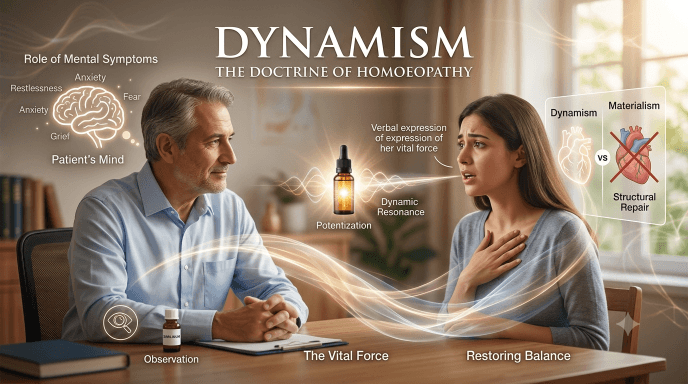
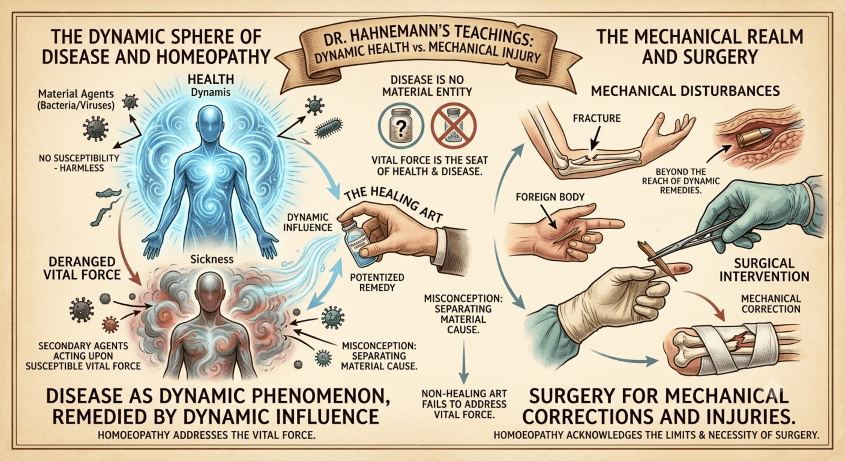
The doctrine of Homoeopathy is inseparably bound with the principle of dynamism. It does not aim at repairing the material body in isolation, but rather seeks to restore the vital force—the dynamic essence that animates life. Disease, in this philosophy, is not merely a structural defect or chemical imbalance; it is a disturbance on the dynamic plane, a disharmony of the spirit‑like energy that governs sensation and function.
Homoeopathic medicine, therefore, is not material in its curative action. Prepared through potentization, it transcends crude substance and becomes a dynamic remedy, capable of resonating with the disturbed vital force. Cure is achieved not by suppressing symptoms or altering tissues directly, but by stimulating the inner harmony, allowing the body to reorganize itself from within outward.
Thus, the true aim of Homoeopathy is not to treat the corporeal frame, but to re‑establish balance in the living dynamis, from which health naturally flows into the material body.
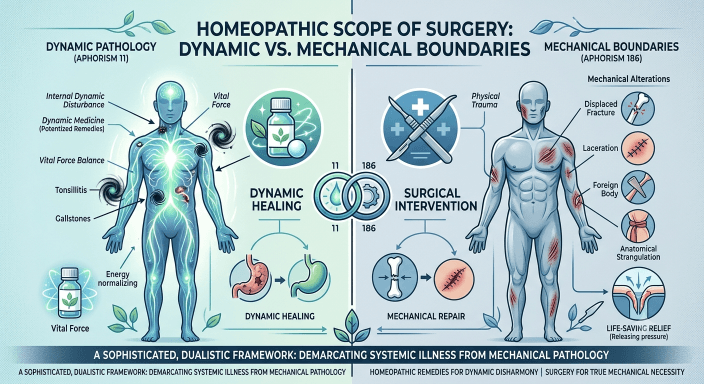
Surgery represents one of the most decisive acts in medical practice—an intervention that seeks immediate relief by removing or altering diseased tissue. Yet, within the philosophy of homoeopathy, surgery is not regarded as a primary mode of cure but rather as a necessary measure when the natural laws of healing cannot be invoked. Homoeopathy emphasizes restoration through the vital force, aiming to correct internal imbalance rather than mechanically excising its manifestations.
The scope of surgery in homoeopathy lies in emergencies, irreparable structural damage, or conditions where mechanical obstruction threatens life. Its limitations, however, are evident when surgery is employed as a substitute for true cure, ignoring the deeper dynamic disturbance that gave rise to pathology. Thus, surgery may save life or prevent immediate danger,
but it cannot address the underlying susceptibility that homoeopathy seeks to harmonize.
In this way, surgery and homoeopathy are not adversaries but complementary disciplines. Surgery provides mechanical aid where necessary, while homoeopathy ensures the restoration of health by addressing the vital force. The ethical challenge lies in discerning when surgical intervention is indispensable and when reliance on the body’s healing potential, guided by homoeopathic remedies, is sufficient.
Disease is not a material thing lodged in the body but a dynamic disturbance of the vital force, the invisible principle that sustains life. When this vital force is in harmony, health prevails; when disturbed, it manifests as altered sensations and functions that we call disease. Thus, disease is not a foreign substance but an immaterial imbalance, and cure lies in restoring the vital force to its natural equilibrium.