Now, as in the cure effected by the removal of the whole of the perceptible signs and symptoms of the disease the internal alteration of the vital principle to which the disease is due consequently the whole of the disease - is at the same time removed [ A warning dream, a superstitious fancy, or a solemn prediction that death would occur at a certain day or at a certain hour, has not infrequently produced all the signs of commencing and increasing disease, of approaching death and death itself at the hour announced, which could not happen without the simultaneous production of the inward change (corresponding to the state observed externally); and hence in such cases all the morbid signs indicative of approaching death have frequently been dissipated by an identical causes, by some cunning deception or persuasion to a belief in the contrary, and health suddenly restored, which could not have happened without the removal by means of this moral remedy, of the internal and external morbid change that threatened death.], it follows that the physician has only to remove the whole of the symptoms in order, at the same time, to abrogate and annihilate the internal change, that is to say, the morbid derangement of the vital force consequently the totality of the disease, the disease itself [ it is only thus that god, the Preserver of mankind, could reveal His wisdom and goodness in reference to the physician what he had to remove in diseases in order to annihilate them and thus reestablish health, But what would we think of His wisdom and goodness if He had shrouded in mysterious obscurity that which was to be cured in diseases (as is asserted by the dominant school of medicine, which affects to possesses a supernatural insight into the inner nature of things), and shut it up in the hidden interior, and thus rendered it impossible for man to know the malady accurately, consequently impossible for him to cure it? ]. But when the disease is annihilated, health is restored, and this is the highest, the sole aim of the physician who knows the true object of his mission, which consists not in learned-sounding prating, but in giving aid to the sick.
Aphorism 17 is closely related to Aphorisms 1 and 7 and may be regarded as a continuation of the fundamental theme introduced at the beginning of the Organon of Medicine. It explains in greater detail the answer to the question: What is the mission of the physician?
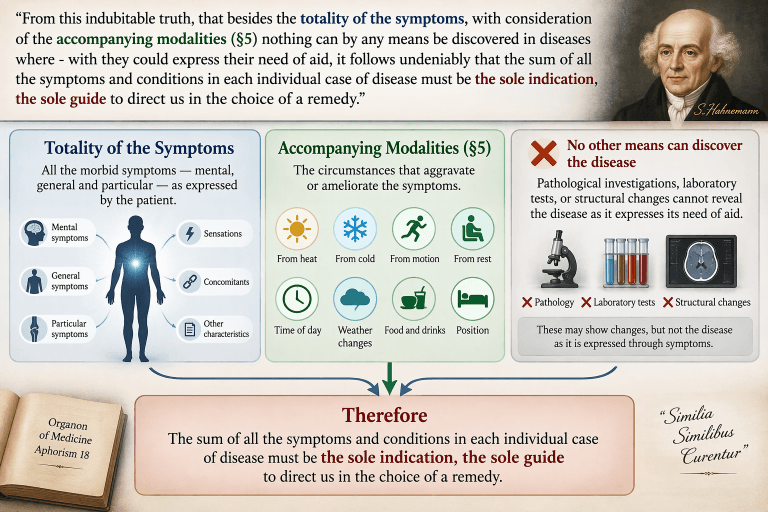
Hahnemann teaches that the physician has no means of directly perceiving the inner disturbance that gives rise to disease. The essential disorder of the dynamic vital force is invisible; it cannot be seen, measured, or calculated. Therefore, the only reliable way to understand the disease is through the collection and study of all perceptible signs and symptoms presented by the patient.
These signs and symptoms serve as the outward expression of the internal disorder. However, symptoms themselves are not the disease in its true essence. They are only the visible reflection or mirror image of the underlying disturbance of the vital force. By carefully observing and understanding this totality of symptoms, the physician is able to perceive the nature of the sickness and select the appropriate remedy.
Furthermore, Dr. Hahnemann states that the complete removal of all perceptible signs and symptoms must be regarded as the cure of the disease, whether these manifestations appear on the physical, mental, or spiritual plane. Even symptoms that may seem trivial or easily ignored, such as warning dreams, superstitious fears, peculiar fancies, or a firm conviction that death will occur at a particular hour, day, or time, deserve careful attention. Such phenomena cannot arise without some disturbance of the vital force and may provide valuable guidance in the selection of the most suitable remedy.
The human organism may be regarded as a biological instrument through which the vital force expresses its state. This expression manifests not only through physical changes but also through thoughts, emotions, perceptions, and verbal communication. For this reason, every deviation from the healthy state, however subtle or unusual, becomes significant to the homoeopathic physician. It is perhaps for this reason that Dr. Hahnemann attached such great importance to mental symptoms, considering them among the most characteristic and individualizing features of a case.
However, it is not the duty of the homoeopathic physician to forcefully elicit or unnecessarily search for mental symptoms. When disease affects the mental sphere, it naturally produces characteristic changes in the patient's thoughts, emotions, and behaviour. These manifestations arise spontaneously from the disease itself and must be carefully observed and considered by the physician in the process of prescribing. It should always be remembered that our sole guide in the selection of a remedy is the totality of the morbid symptoms, whether they are manifested on the mental, physical, or spiritual plane.
Hence, in the light of this aphorism, it may be said that the sole mission of the physician is the removal of all perceptible signs and symptoms of disease, whether they are reflected on the mental, physical, or spiritual plane. If the expression of the natural disease is not covered up by an antipathic medicine, the disease will ultimately be annihilated, and the patient will be restored to health. This is the mission of the physician.
1. To Percept the disease phenomena through the art of case taking.
2. Collection of the perceptible sign and symptoms using data science.
3. To establish the Connection between collected symptoms (Theory of complete symptoms).
4. To exclude the Totality of disease, (Logical thinking by the physician needed).
5. Search the appropriate Remedy (with the help of own mind or with the help of repertory).
6. To make prescription according
Word meaning and explanation:
1. Perceptible sign and symptoms: symptoms that can felt by the patient himself, can be observe by the physician and attendees.
2. Cunning deception: skillful or technical art or act to do something fruitful.
3. Moral remedy: Medicine that has the power to change in the moral plane, like delusion, illusion or false perception like fear and emotion.
4. Totality of disease: The volumetric as well as dimensional information of the disease as a whole, with both the aspect of direction and magnitude.
Related aphorism:
Aphorism - 1, 2, 4, 7,