HomeoEra
Back to Blogs

Aphorism - 14, Health as Harmony: Absence of Morbid Signs and Need for Cure.

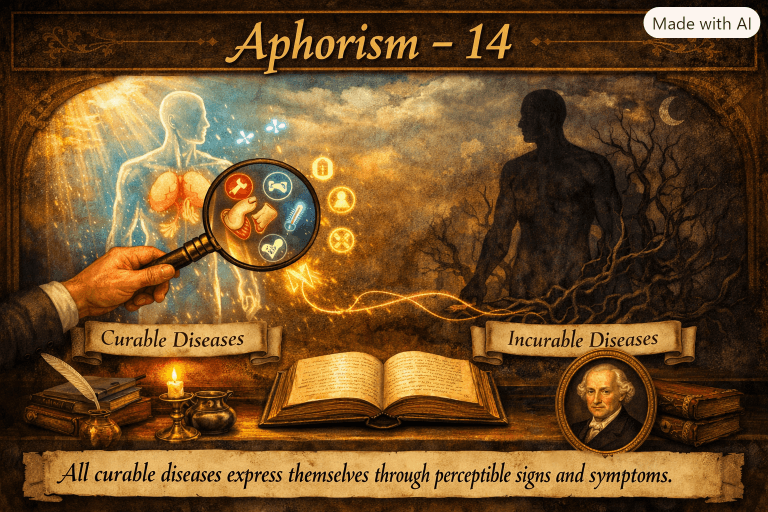
In this aphorism, Dr. Samuel Hahnemann elucidates a fundamental law of observation in medicine: that every curable disorder within the human organism necessarily reveals itself through perceptible signs and symptoms. Nothing curable remains hidden from the discerning physician, for the divine order has ordained that disease must express its presence outwardly to invite cure. Thus, the physician’s art depends entirely upon the faithful interpretation of these manifestations. The morbid phenomena are not mere disturbances but the visible language of Nature, guiding the healer toward restoration. Those affections that grow silently within, without perceptible symptoms, belong to the realm of the incurable; for where no sign is given, no curative response can be awakened. In essence, Hahnemann reminds us that symptoms are the thread of cure—the only bridge between the inner disorder and the physician’s understanding. To grasp that thread is to hold the possibility of healing; to lose it is to stand before disease without remedy.

H

HomeoEra Journal Editorial Team

2 min read157 views
Aphorism - 14, Health as Harmony: Absence of Morbid Signs and Need for Cure.

All curable diseases express themselves through perceptible signs and symptoms

Aphorism - 14,

There is, in the interior of man, nothing morbid that is curable and no visible morbid alteration that is curable, which does not make itself known to the accurately observing physician by means of morbid sign and symptoms -an arrangement in perfect conformity with the infinite goodness of the all-wise Preserver of human life. 

Explanatory note:

“In this aphorism, Dr. Hahnemann clearly distinguishes between curable and incurable diseases. According to him, all diseases that fall under the category of curable disorders present themselves through signs and symptoms perceptible to the true and wise physician. By contrast, diseases that are insidious in nature, developing secretly within the interior of the organism without perceptible signs and symptoms, belong to the category of incurable diseases.”   

Indirectly, Dr. Hahnemann wishes to emphasize that symptoms are our only hope for curing disease. Only by holding fast to the thread of symptoms can we reach the goal of cure. Diseases without this thread—those that do not manifest themselves through perceptible signs and symptoms—cannot be cured. in the essence form we can say that " all curable diseases express themselves through perceptible sign and symptoms. 

Case insight:

Recently, I received a case of gallstone colic. The patient was extremely anxious due to severe pain and was unable to move; even a deep breath aggravated the pain and was accompanied by vertigo. Upon deeper investigation, I discovered that she experienced a distinct spell of vertigo whenever she attempted to lie on her left side. here in this case the location was Gallbladder, Sensation was colicky pain, modality was pain get worse by motion and the vertigo was concomitant. So, I found one complete symptom. 

I prescribed her four doses of Colocynthis 30, administered at intervals of thirty minutes. Within two hours she experienced complete relief—the pain had entirely subsided.

At first glance, this case resembled one of Bryonia, which is indeed a remarkable remedy for gallstone colic. However, a contra‑indicating symptom was present—vertigo aggravated by lying on the left side. This peculiar modality does not correspond with Bryonia but aligns exactly with Colocynthis, thereby confirming the appropriateness of the prescription.  
World meaning and explanation:

Have a Question?
Ask HomeoEra Journal Editorial Team about "Aphorism - 14, Health as Harmony: Absence of Morbid Signs and Need for Cure." and get a personalized response directly to your email.

0/500 characters

0 characters (minimum 10 required)

🔒 Privacy Notice: Your information will only be used to respond to your query and won't be shared with third parties.

Doctrine of Homoeopathy: From Vitalism to Healing
Organon & Philosophy

Doctrine of Homoeopathy: From Vitalism to Healing

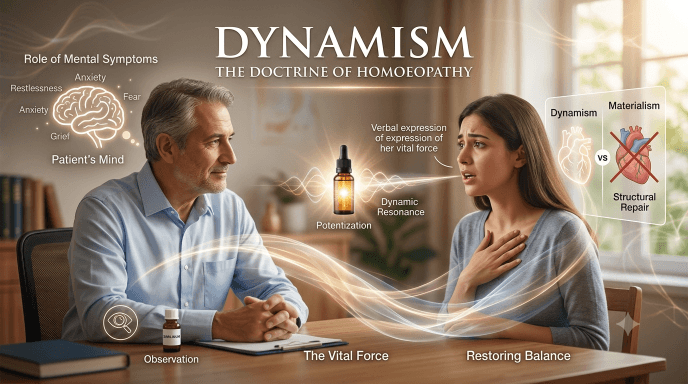
The doctrine of Homoeopathy is inseparably bound with the principle of dynamism. It does not aim at repairing the material body in isolation, but rather seeks to restore the vital force—the dynamic essence that animates life. Disease, in this philosophy, is not merely a structural defect or chemical imbalance; it is a disturbance on the dynamic plane, a disharmony of the spirit‑like energy that governs sensation and function. Homoeopathic medicine, therefore, is not material in its curative action. Prepared through potentization, it transcends crude substance and becomes a dynamic remedy, capable of resonating with the disturbed vital force. Cure is achieved not by suppressing symptoms or altering tissues directly, but by stimulating the inner harmony, allowing the body to reorganize itself from within outward. Thus, the true aim of Homoeopathy is not to treat the corporeal frame, but to re‑establish balance in the living dynamis, from which health naturally flows into the material body.

HHomeoEra Journal Editorial Team
7m295
Surgical Intervention in Homoeopathy: Necessity, Limits, and Integration
Organon & Philosophy

Surgical Intervention in Homoeopathy: Necessity, Limits, and Integration

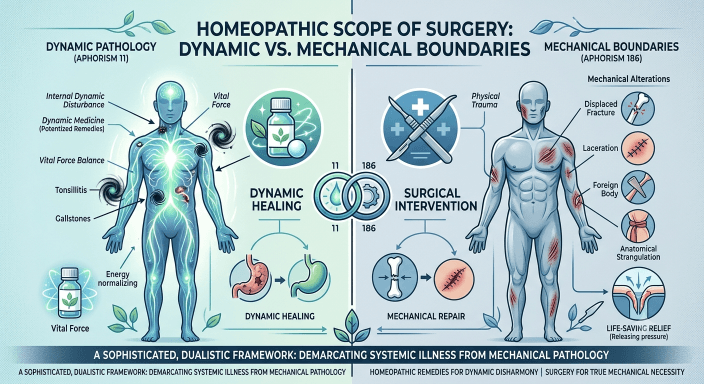
Surgery represents one of the most decisive acts in medical practice—an intervention that seeks immediate relief by removing or altering diseased tissue. Yet, within the philosophy of homoeopathy, surgery is not regarded as a primary mode of cure but rather as a necessary measure when the natural laws of healing cannot be invoked. Homoeopathy emphasizes restoration through the vital force, aiming to correct internal imbalance rather than mechanically excising its manifestations. The scope of surgery in homoeopathy lies in emergencies, irreparable structural damage, or conditions where mechanical obstruction threatens life. Its limitations, however, are evident when surgery is employed as a substitute for true cure, ignoring the deeper dynamic disturbance that gave rise to pathology. Thus, surgery may save life or prevent immediate danger, but it cannot address the underlying susceptibility that homoeopathy seeks to harmonize. In this way, surgery and homoeopathy are not adversaries but complementary disciplines. Surgery provides mechanical aid where necessary, while homoeopathy ensures the restoration of health by addressing the vital force. The ethical challenge lies in discerning when surgical intervention is indispensable and when reliance on the body’s healing potential, guided by homoeopathic remedies, is sufficient.

HHomeoEra Journal Editorial Team
4m227
Aphorism - 13, limitation of medicine and scope for surgery in Homoeopathy.
Organon & Philosophy

Aphorism - 13, limitation of medicine and scope for surgery in Homoeopathy.

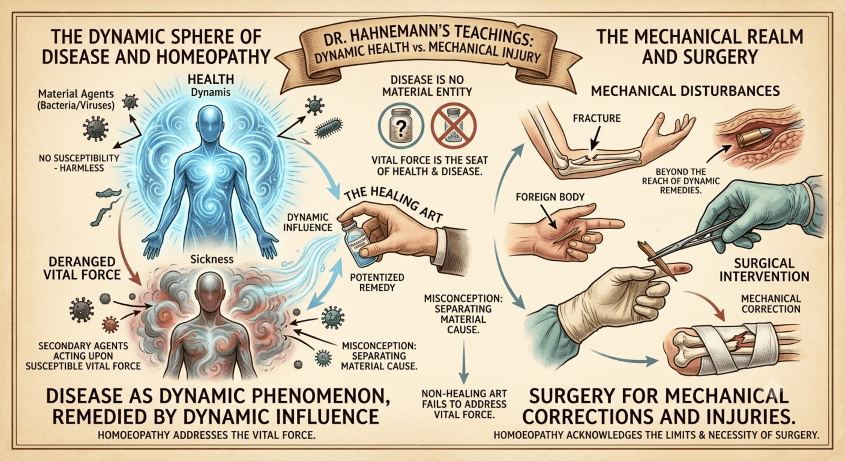
Disease is not a material thing lodged in the body but a dynamic disturbance of the vital force, the invisible principle that sustains life. When this vital force is in harmony, health prevails; when disturbed, it manifests as altered sensations and functions that we call disease. Thus, disease is not a foreign substance but an immaterial imbalance, and cure lies in restoring the vital force to its natural equilibrium.

HHomeoEra Journal Editorial Team
2m137
Organopathy in Homoeopathy: Bridging Organ Affinity and Classical Cure.
Organon & Philosophy

Organopathy in Homoeopathy: Bridging Organ Affinity and Classical Cure.

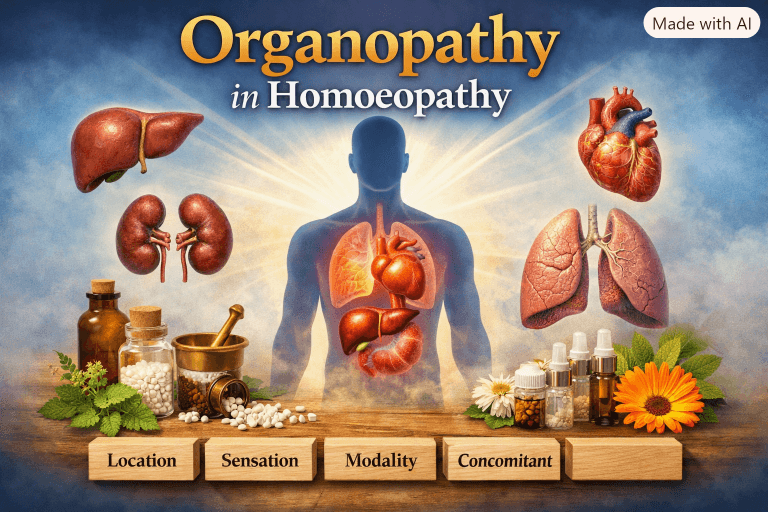
In the course of homoeopathic practice, many physicians have observed that certain remedies display a marked affinity for particular organs. This organ‑specific action has given rise to the concept of Organopathy, where medicines are employed not merely for their general symptom similarity but for their targeted influence upon vital organs and systems. At first glance, such prescriptions may appear to contradict the fundamental principle of treating the patient rather than the disease. Yet, when examined more closely, they reveal themselves as a natural extension of homoeopathic philosophy. Every medicine, in its proving, demonstrates a distinct relationship to certain tissues or organs, and this affinity cannot be ignored in clinical application. Organopathy, therefore, does not stand apart from homoeopathy but rather complements it, offering a practical method of prescription that emphasizes location and organ involvement while remaining grounded in the totality of symptoms. It is a refinement of practice, reminding us that the organ is not the disease itself but the stage upon which the disturbance of the vital force manifests.

HHomeoEra Journal Editorial Team
5m139

Comments (0)

Sign in or sign up to join the discussion

No comments yet. Be the first to share your thoughts!

Newsletter

Stay Updated with Latest Research

Get weekly digests of new articles, case studies, and homeopathic insights delivered to your inbox

By subscribing, you agree to our Privacy Policy. Unsubscribe anytime.