
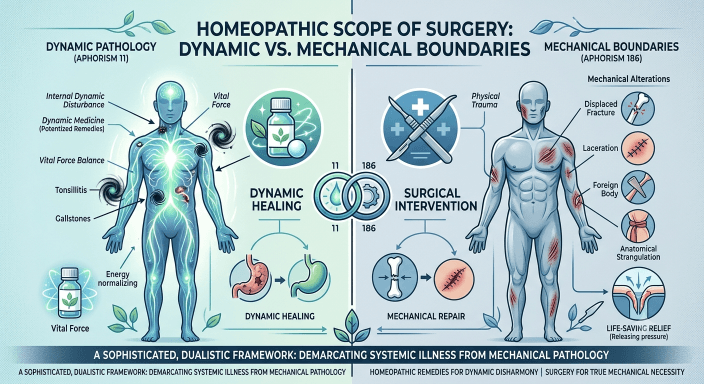
Homeopathic Scope of Surgery: Dynamic Pathology vs. Mechanical Boundaries:
Homeopathy does not reject surgery outright; rather, it defines a precise boundary between dynamic disease and mechanical pathology. While modern medicine often uses surgery to excise the physical manifestations of a disease, homeopaths view structural changes as late-stage end products of a deeper, dynamic disturbance in the vital force—a principal Samuel Hahnemann details in Aphorism 11 of the Organon of Medicine.Dynamic Pathology vs. Mechanical Alterations:
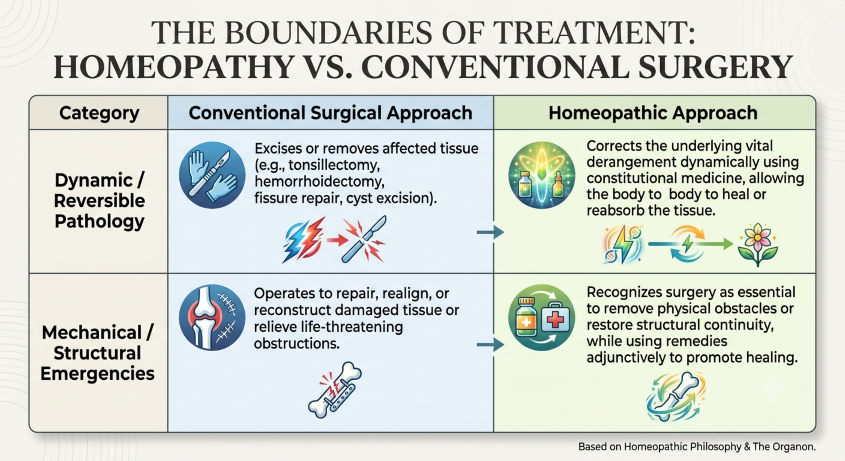
The Role of Mechanical Interventions in Hahnemannian Practice:
Aphorism that talked about surgical intervention:
Conclusion:
The integration of surgical principles within homeopathic philosophy reveals that homeopathy is far from an anti-surgical medical system. Rather, it offers a sophisticated, dualistic framework that carefully demarcates dynamic systemic illness from mechanical structural pathology. By analyzing Samuel Hahnemann’s core tenets in the Organon of Medicine—specifically the dynamic derangement described in Aphorism 11 alongside the mechanical realities outlined in Aphorism 186—a clear boundary emerges between conditions requiring dynamic medicinal healing and those demanding immediate physical intervention.
Where conventional medicine frequently relies on surgical excision as a primary response to structural changes—such as cysts, hemorrhoids, tonsillar hypertrophy, or early-stage calculi—homeopathy identifies these local manifestations as the downstream end products of a deeper, vital disturbance. Treating these conditions dynamically with constitutional remedies allows the body to reabsorb, heal, and resolve the pathology from within, addressing the underlying root cause rather than merely eliminating its physical evidence.
Conversely, when physical continuity is broken, foreign bodies impede vital functions, or severe mechanical obstructions threaten life, surgical intervention is not only acknowledged but deemed indispensable. In these instances, surgery serves as an essential mechanical prerequisite that prepares the physical structure so that dynamic remedies can subsequently optimize post-operative recovery and tissue repair.
Ultimately, homeopathy’s stance on surgery is defined by precision, discrimination, and deep physiological respect. By reserving surgical procedures for true mechanical necessities and deploying dynamized medicines for internal tissue dysfunctions, homeopathy establishes a comprehensive therapeutic hierarchy—one that minimizes unnecessary operative risks while elevating patient outcomes through an intentional, holistic approach to healing.