HomeoEra
Back to Blogs

Aphorism 16: The Law of Corresponding Planes, Dynamic to Dynamic and Material to Material.

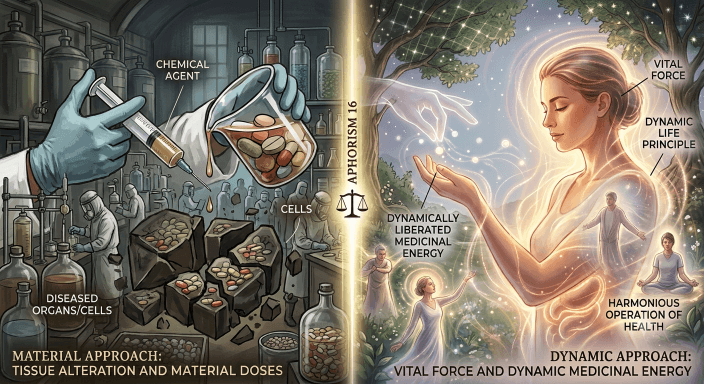
According to Dr. Hahnemann, man is an indivisible unity of the material body and the dynamic vital force, the latter being the invisible principle that animates and governs the organism. Disease originates as a disturbance of this dynamic life force and only subsequently manifests through the material body as symptoms and structural changes. Therefore, a dynamic disorder can be cured only by a dynamic medicinal influence acting upon the same plane of existence. While conventional medicine generally views disease as a material alteration of organs, tissues, or molecules and consequently employs material interventions, Homoeopathy seeks to address the underlying dynamic cause through potentized remedies. Thus, Aphorism 16 establishes the fundamental principle that the dynamic can be overcome only by the dynamic, just as the material can be influenced only by material means.

H

HomeoEra Journal Editorial Team

3 min read1 views
Aphorism 16: The Law of Corresponding Planes, Dynamic to Dynamic and Material to Material.

Dynamic Diseases Can Be Cured by Dynamic Medicines; Material Destruction Requires Mechanical Measures.
(Homoeopathy sets the limit of surgery)

Aphorism - 16,

" Our vital force, as a spirit-like dynamis, cannot be attacked and affected by injurious influences on the healthy organism caused by the external inimical forces that disturb the harmonious play of life, otherwise than in a spirit-like (dynamic) way, and in like manner, all such morbid derangements (disease) cannot be removed from it by the physician in any other way than by the spirit -like (dynamic [most severe disease may be produced by sufficient disturbance of the vital force through the imagination and also cured by the same means.] virtual) alternative powers of the serviceable medicine acting upon our spirit like vital force, which perceives them through the medium of the sentient faculty of the nerves everywhere present in the organism, so that it is only by their dynamic acting on the vital force that remedies are able to re-establish and do actually re-establish health and vital harmony, after the changes in the health of the patient recognizable by our senses (the totality of the symptoms) have revealed the disease to the carefully observing and investigating physician as fully as was requisite in order to enable him to cure it."

Explanatory note:

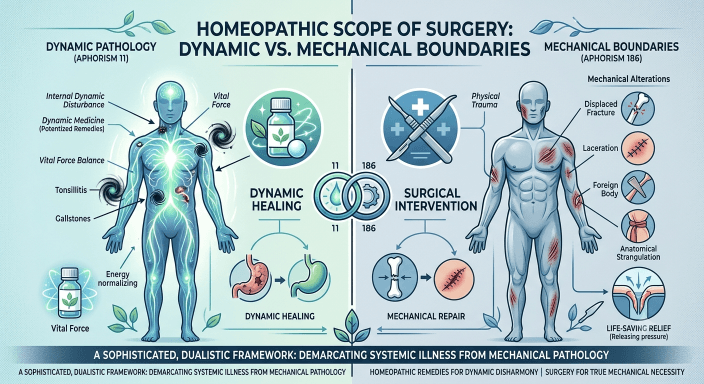
Aphorism 16 draws a clear line of demarcation between Homoeopathy and Allopathy. It further elucidates the principles set forth in Aphorism 13 and may therefore be regarded as its continuation. Together, these aphorisms explain the dynamic nature of disease and cure, thereby establishing an important philosophical foundation for homoeopathic therapeutics. Aphorism 16 also defines the proper sphere of each system, clarifying when a dynamic medicinal approach is required and when mechanical or surgical intervention is more appropriate.

Homoeopathy acts most effectively in diseases that originate on the dynamic plane, such as miasmatic disorders, emotional disturbances, and functional derangements of the vital force. Since these conditions arise from a dynamic imbalance, they require a dynamic medicinal influence for their restoration. Conventional medicine, on the other hand, is particularly valuable in conditions involving material or structural damage, such as fractures, road-traffic injuries, wounds, and other forms of mechanical trauma, where surgical or mechanical measures are indispensable. Nevertheless, even in such mechanical conditions, the dynamic plane is often affected, giving rise to pain, shock, inflammation, and disturbances of the vital force. In these circumstances, mechanical or surgical treatment addresses the structural injury, while homoeopathic medication may be employed as an adjunct to support the dynamic restoration of the organism. Thus, Aphorism 16 teaches that dynamic disorders require dynamic remedies, whereas material destruction demands mechanical measures, with both approaches having their proper sphere of application. 

In this regard, it should be remembered that certain conditions, such as tumors, cysts, and other internally developed growths, are often regarded in conventional medicine as conditions requiring surgical intervention. From the homoeopathic standpoint, however, such growths are not merely local structural abnormalities but manifestations of an underlying dynamic disturbance of the vital force. Since they originate from within the organism rather than from external mechanical injury, they should be viewed as expressions of an internal diseased state. Consequently, homoeopathic treatment aims to address the fundamental dynamic cause responsible for their development. Nevertheless, when a growth produces irreversible structural damage, threatens vital functions, or creates an immediate risk to life, surgical measures may become necessary, while homoeopathic treatment may continue to support the patient's overall restoration of health.
Have a Question?
Ask HomeoEra Journal Editorial Team about "Aphorism 16: The Law of Corresponding Planes, Dynamic to Dynamic and Material to Material." and get a personalized response directly to your email.

0/500 characters

0 characters (minimum 10 required)

🔒 Privacy Notice: Your information will only be used to respond to your query and won't be shared with third parties.

Aphorism 15: The Unity of the Material Body and the Dynamic Vital Force.
Organon & Philosophy

Aphorism 15: The Unity of the Material Body and the Dynamic Vital Force.

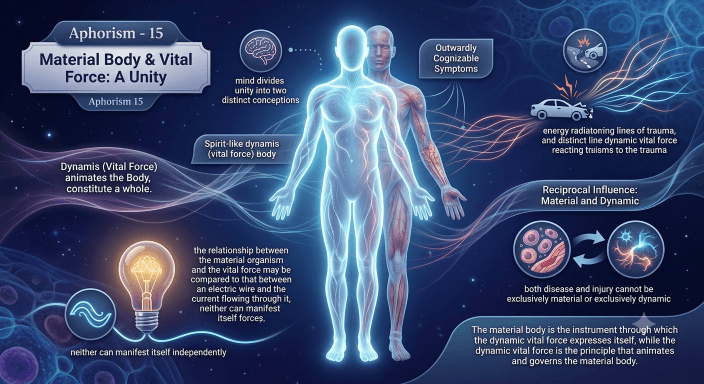
Aphorism 15 reveals the profound relationship between the material organism and the dynamic vital force. Although distinct in conception, they are so intimately united that neither can manifest itself independently of the other. The material body serves as the vehicle through which the vital force expresses itself, while the vital force animates and governs the organism. Consequently, disease often appears to originate in the physical body, whereas its true seat lies in the dynamic plane, the observable symptoms being merely the outward reflections of an internal derangement of the vital force. Likewise, when the body sustains a physical injury, such as in a road accident, the effect is not confined to the material tissues alone, but also extends to the dynamic sphere. Thus, the relationship between the body and the vital force is reciprocal and inseparable, demonstrating that every dynamic disturbance finds expression in the organism, and every profound bodily affection influences the vital force, affirming Hahnemann's doctrine of the unity of life and organism

HHomeoEra Journal Editorial Team
4m13
Aphorism - 14, Health as Harmony: Absence of Morbid Signs and Need for Cure.
Organon & Philosophy

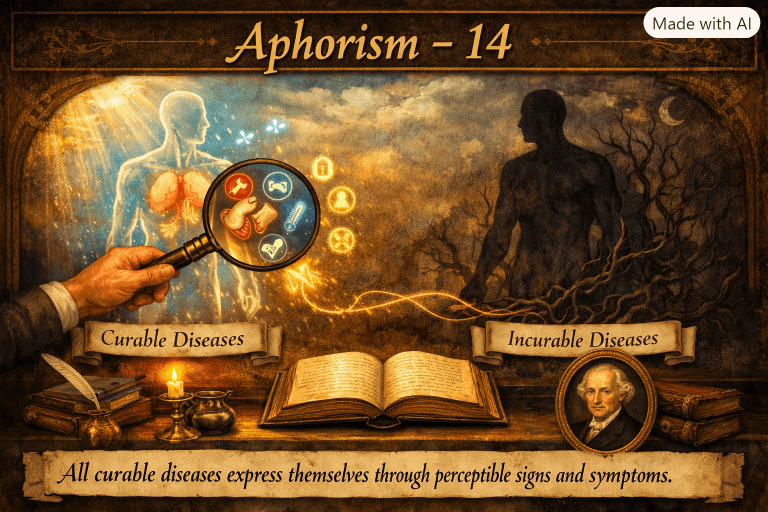
Aphorism - 14, Health as Harmony: Absence of Morbid Signs and Need for Cure.

In this aphorism, Dr. Samuel Hahnemann elucidates a fundamental law of observation in medicine: that every curable disorder within the human organism necessarily reveals itself through perceptible signs and symptoms. Nothing curable remains hidden from the discerning physician, for the divine order has ordained that disease must express its presence outwardly to invite cure. Thus, the physician’s art depends entirely upon the faithful interpretation of these manifestations. The morbid phenomena are not mere disturbances but the visible language of Nature, guiding the healer toward restoration. Those affections that grow silently within, without perceptible symptoms, belong to the realm of the incurable; for where no sign is given, no curative response can be awakened. In essence, Hahnemann reminds us that symptoms are the thread of cure—the only bridge between the inner disorder and the physician’s understanding. To grasp that thread is to hold the possibility of healing; to lose it is to stand before disease without remedy.

HHomeoEra Journal Editorial Team
3m292
Doctrine of Homoeopathy: From Vitalism to Healing
Organon & Philosophy

Doctrine of Homoeopathy: From Vitalism to Healing

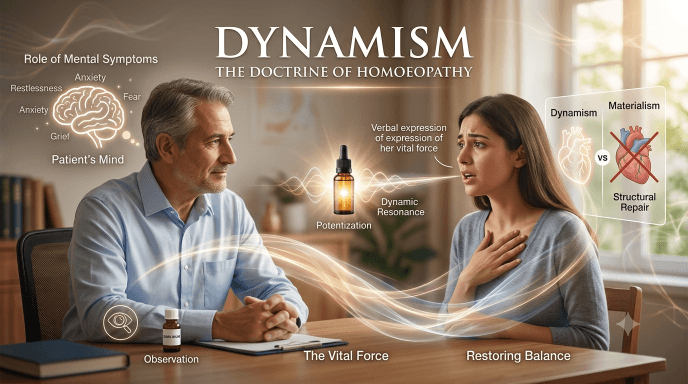
The doctrine of Homoeopathy is inseparably bound with the principle of dynamism. It does not aim at repairing the material body in isolation, but rather seeks to restore the vital force—the dynamic essence that animates life. Disease, in this philosophy, is not merely a structural defect or chemical imbalance; it is a disturbance on the dynamic plane, a disharmony of the spirit‑like energy that governs sensation and function. Homoeopathic medicine, therefore, is not material in its curative action. Prepared through potentization, it transcends crude substance and becomes a dynamic remedy, capable of resonating with the disturbed vital force. Cure is achieved not by suppressing symptoms or altering tissues directly, but by stimulating the inner harmony, allowing the body to reorganize itself from within outward. Thus, the true aim of Homoeopathy is not to treat the corporeal frame, but to re‑establish balance in the living dynamis, from which health naturally flows into the material body.

HHomeoEra Journal Editorial Team
7m325
Surgical Intervention in Homoeopathy: Necessity, Limits, and Integration
Organon & Philosophy

Surgical Intervention in Homoeopathy: Necessity, Limits, and Integration

Surgery represents one of the most decisive acts in medical practice—an intervention that seeks immediate relief by removing or altering diseased tissue. Yet, within the philosophy of homoeopathy, surgery is not regarded as a primary mode of cure but rather as a necessary measure when the natural laws of healing cannot be invoked. Homoeopathy emphasizes restoration through the vital force, aiming to correct internal imbalance rather than mechanically excising its manifestations. The scope of surgery in homoeopathy lies in emergencies, irreparable structural damage, or conditions where mechanical obstruction threatens life. Its limitations, however, are evident when surgery is employed as a substitute for true cure, ignoring the deeper dynamic disturbance that gave rise to pathology. Thus, surgery may save life or prevent immediate danger, but it cannot address the underlying susceptibility that homoeopathy seeks to harmonize. In this way, surgery and homoeopathy are not adversaries but complementary disciplines. Surgery provides mechanical aid where necessary, while homoeopathy ensures the restoration of health by addressing the vital force. The ethical challenge lies in discerning when surgical intervention is indispensable and when reliance on the body’s healing potential, guided by homoeopathic remedies, is sufficient.

HHomeoEra Journal Editorial Team
4m254

Comments (0)

Sign in or sign up to join the discussion

No comments yet. Be the first to share your thoughts!

Newsletter

Stay Updated with Latest Research

Get weekly digests of new articles, case studies, and homeopathic insights delivered to your inbox

By subscribing, you agree to our Privacy Policy. Unsubscribe anytime.