HomeoEra
Back to Blogs

Organopathy in Homoeopathy: Bridging Organ Affinity and Classical Cure.

In the course of homoeopathic practice, many physicians have observed that certain remedies display a marked affinity for particular organs. This organ‑specific action has given rise to the concept of Organopathy, where medicines are employed not merely for their general symptom similarity but for their targeted influence upon vital organs and systems. At first glance, such prescriptions may appear to contradict the fundamental principle of treating the patient rather than the disease. Yet, when examined more closely, they reveal themselves as a natural extension of homoeopathic philosophy. Every medicine, in its proving, demonstrates a distinct relationship to certain tissues or organs, and this affinity cannot be ignored in clinical application. Organopathy, therefore, does not stand apart from homoeopathy but rather complements it, offering a practical method of prescription that emphasizes location and organ involvement while remaining grounded in the totality of symptoms. It is a refinement of practice, reminding us that the organ is not the disease itself but the stage upon which the disturbance of the vital force manifests.

A

Admin User

September 10, 20265 min read96 views
Organopathy in Homoeopathy: Bridging Organ Affinity and Classical Cure.

Introduction:

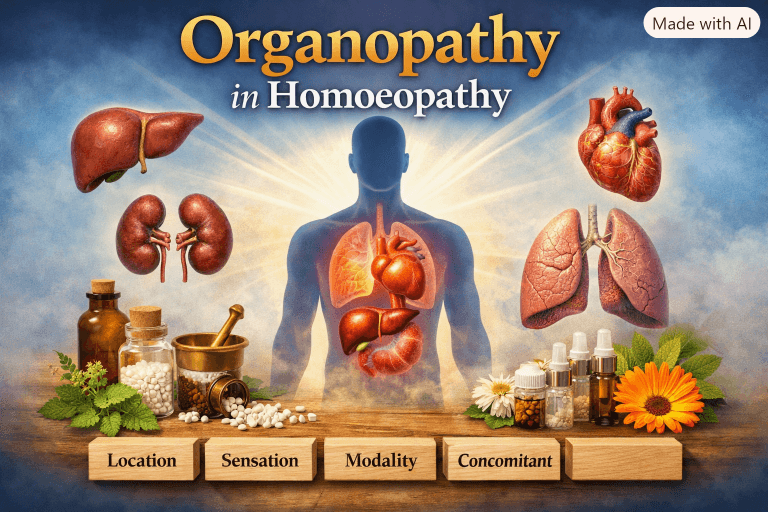
In the course of homoeopathic practice, many physicians have observed that certain remedies display a marked affinity for particular organs. This organ‑specific action has given rise to the concept of Organopathy, where medicines are employed not for their general symptom similarity but for their targeted influence on vital organs and systems. At first glance, such organopathic prescriptions may appear to contradict the core principle of treating the patient rather than the disease. However, if we reflect on Dr. Hahnemann’s exclusion of the totality—later further elaborated by Dr. Boenninghausen—the very first point of consideration is location, which naturally directs attention to the affected organ. The remaining three points—sensation, modality, and concomitant—are entirely based upon this foundation. 

Location is clearly evident, as every medicine in its proving demonstrates a distinct affinity for a particular organ or system. Each location is accompanied by characteristic sensations and modalities and is further enriched by a definite concomitant. Together, these four pillars—location, sensation, modality, and concomitant—form the complete symptom, providing the foundation for both classical homoeopathic prescribing and the organ‑specific approach of homoeopathy. Thus, the apparent contradiction between Organopathy and the principle of treating the patient rather than the disease ultimately dissolves, revealing a deeper harmony within homoeopathic philosophy. In fact, the most reliable way of prescribing is to complete all four elements, much like the stability of a chair resting firmly on its four legs.

in essence we could say, "Organopathy is not a deviation but a refinement of homoeopathic philosophy, harmonizing organ affinity with the totality of symptoms. It reminds us that the organ is not the disease, but the stage upon which the drama of the vital force unfolds." 

Definition:

Hence, in a more precise way, we can define Organopathy as. 

"Organopathy is a type of homoeopathic prescription in which medicines are selected according to their affinity for specific organs or systems of the living organism, including the human body. It is not apart from homoeopathy, but rather an integral part of it" 

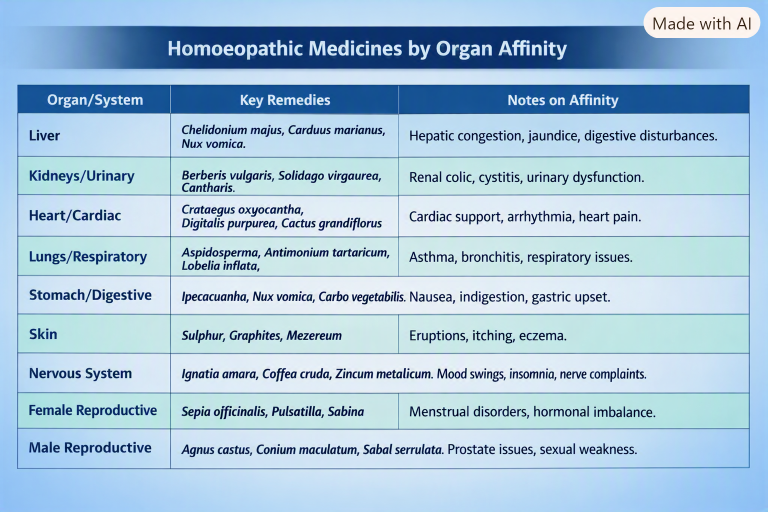
Homoeopathic medicines that act particularly through their affinity for specific organs are listed here.

Organopathy: A Complementary Method of Homoeopathic Prescription:

Of course, the list of organ‑specific remedies is extensive, and not all can be included here. However, this overview provides a general understanding for students of homoeopathy that the organopathic method of prescription is also a valid and systematic approach to the selection of medicines—one that emphasizes organ affinity while remaining firmly within the broader framework of homoeopathic philosophy. 

Foundation of Organopathy:

it was Doctor James Compton Burnett who discovered the Organopathic way of prescription, called a branch of Homoeopathy. Organopathy is note a seperate system but a imperfect Homoeopathy.

In 1840, in Wiltshire, England, a boy named James Compton Burnett was born. He was curious and bright, and studied medicine with great interest. He learned anatomy in Vienna and later graduated from Glasgow University in 1872, becoming a doctor in regular medicine.

But his career took a different direction. When he discovered homeopathy, he felt it matched better with what he saw in his patients. Slowly, he moved away from traditional medicine and embraced homeopathy.

Burnett noticed that some remedies worked especially well on certain organs, like the heart, liver, or lungs. From this idea, he developed Organopathy—a branch of homeopathy that focuses on treating specific organs, not just the overall symptoms.

He wrote boldly about topics like vaccinosis, breast tumors, and tuberculosis. He introduced new ideas such as nosodes, challenged both mainstream medicine and strict homeopaths, and became known as an innovator.

When he died suddenly in London in 1901, Burnett was remembered not only as a doctor but also as a pioneering thinker. His concept of Organopathy remains his lasting contribution, showing his belief that healing should be both scientific and compassionate.

Dr. Kent view on Organopathy:

In the chapter of Carduus marianus in his famous work Lacture on Materia medica. Dr. Kent expresses his view that is very close to the concept of Organopathy, here Dr. Kent says, "if a homoeopathic author can be excused for the expression that particular medicine works for a particular organ, I would like to say that Carduus marinaus is the medicine for liver and accompanied disease condition like portal stasis and gall stone”

Kent’s caution: Kent’s caution is evident in his apologetic phrase, “if a homoeopathic author can be excused,” which he uses to distance himself from pure Organopathy. This shows that he recognized the danger of reducing homoeopathy to mere organ‑based therapeutics, yet at the same time acknowledged that certain remedies exhibit undeniable organ‑specific action. Like Dr. Kent, every busy physician in the course of practice eventually realizes this fact—that some medicines repeatedly demonstrate a marked affinity for particular organs, even though the guiding principle remains the totality of symptoms

Conclusion:

Organopathy, as introduced by Dr. J. Compton Burnett and cautiously acknowledged by Dr. Kent, represents not a departure from homoeopathy but a complementary refinement of its philosophy. While classical homoeopathy insists upon the totality of symptoms, Organopathy reminds us that remedies often reveal a distinct affinity for particular organs, which cannot be ignored in clinical practice. Burnett’s pioneering work established Organopathy as a branch within homoeopathy, and Kent’s guarded concession in the Carduus marianus lecture illustrates that even the most orthodox practitioners recognized the practical reality of organ‑specific action.

Thus, Organopathy should be understood as a supportive method of prescription—one that harmonizes organ affinity with the four pillars of Boenninghausen’s schema: location, sensation, modality, and concomitant. Far from being an imperfect deviation, it enriches homoeopathy by offering physicians a systematic way to address organ‑based pathology without abandoning the holistic principle of treating the patient. In this light, Organopathy stands as both a philosophical bridge and a clinical tool, reminding us that the organ is not the disease, but the stage upon which the drama of the vital force unfolds

A

About Admin User

HomeoEra: A Global Platform for Doctors Our mission is to build the largest database of homoeopathic knowledge for future generations. With a special focus on teaching Materia Medica and the Organon of Medicine, we aim to strengthen the foundation of classical homoeopathy worldwide. We invite you to share your cured cases on this platform, contribute to collective learning, and support fellow practitioners. Together, let us take a decisive step toward establishing world-class homoeopathy. Join hands with HomeoEra—where knowledge meets cure.

Have a Question?
Ask Admin User about "Organopathy in Homoeopathy: Bridging Organ Affinity and Classical Cure. " and get a personalized response directly to your email.

0/500 characters

0 characters (minimum 10 required)

🔒 Privacy Notice: Your information will only be used to respond to your query and won't be shared with third parties.

Comments (0)

Sign in or sign up to join the discussion

No comments yet. Be the first to share your thoughts!

Newsletter

Stay Updated with Latest Research

Get weekly digests of new articles, case studies, and homeopathic insights delivered to your inbox

By subscribing, you agree to our Privacy Policy. Unsubscribe anytime.