HomeoEra
Back to Blogs

Aphorism 15: The Unity of the Material Body and the Dynamic Vital Force.

Aphorism 15 reveals the profound relationship between the material organism and the dynamic vital force. Although distinct in conception, they are so intimately united that neither can manifest itself independently of the other. The material body serves as the vehicle through which the vital force expresses itself, while the vital force animates and governs the organism. Consequently, disease often appears to originate in the physical body, whereas its true seat lies in the dynamic plane, the observable symptoms being merely the outward reflections of an internal derangement of the vital force. Likewise, when the body sustains a physical injury, such as in a road accident, the effect is not confined to the material tissues alone, but also extends to the dynamic sphere. Thus, the relationship between the body and the vital force is reciprocal and inseparable, demonstrating that every dynamic disturbance finds expression in the organism, and every profound bodily affection influences the vital force, affirming Hahnemann's doctrine of the unity of life and organism

H

HomeoEra Journal Editorial Team

4 min read10 views
Aphorism 15: The Unity of the Material Body and the Dynamic Vital Force.

How the Material Body and the Dynamic Vital Force Are Inseparable

Aphorism - 15.

"The affection of the morbidly deranged, spirit-like dynamis (vital force) that animates our body in the invisible interior, and the totality of the outwardly cognizable symptoms produced by it in the organism and representing the existing malady, constitute a whole; they are one and the same. The organism is indeed the material instrument of the life, but it is not conceivable without the animation imparted to it by the instinctively perceiving and regulating dynamis, just as the vital force is not conceivable without the organism, consequently the two together constitute a unity, although in thought our mind separates this unity into two distinct conception for the sake of easy comprehension. 

Explanatory notes:

Aphorism 15 is intimately connected with Aphorism 7. A careful study of these two aphorisms reveals an important truth: symptoms do not constitute the disease itself; rather, they are merely the outward reflection of the internally deranged dynamic vital force.

If a physician is capable of perceiving the actual nature of this dynamic derangement, he can prescribe directly for the disturbed state of the vital force. However, when such perception is lacking, he must rely upon symptoms as the basis of prescription. Yet symptoms do not always convey the true nature of the underlying disorder and may, at times, prove misleading.

This can be illustrated by the example of heel pain. The symptom of aggravation on first motion in the morning, with relief from continued motion, is classically associated with Rhus Toxicodendron. Nevertheless, in my clinical experience, I have prescribed Rhus tox on several occasions solely on the basis of this symptom and obtained little or no satisfactory result. Such experiences suggest that individual symptoms, however characteristic they may appear, do not invariably reveal the true dynamic state of the patient. Therefore, the physician must strive to perceive the deeper derangement of the vital force rather than depend exclusively upon isolated symptomatic indications.

In this aphorism, Dr. Hahnemann elucidates the relationship between the material body and the dynamic vital force. Although they are distinct entities, they are mutually dependent and function in such perfect harmony that they appear as one. Their connection is so intimate that neither can manifest itself independently of the other.

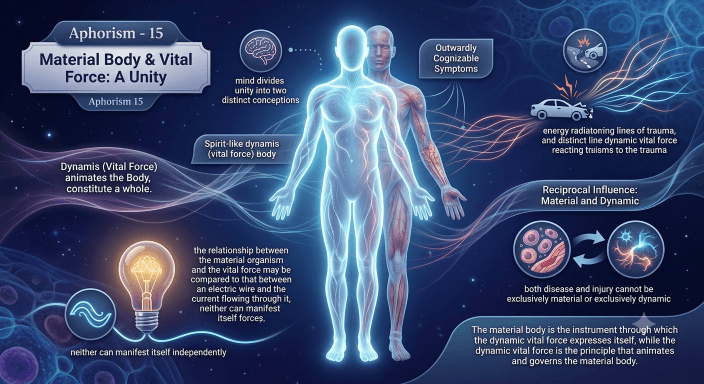
The relationship between the material organism and the vital force may be compared to that between an electric wire and the current flowing through it. Just as the illumination of a bulb is impossible in the absence of either the wire or the electric current, the expression of life is impossible without the conjoint action of both the material body and the dynamic vital force. Each requires the other for the manifestation of life and its functions.

In this manner, the dynamic vital force manifests itself through the material body. Consequently, it often appears as though disease originates in the physical organism; however, according to Hahnemannian philosophy, the true seat of disease lies in the dynamic plane. The pathological changes observed in the material body are merely the outward expressions of an underlying dynamic disturbance.

Conversely, when the material body suffers injury, such as in a road accident, the damage is not confined solely to the physical tissues. The dynamic vital force is also affected by the trauma. Thus, the influence is reciprocal: disturbances of the vital force become manifest in the body, while profound bodily injuries likewise impress themselves upon the dynamic sphere. The material organism and the dynamic vital force are therefore so intimately united that an affection of one inevitably influences the other. 

So, we can summaries the text as. 

" The material body is the instrument through which the dynamic vital force expresses itself, while the dynamic vital force is the principle that animates and governs the material body. Consequently, neither disease nor injury can be exclusively material or exclusively dynamic; each exerts its influence upon the other according to the nature and depth of the disturbance." 
Word meaning and explanation:

Have a Question?
Ask HomeoEra Journal Editorial Team about "Aphorism 15: The Unity of the Material Body and the Dynamic Vital Force." and get a personalized response directly to your email.

0/500 characters

0 characters (minimum 10 required)

🔒 Privacy Notice: Your information will only be used to respond to your query and won't be shared with third parties.

Aphorism - 14, Health as Harmony: Absence of Morbid Signs and Need for Cure.
Organon & Philosophy

Aphorism - 14, Health as Harmony: Absence of Morbid Signs and Need for Cure.

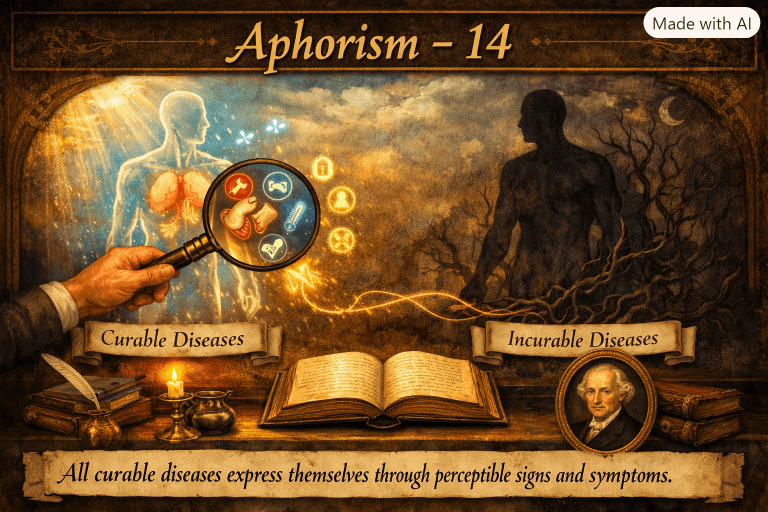
In this aphorism, Dr. Samuel Hahnemann elucidates a fundamental law of observation in medicine: that every curable disorder within the human organism necessarily reveals itself through perceptible signs and symptoms. Nothing curable remains hidden from the discerning physician, for the divine order has ordained that disease must express its presence outwardly to invite cure. Thus, the physician’s art depends entirely upon the faithful interpretation of these manifestations. The morbid phenomena are not mere disturbances but the visible language of Nature, guiding the healer toward restoration. Those affections that grow silently within, without perceptible symptoms, belong to the realm of the incurable; for where no sign is given, no curative response can be awakened. In essence, Hahnemann reminds us that symptoms are the thread of cure—the only bridge between the inner disorder and the physician’s understanding. To grasp that thread is to hold the possibility of healing; to lose it is to stand before disease without remedy.

HHomeoEra Journal Editorial Team
3m292
Doctrine of Homoeopathy: From Vitalism to Healing
Organon & Philosophy

Doctrine of Homoeopathy: From Vitalism to Healing

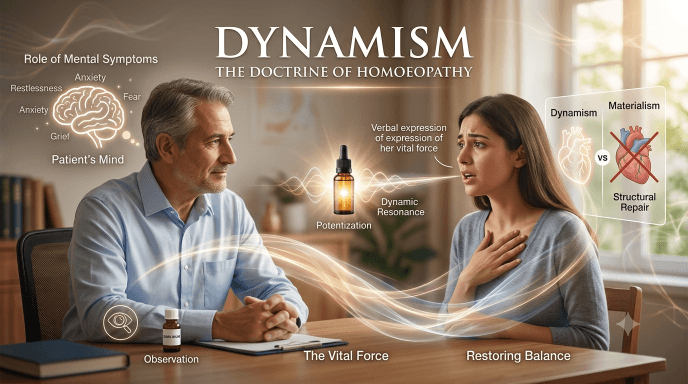
The doctrine of Homoeopathy is inseparably bound with the principle of dynamism. It does not aim at repairing the material body in isolation, but rather seeks to restore the vital force—the dynamic essence that animates life. Disease, in this philosophy, is not merely a structural defect or chemical imbalance; it is a disturbance on the dynamic plane, a disharmony of the spirit‑like energy that governs sensation and function. Homoeopathic medicine, therefore, is not material in its curative action. Prepared through potentization, it transcends crude substance and becomes a dynamic remedy, capable of resonating with the disturbed vital force. Cure is achieved not by suppressing symptoms or altering tissues directly, but by stimulating the inner harmony, allowing the body to reorganize itself from within outward. Thus, the true aim of Homoeopathy is not to treat the corporeal frame, but to re‑establish balance in the living dynamis, from which health naturally flows into the material body.

HHomeoEra Journal Editorial Team
7m324
Surgical Intervention in Homoeopathy: Necessity, Limits, and Integration
Organon & Philosophy

Surgical Intervention in Homoeopathy: Necessity, Limits, and Integration

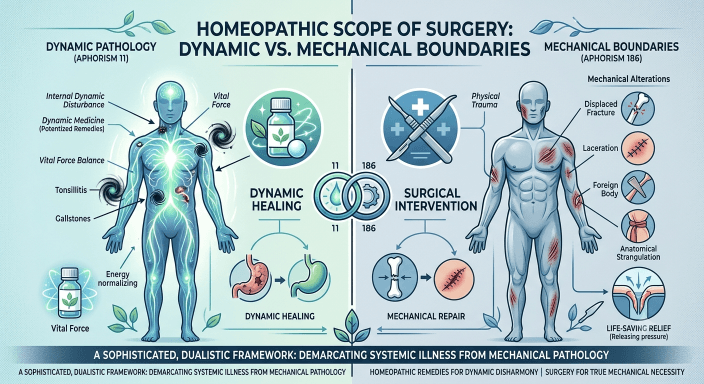
Surgery represents one of the most decisive acts in medical practice—an intervention that seeks immediate relief by removing or altering diseased tissue. Yet, within the philosophy of homoeopathy, surgery is not regarded as a primary mode of cure but rather as a necessary measure when the natural laws of healing cannot be invoked. Homoeopathy emphasizes restoration through the vital force, aiming to correct internal imbalance rather than mechanically excising its manifestations. The scope of surgery in homoeopathy lies in emergencies, irreparable structural damage, or conditions where mechanical obstruction threatens life. Its limitations, however, are evident when surgery is employed as a substitute for true cure, ignoring the deeper dynamic disturbance that gave rise to pathology. Thus, surgery may save life or prevent immediate danger, but it cannot address the underlying susceptibility that homoeopathy seeks to harmonize. In this way, surgery and homoeopathy are not adversaries but complementary disciplines. Surgery provides mechanical aid where necessary, while homoeopathy ensures the restoration of health by addressing the vital force. The ethical challenge lies in discerning when surgical intervention is indispensable and when reliance on the body’s healing potential, guided by homoeopathic remedies, is sufficient.

HHomeoEra Journal Editorial Team
4m253
Aphorism - 13, limitation of medicine and scope for surgery in Homoeopathy.
Organon & Philosophy

Aphorism - 13, limitation of medicine and scope for surgery in Homoeopathy.

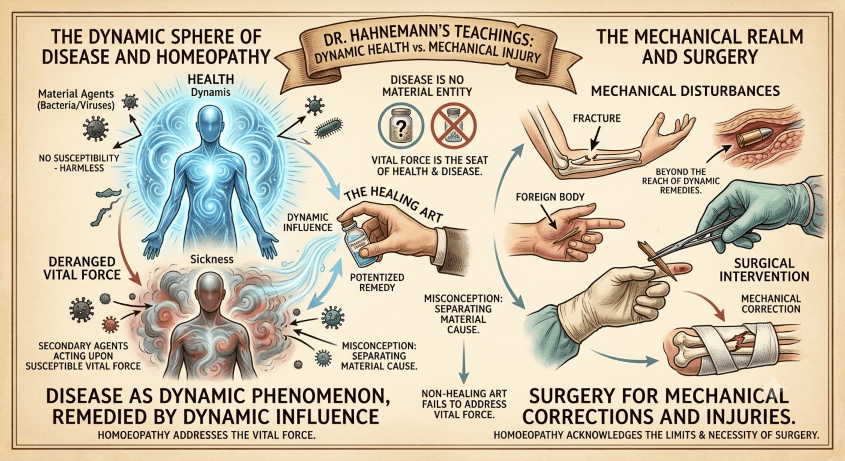
Disease is not a material thing lodged in the body but a dynamic disturbance of the vital force, the invisible principle that sustains life. When this vital force is in harmony, health prevails; when disturbed, it manifests as altered sensations and functions that we call disease. Thus, disease is not a foreign substance but an immaterial imbalance, and cure lies in restoring the vital force to its natural equilibrium.

HHomeoEra Journal Editorial Team
2m151

Comments (0)

Sign in or sign up to join the discussion

No comments yet. Be the first to share your thoughts!

Newsletter

Stay Updated with Latest Research

Get weekly digests of new articles, case studies, and homeopathic insights delivered to your inbox

By subscribing, you agree to our Privacy Policy. Unsubscribe anytime.