An overview:
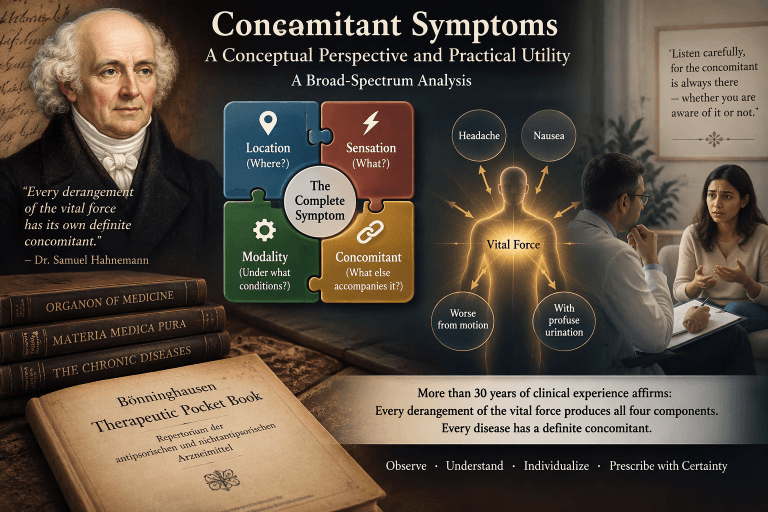
Upon carefully exploring Bönninghausen's writings, one discovers a profound conceptual understanding of concomitants, which he regarded as the fourth indispensable element of the complete symptom, alongside location, sensation, and modalities. However, when we examine his repertory, the Therapeutic Pocket Book, we find that its practical arrangement is primarily organized around three observable components: location, sensation, and modality. Concomitants do not appear as a separate and independent division of the repertory. Thus, while the Therapeutic Pocket Book is theoretically founded upon four elements of the complete symptom, its practical construction presents only three principal divisions, with concomitants being incorporated throughout the repertorial framework rather than isolated into a distinct section.
Now a very important question arises here. How many symptoms in Therapeutic Pocket Book presenting that complete its all fourth legs and in what percentage it is present?
The honest answer is that no reliable percentage has ever been calculated by Bönninghausen himself, nor am I aware of any published statistical study that has quantified what proportion of rubrics in the Therapeutic Pocket Book represent all four components of the complete symptom.
Conceptually, a "complete symptom" requires:
- Location (Where?)
- Sensation (What?)
- Modality (Under what conditions?)
- Concomitant (What else accompanies it?)
The difficulty is that in the Therapeutic Pocket Book, these elements are scattered throughout the repertory and are intended to be combined by the physician, not necessarily presented together within a single rubric. Consequently, many rubrics represent only one component, some represent two, fewer represent three, and only a limited number can be regarded as expressing all four components simultaneously.
For example:
- "Head, left side" = Location only.
- "Burning pain in head" = Location + Sensation.
- "Burning pain in head, worse from motion" = Location + Sensation + Modality.
- "Burning pain in left side of head, worse from motion, accompanied by profuse urination" = all four elements.
Another very important question emerges from this discussion: Why did Dr. Bönninghausen find it necessary to introduce the Doctrine of Analogy? If we examine the text carefully, we find a combined and logical answer to these questions.
" There is a relative paucity of data in the entire Materia Medica that fully encompasses all four elements of the complete symptom. Most recorded symptoms contain only three components rather than all four. This deficiency may be attributed to the limited scope of drug proving, the incomplete observation and recording of symptoms, or an insufficiently comprehensive and logical interpretation of proving data. Consequently, the physician often encounters symptom-pictures that are incomplete and must rely upon a deeper understanding of the remedy and its relationships to reconstruct the complete symptom." Perhaps this was the cause, Dr. Hahnemann emphases the use of inductive and deductive logic in the use of Materia medica.
In my opinion, derived from more than thirty years of clinical experience, every derangement of the vital force invariably manifests all four components of the complete symptom. This leads to an important conclusion: every diseased state possesses a definite concomitant, whether the physician is aware of it or not. The apparent absence of a concomitant does not necessarily indicate its non-existence; rather, it may reflect deficiencies in observation, case-taking, symptom recording, or interpretation. Thus, the concomitant should be regarded as an inherent aspect of every expression of disease, awaiting recognition by the perceptive physician.
Examples of the complete symptoms:
- Non coaguble bleeding from the nose, with the sensation of tightness across the bridge of the
nose, (Hamamelis, Ruta)
- Diabetes mellitus with rheumatic
pain. (Lactic
acid)
- Constipation of young men with habit of masturbation or night pollutions. (Lyco.,)
- Asthmatic breathing with loose
evacuation of bowels (Diarrhoea) (Nat. sulph)
- Atrophy of the breast with dryness
of mouth, throat, nose. (Onosmodium)
- Headache with increased
sense of hearing (Phytolacca)
- Pain of shifting nature or fix or headache Associated with
chillness (Pulsatilla)
- Asthma with splitting headache (Sticta)
- Crusta lactea or tenia capitis with itching in association of urinary complaint (Viola tricolor)
- Leucorrhoea worse at daytime and absent at night associated
with exhaustion and enlargement of
the mammary glands
- Pain in the head over the left eye worse with sun rise and
ameliorate with sun set, worse with least motion of any part of the body
complaint associated with fear of
pointing things like pin (Spigelia)
- Sore throat (thyroid) even with swelling of chin, < after
eating sweet and at night, with
suffocation and soreness of abdomen (Spong.)
- Colic (Abdominal pain) ameliorate by bending double and hard pressure
with cramp of calf (Colocynth,)
- heart palpitation worse by least motion associated with uterine or ovarian complaint (cimicifuga)
- Constipation with anger on himself (Aloe,)
- Headache across the forehead < by every footstep with heaviness of eye and nausea (Aloe)
- Caries of the femur or the other bone of the body associated with diarrhea (Strontiana
carbonica)
- Congestion of the heart lung or head < by least motion, least draft of
cold with edema of ankle and
diarrhea (Strontiana c.)
- Chronic sprain of the ankle joint with Oedema (Strontiana carb.)
Oftentimes, concomitant symptoms appear in the text with the keyword "with," but this is by no means an infallible rule. The examples discussed above clearly demonstrate that the appearance of concomitant symptoms in a state of vital derangement is itself a definite and consistent phenomenon. In other words, every true morbid disturbance possesses its own concomitant expression, whether it is readily perceived or not. Therefore, the simplistic notion that, after identifying the location, sensation, and modality, all remaining parts of the patient's statement should automatically be regarded as concomitants is fundamentally erroneous. A concomitant is not merely any residual symptom; it is a definite symptom that accompanies the principal manifestation of the disease and forms an integral part of the complete symptom-picture.
Introduction of the Doctrine of Analogy:
The drawback that we observe in the case of concomitants is equally encountered in the case of sensations. In the Materia Medica, a large number of symptoms are recorded without a clearly defined sensation, just as many are recorded without an explicitly stated concomitant. Yet no one would argue that a disease manifestation exists without sensation merely because the sensation was not observed, elicited, or recorded. The apparent absence of sensation, like the apparent absence of a concomitant, often reflects an imperfection in observation, proving, case-taking, or symptom interpretation rather than a true deficiency in the symptom itself. Consequently, the lack of a recorded concomitant should not be regarded as evidence of its non-existence any more than the lack of a recorded sensation implies the absence of sensation.
In order to overcome this practical difficulty, Dr. Bönninghausen introduced the Doctrine of Analogy. "According to this doctrine, when a definite sensation is observed in several locations but is not explicitly recorded in every affected part, the physician may legitimately infer its presence in those locations where the sensation has not been mentioned. Thus, if a characteristic sensation repeatedly appears in connection with a remedy, it may, by analogy, be assumed to extend to other affected locations lacking a recorded sensation. This principle enables the physician to bridge the gaps in the Materia Medica and to utilize incomplete proving data in a rational and systematic manner."
Logical interpretation:
The practical application of the theory of complete symptoms is rendered difficult by the incompleteness of symptom records in the Materia Medica. A complete symptom is not merely an isolated symptom; it is a distinct expression of the deranged vital force. When fully developed, it contains within itself all the essential elements necessary for individualization and may be sufficient to lead the physician to the appropriate remedy. In this sense, a complete symptom represents a totality of the disease in miniature.