Does Autopsy (Postmortem Examination) Truly Reveal the Cause of Disease?
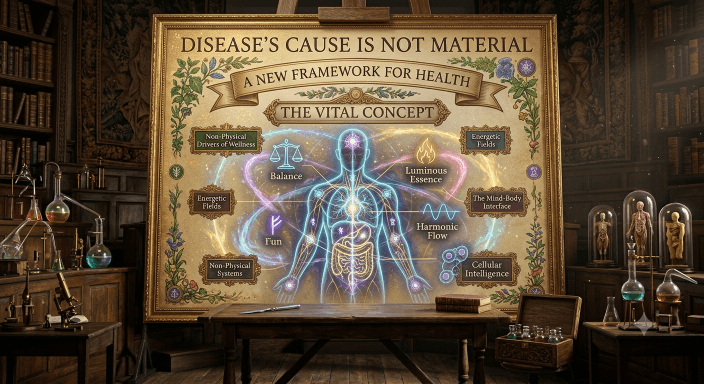
This is a fundamental and pre-established observation: the human being is composed of both material and dynamic dimensions. The material body represents the physical plane, while the dynamic principle constitutes the immaterial or vital plane. Among these two, the dynamic plane is far more susceptible to the influence of disease than the material body.
Even when the body suffers a purely physical injury, such as a burn or trauma from a road accident, clinical experience often shows that complete restoration of the damaged tissues does not necessarily restore the patient's sense of health and well-being. Structural repair may be achieved, yet the individual may continue to experience suffering, weakness, or a persistent sense of disorder.
Such observations suggest that health cannot be explained solely in terms of material integrity. They point toward a deeper level of organization governing the organism. From this perspective, the primary disturbance of disease originates within the dynamic plane, while the pathological changes observed in tissues and organs are merely its subsequent material manifestations. The visible lesions are therefore not the disease itself, but rather the external expressions of an underlying dynamic derangement.
If this premise is accepted, then a fundamental limitation of autopsy becomes evident. An autopsy is performed only after death, when the dynamic principle is no longer present and only the material body remains available for examination. Consequently, it can reveal the structural alterations produced by disease and may help determine the anatomical cause of death, but it cannot directly disclose the original dynamic disturbance from which the disease arose. Therefore, while autopsy is a valuable tool for studying the material consequences and terminal effects of disease, its ability to uncover the primary cause of disease remains inherently limited.
An autopsy, or postmortem examination, is a medical procedure performed after death to investigate the cause of death and to identify any disease, injury, or pathological changes present in the body. By examining the organs and tissues, the pathologist can correlate clinical symptoms with structural alterations and assess the extent of disease. Autopsy has historically played an important role in the advancement of medical knowledge by providing insight into the anatomical and pathological consequences of disease.
The material body and the dynamic plane are inseparably integrated with one another, each continuously influencing and affecting the other. Consequently, the process leading to death may proceed in either direction: from the material plane to the dynamic plane, as in cases of severe physical injury or destruction of vital organs, or from the dynamic plane to the material plane, where a primary disturbance of the vital force gradually gives rise to pathological changes in the body. Thus, life and disease represent a constant interaction between these two dimensions of human existence, and disturbances in either sphere may ultimately culminate in death.
Allopathic perspective: If death occurs from the material plane toward the dynamic plane, such as in extensive burns, severe road traffic accidents, fatal injuries to vital organs, drowning, or mechanical obstruction of the respiratory tract by a foreign body, autopsy can play a decisive role in determining the cause of death. In such cases, the chain of causation is often evident in the material body itself. The postmortem examination may reveal extensive tissue destruction, damage to essential organs, airway obstruction, aspiration of foreign material, or pathological changes consistent with drowning. Here, the immediate cause of death lies within the physical domain, and autopsy provides valuable and often conclusive evidence regarding the mechanism and cause of death.
From this perspective, autopsy is highly useful when death results primarily from material or mechanical factors affecting the organism. Its limitation becomes apparent only when one attempts to investigate the primary dynamic origin of disease. Thus, while autopsy may successfully identify the material cause of death, it does not necessarily disclose the deeper dynamic disturbance that may have preceded and ultimately contributed to the disease process.
Homoeopathic perspective: From the homoeopathic standpoint, when the direction of disease proceeds from the dynamic plane to the material plane, the pathological findings revealed by autopsy represent nothing more than the final outcome of a long-standing dynamic disease process. The structural alterations observed in organs and tissues are regarded as the ultimate effects of the disease rather than its primary cause.
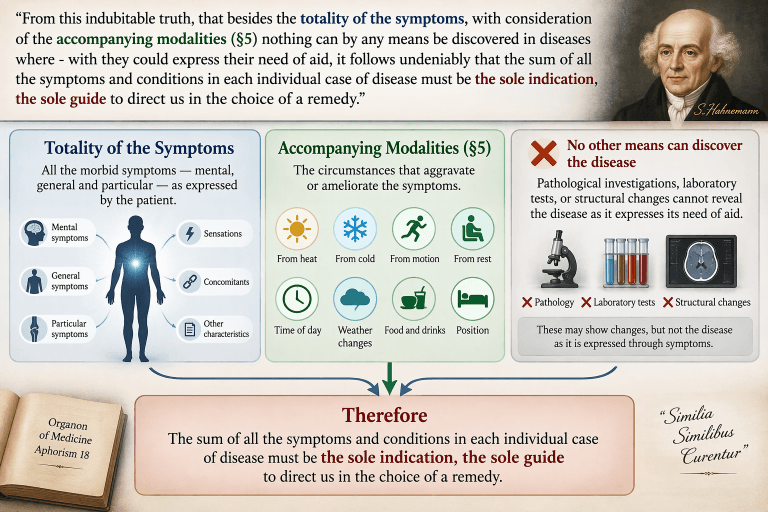
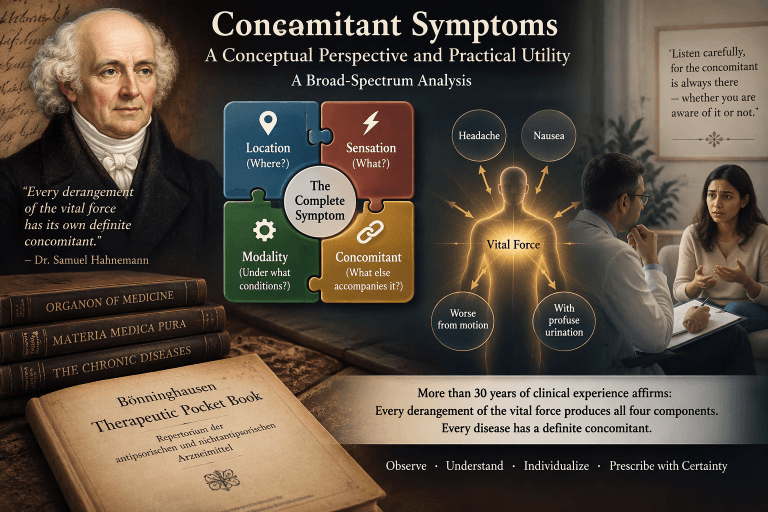
In such cases, autopsy may demonstrate the anatomical cause of death and the extent of pathological damage, but it provides little insight into the original dynamic disturbance that initiated the disease process. Nor does it offer direct guidance for the selection of the homoeopathic remedy, which must be chosen on the basis of the characteristic symptoms manifested during the patient's lifetime. The symptom totality, reflecting the dynamic derangement of the vital force, disappears with death and therefore cannot be reconstructed through postmortem examination.
Consequently, from a homoeopathic perspective, autopsy is of limited value in investigating the fundamental nature and origin of disease. It primarily reveals the end products of the disease process rather than the dynamic alterations that preceded them. Therefore, while autopsy may be useful for determining the material cause of death, it contributes little toward understanding the dynamic cause of disease or toward therapeutic decision-making in homoeopathic practice.
Conclusion:
Autopsy remains an important scientific tool for determining the material cause of death and for studying the structural changes produced by disease. When death results from obvious physical causes, such as severe trauma, burns, drowning, poisoning, or obstruction of vital passages, postmortem examination can provide valuable and often conclusive evidence regarding the mechanism of death.
However, from the homoeopathic perspective, disease originates as a dynamic disturbance of the vital force and only later manifests as pathological changes in tissues and organs. Since an autopsy is performed after death, when the dynamic principle is no longer present, it can reveal only the material consequences of disease and not the original dynamic derangement that gave rise to them. The lesions observed at postmortem are therefore regarded as the end products of the disease process rather than the disease itself.
Thus, the value of autopsy depends largely upon one's conception of disease. For the pathologist, it is an indispensable means of investigating structural pathology and the material cause of death. For the homoeopathic physician, however, it offers limited insight into the fundamental nature of disease, which can be understood only through the living patient's symptoms and the manifestations of the disturbed vital force. In this sense, autopsy may explain how death occurred materially, but it cannot fully explain why disease originated dynamically.
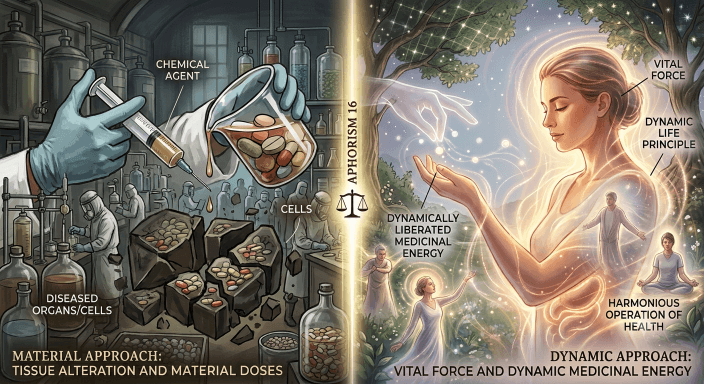
"As the cause of disease is dynamic rather than material, its cure does not depend upon a material dose."