
Medical Blog Articles
Explore evidence-based homeopathic insights and articles from our expert practitioners
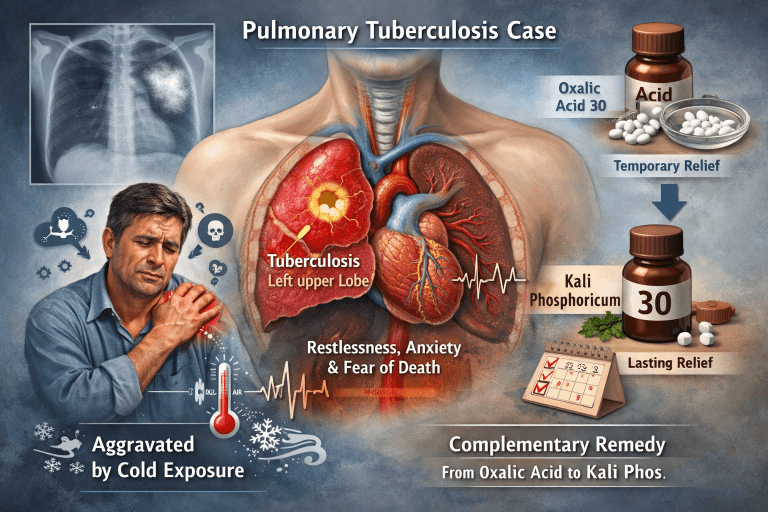
Kali Phosphoric as Complementary to Oxalic Acid: in Tubercular Affection of the Left Scapular Region
This case illustrates the dynamic role of complementary remedies in homoeopathy. A patient with pulmonary tuberculosis of the left upper lobe, complicated by pleural effusion, initially responded to Calcarea Carbonica and later obtained temporary relief from Oxalic Acid. However, the persistence of pain, restlessness, anxiety, and fear of death—aggravated by cold exposure—necessitated deeper exploration. Guided by Hering’s Guiding Symptoms, Kali Phosphoricum was identified as a complementary and chronic remedy to Oxalic Acid. Its administration provided lasting relief, with sustained improvement even after discontinuation. This outcome highlights the importance of contextual complementarity, where Kali Phos not only complemented Oxalic Acid but also addressed the chronic dimension of cardiac‑pulmonary involvement.

Fever: A Broad-Spectrum Therapeutic in Homoeopathy.
Homoeopathy is applicable in all curable cases; the real challenge, however, is in its application. This timeless statement by Dr. J.T. Kent is very true, and this is especially true in case of fever. Managing a case of fever is always challenging for a Homoeopathic physician, need patience and accuracy in the selection of medicine. Thermal symptoms are very prominent in the case of fever, require physician attention. like thirst pattern, heat distribution, sweating pattern, desire and Averion, urination and defecation etc. causative modality is also playing important role in the selection of medicine, therefore essentially must be considered. Managing fever is easy for true practitioner of healing art, under the guidance of Organon of medicine.
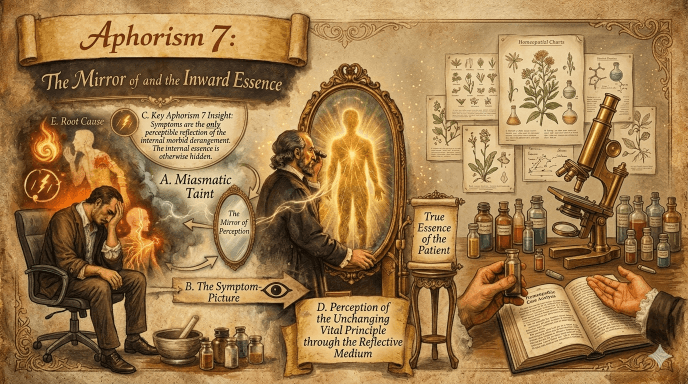
Aphorism - 7, "Symptoms as the mirror of Disease’s Dynamic essence."
The only way a physician can truly know a disease is through the careful collection of all its symptoms. These symptoms, however, are not the disease itself; rather, they are the outward reflections of the inner disturbance of the vital force. Since the dynamic essence of disease cannot be observed or measured directly, the physician must rely upon the complete constellation of symptoms to guide the choice of remedy. Yet, symptomatology alone does not furnish the true portrait of the disease. Success in treatment depends not merely on assembling symptoms, but on the physician’s power of perception—the ability to discern what lies behind the outward signs, to penetrate beyond superficial similarity, and to grasp the dynamic essence that constitutes the real totality of the patient’s condition. This aphorism clarifies, why physician need power of perception.
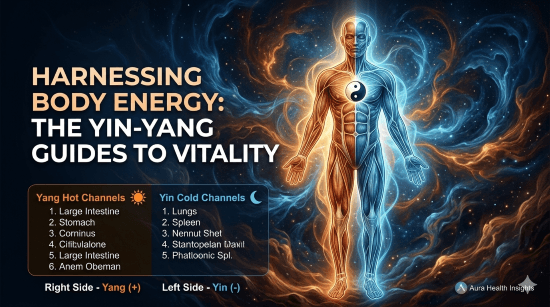
Side affinity of Homoeopathic Medicine: an explanatory note.
The vital force manifests itself in diverse ways, shaping the organism’s responses to health and disease. One of its remarkable expressions is side affinity—the tendency of certain remedies to act predominantly on one side of the body. Some medicines exert their influence chiefly on the right side, while others demonstrate a marked preference for the left. A select group of remedies reveals an even more distinctive pattern: they alternate their action, sometimes affecting the left, at other times the right, but never both sides simultaneously. This alternating affinity reflects the dynamic and intelligent nature of the vital force, which governs the organism with precision and balance. Lac caninum stands as the classical example of such alternating side action, illustrating how the vital force channels its energy in a polarized yet orderly manner. Thus, side affinity is not merely a clinical observation but a profound indication of the vital force’s role as the operative principle of life—directing, regulating, and expressing itself through lateral tendencies that guide the homoeopathic physician in remedy selection.
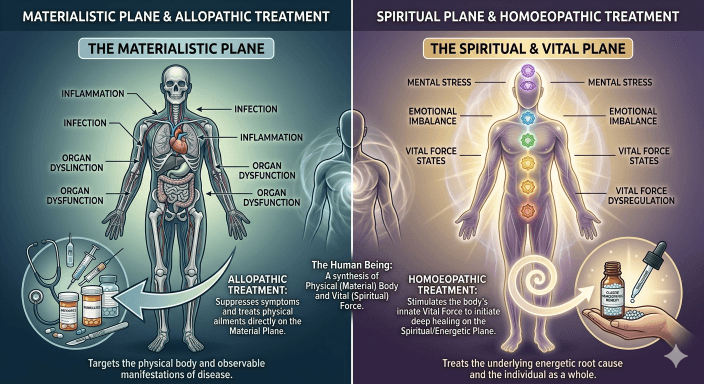
Beyond the Placebo: A Deeper Dive into Homoeopathy
The debate around homoeopathy and the placebo effect has long been a point of contention in modern science. Conventional medicine, grounded in material analysis, often dismisses homoeopathic remedies as inert because they contain no measurable molecules. Yet, clinical experience spanning decades reveals that homoeopathy operates on a different plane—one that transcends the physical body. It does not act upon organs, tissues, or biochemical pathways, but rather upon the vital force, the subtle energy pattern that animates life. Allopathy treats the material body, seeking to correct pathology through measurable interventions. Homoeopathy, by contrast, seeks to restore harmony in the patient’s spiritual essence, arranging energy patterns that manifest as health. This divergence explains why the scientific community frequently labels homoeopathy as placebo: its effects are invisible to molecular science, but profoundly evident in lived experience. To practitioners and patients alike, homoeopathy is not a myth but a dynamic healing art, addressing the human being as a whole—body, mind, and spirit.
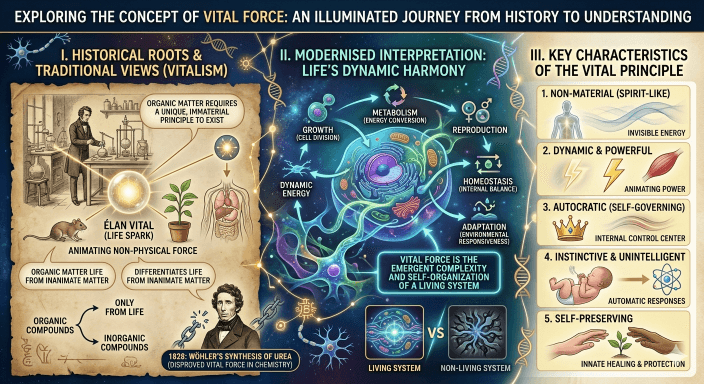
Vital force: The invisible Architect of Health and its various Operation.
The Vital Force is the fundamental operative principle within the body of a living organism. It flows through various energy channels and performs essential vital operations. It is classified into two types: Yin (Negative) and Yang (Positive). When these remain in balanced form across the left and right halves of the body, the state is termed health. When the flow is disturbed, the Vital Force becomes deranged. Dr. Samuel Hahnemann described this deranged condition of the Vital Force as disease. The Vital Force is dynamic in nature, more unstable than the material body, and thus capable of producing disease. It is both autocratic and automatic. In health, it harmonizes the organism; in disease, it generates morbid sensations. Transformation from disease back into health can occur only through the Vital Force. Hence, the Vital Force is solely responsible for the restoration of health, while the material body possesses no such power.

Vaccination: Mechanism, History, Principles, Risks, and Prevention — A Homoeopathic Perspective
In contemporary discourse, vaccination is often presented as the sole solution for the prevention of disease. Yet it is important to pause and examine what vaccination truly represents. From a homoeopathic perspective, vaccination may be regarded as either an imperfect application of homoeopathy or as a practice more closely aligned with the principle of isopathy. Homoeopathy, founded on the law of similia similibus curentur (“like cures like”), requires a remedy to be prescribed on the basis of symptom similarity, tailored to the individual’s dynamic state. Vaccination, however, does not follow this individualized approach. Instead, it introduces a disease product or attenuated pathogen into the body with the aim of stimulating immunity. This method resembles isopathy, where the very substance causing disease is used in a modified form to prevent or treat it. The distinction is crucial: Homoeopathy emphasizes individualized prescription, dynamic resonance, and symptom similarity. Isopathy relies on the direct use of disease products or their derivatives, without the nuanced matching of symptoms. Thus, vaccination may be seen as a crude or partial reflection of homoeopathic principles, lacking the refinement of individualized remedy selection. While it seeks to protect populations, it does so by imposing a uniform solution, whereas homoeopathy insists upon the uniqueness of each patient’s constitution and symptom totality.
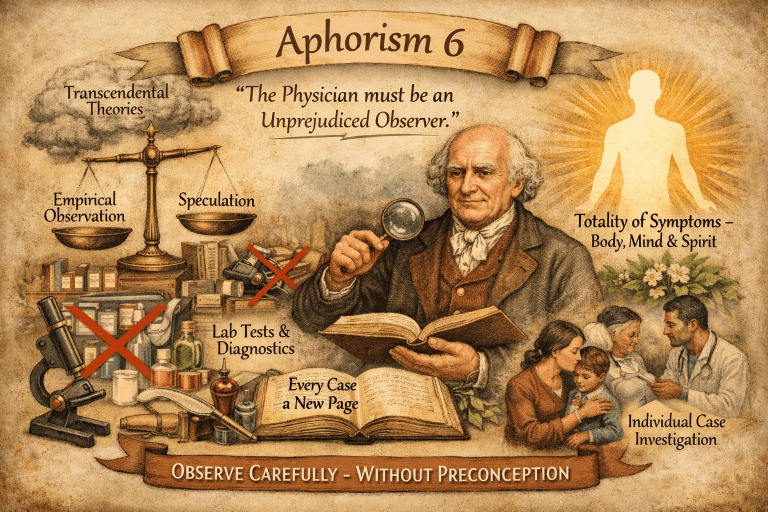
Aphorism - 6, "A physician must be unprejudiced observer" (Every sick maintain individuality)
In Aphorism 6 of the Organon of Medicine, Dr. Samuel Hahnemann defines the essential character of the true physician — the unprejudiced observer. He instructs that the physician must approach every case as entirely new, free from preconceived notions or reliance on past experiences. Observation, not speculation, is the foundation of true healing. This Aphorism illuminates the futility of transcendental theories and emphasizes the principle of individuality. The physician’s duty is to perceive and record every deviation from health — whether of body, mind, or spirit — through signs and symptoms that are perceptible, observable, and felt. These manifestations form the totality of symptoms, the only reliable portrait of disease in its full extent. Thus, Hahnemann’s teaching in Aphorism 6 transcends mere technique; it is a moral and intellectual discipline. It calls upon the physician to cultivate purity of perception, humility before nature, and fidelity to experience — the true spirit of homeopathic investigation.
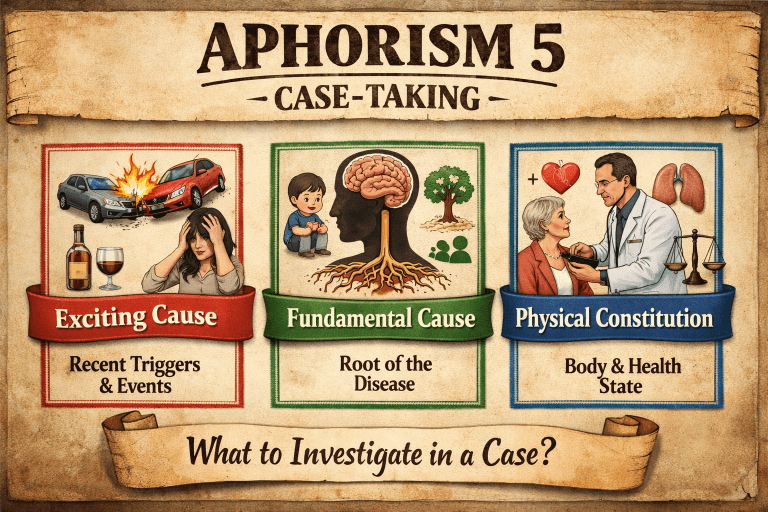
Aphorism - 5, "The Investigation of Causes: A Guide to Case Taking in Acute and Chronic Diseases"
In Aphorism 5, Hahnemann emphasizes that the physician must carefully investigate not only the present symptoms but also the possible exciting and maintaining causes of disease. He points out that in many cases, especially chronic ones, external factors such as lifestyle, habits, occupations, and environmental influences may perpetuate illness. He writes: “Useful to the physician in assisting him to cure are the particulars of the most probable exciting cause of the acute disease, as also the ascertainable occasion of the chronic malady.” Thus, Aphorism 5 serves as a guiding principle for case taking, reminding practitioners to look beyond the immediate symptom picture and to consider the broader causal context—whether acute triggers or chronic maintaining factors. actually, teaching on the case taking starting from aphorism 5.

Mother Tincture or Dynamic Medicine? A Philosophical Clarification
Homoeopathy is based on the idea of dynamics, where both illness and medicine are seen as living, active forces rather than just material things. The rule of similia similibus curentur—“like cures like”—works only when remedies act through their dynamic power, not through raw substance. Yet, confusion often arises when mother tinctures are used as if they were the same as potentized medicines. A mother tincture still holds the crude drug in its material form, while a true homoeopathic remedy is freed from matter and turned into dynamic energy through potentization. To call the use of tinctures homoeopathy is to miss its real foundation. True homoeopathy is not about giving raw drugs, but about using their dynamic imprint to awaken the vital force. The line between crude and dynamic medicine is not small—it is the very mark that separates real homoeopathy from simple herbal practice.
Totality of Symptoms: From Mystery to Meaning.
The “totality of symptoms” remains a term shrouded in mystery—difficult to define and even more difficult to apply in practice. What, in fact, constitutes the totality of symptoms? The question is still unresolved. Though many stalwarts of homeopathy have offered their interpretations, none has yet provided a view that is universally accepted, consistent, and fully intelligible. One truth must be emphasized: merely assembling a group of symptoms collected from the patient through head‑to‑foot investigation does not constitute the true totality of symptoms. In order to resolve this enigma, many homeopathic physicians have made earnest efforts and contributed their perspectives. The theory of the evolution and classification of symptoms was the very first attempt to achieve clarity in defining the totality of symptoms.
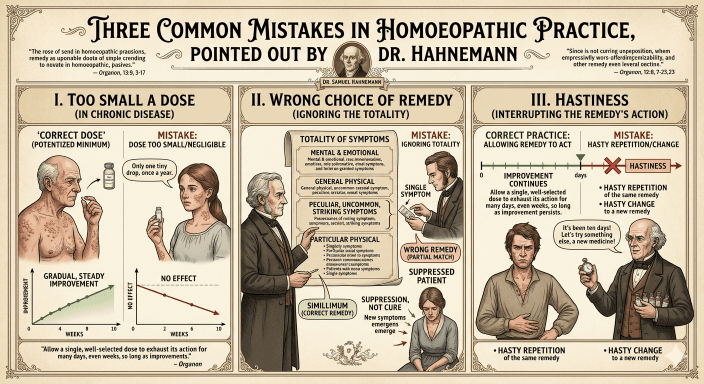
The Minimum Dose: Three Common Physician Mistakes That Make Cure Difficult.
Practicing Classical Homoeopathy is an arduous task, demanding not only intellectual rigor but also deep fidelity to the principles laid down by Dr. Samuel Hahnemann. Despite its promise of gentle and lasting cures, the path is fraught with difficulties. Hahnemann himself observed that physicians often fall into certain errors which compromise the success of treatment, whether in acute or chronic cases. These errors, scattered across his writings in the Organon of Medicine and The Chronic Diseases, were later synthesized by commentators into three cardinal mistakes that repeatedly lead to failure in cure. 1. Improper Selection of the Remedy Physicians frequently prescribe without grasping the full totality of symptoms. Isolated or superficial symptom-matching fails to capture the dynamic essence of disease, resulting in remedies that do not act. Hahnemann emphasized that the outwardly reflected picture of the internal disturbance—the totality of symptoms—must alone guide the choice of medicine. 2. Improper Dose and Potency Neglecting the principle of the minimum dose is another common error. Over-dosing or misjudging potency disturbs the vital force rather than harmonizing it. The physician must carefully adjust potency and repetition, respecting the subtle action of dynamic remedies. 3. Impatience in Observation Many practitioners fail to allow the remedy sufficient time to act. Hastily changing prescriptions before the vital force has responded interrupts the curative process. Hahnemann warned that the physician must wait and observe, trusting the remedy’s action rather than rushing to alter treatment.