HomeoEra
Back to Blogs

Vital force: The invisible Architect of Health and its various Operation.

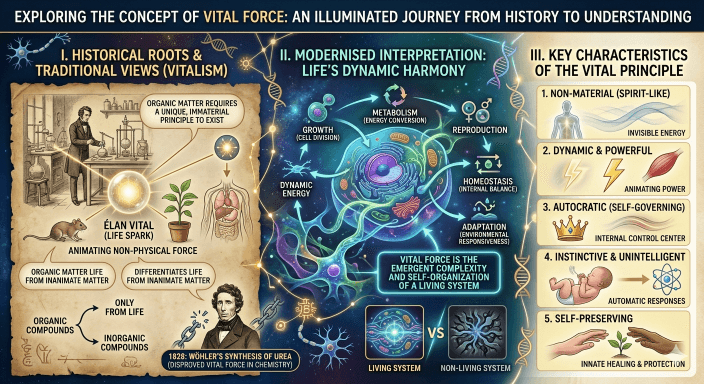
The Vital Force is the fundamental operative principle within the body of a living organism. It flows through various energy channels and performs essential vital operations. It is classified into two types: Yin (Negative) and Yang (Positive). When these remain in balanced form across the left and right halves of the body, the state is termed health. When the flow is disturbed, the Vital Force becomes deranged. Dr. Samuel Hahnemann described this deranged condition of the Vital Force as disease. The Vital Force is dynamic in nature, more unstable than the material body, and thus capable of producing disease. It is both autocratic and automatic. In health, it harmonizes the organism; in disease, it generates morbid sensations. Transformation from disease back into health can occur only through the Vital Force. Hence, the Vital Force is solely responsible for the restoration of health, while the material body possesses no such power.

H

HomeoEra Journal Editorial Team

Updated 8 min read1227 views
Vital force: The invisible Architect of Health and its various Operation.

Morden Scientific approach of Vital force

An Overview:

Every object we see in the world is made up of two basic elements: matter and energy. Matter gives shape and structure, while energy brings movement, change, and activity. Together, they form the foundation of existence.

Modern quantum physics continues to prove and expand the idea that matter and energy are interchangeable, first explained by Einstein’s equation E=mc2. Recent studies show that materials can shift between different quantum states, electrons can act both like particles and waves, and energy can even be stored or transferred in new quantum systems. (Dynamic nature of Energy)

This makes it clear that matter and energy are not separate substances but two sides of the same reality. Depending on the state or phase, matter appears as solid form, while energy shows itself as motion, vibration, or radiation. Together, they reveal the unity of physical existence and energy is the base of physical world. From this discussion, it becomes clear that energy is dynamic in nature.

Exactly — the principle that matter and energy are inseparably linked in the physical world also extends into the biological world.

Biological Parallels:

Matter as structure: Cells, tissues, and organs provide the physical framework — proteins, lipids, carbohydrates, and nucleic acids are the “matter” that gives shape and stability.

Energy as activity: ATP, ion gradients, and metabolic pathways drive movement, signaling, repair, and adaptation. Without energy, the biological matter remains inert. similarly, without soul the organism is dead. 

Unity in Biology:

Metabolism: Food (matter) is transformed into energy through cellular respiration.

Neurobiology: Electrical impulses (energy) travel across neurons built from proteins and lipids (matter).

Growth & Healing: DNA (matter) guides cellular processes, but energy is required for replication, transcription, and repair.

Dynamic Interplay: Just as quantum physics shows matter and energy as two sides of one reality, biology demonstrates that structure and function are inseparable. A muscle fiber is matter, but contraction is energy. A neuron is matter, but thought is energy in motion.

So, the same truth applies life itself is the dance of matter and energy — structure animated by vitality.

First law of energy conservation:

States that "energy cannot be created nor be destroyed — it can only be transformed from one form to another. The total energy of an isolated system always remains constant."

Vital energy is recognized as one of the transformations of energy that exists in the physical world. Yet, the precise mechanism of this transformation remains unknown. Dr. Samuel Hahnemann, in his Organon of Medicine, referred to this vital energy as the Vital Force. He described it as the sole operative principle within the living organism — the dynamic power that animates matter and sustains life as well as responsible for disease and health and for other vital operation performed the body of living organism. 

Vital derangement:

In the comparison between energy and matter, matter appears more stable, while energy is inherently dynamic. Matter provides structure and persistence, but energy is the principle of change, motion, and transformation. Because of this dynamic nature, derangement or disturbance can more easily occur in the energetic aspect of existence than in the material form. As the fact reflected in the Aphorism 16 of the Organon of medicine. 

Homoeopathic Philosophical Approach of Vital force


Aphorism 16,

"Our vital   force, as a spirit-like dynamis, cannot be attacked and affected by injurious influences on the healthy organism caused by the external inimical forces that disturb the harmonious play of life, otherwise than in a spirit-like (Dynamic) way, and in like manner, all such morbid derangements (diseases) cannot be removed from it by the physician in any other way than by the spirit-like (Dynamic[ most severe disease may be produced by sufficient disturbance of the vital force through the imagination and also cured by the same means ] virtual) Alternative power of the serviceable medicines acting upon our spirit like vital force which perceives them through the medium of the sentient faculty of the nerves everywhere present in the organism, so that it is only by their dynamic action on the vital force that remedies are able to re-establish and do actually re-establish health and vital harmony, after the changes in the health of the patient recognizable by our senses (the totality of the symptoms) have revealed the disease to the carefully observing and investigating physician as fully as was requisite in order to enable him to cure it."    


(Explanatory note)


In this aphorism, Dr. Hahnemann explains that the Vital Force is dynamic or spirit‑like in nature, and can be affected only by a dynamic, subversive influence (miasm). Both health and disease exist entirely on the dynamic plane. A dynamic disturbance can be cured only by a corresponding dynamic force—namely, dynamic medicine.

We possess only one technique to diagnose this dynamic disturbance within the body: the abnormal sensations produced by the sensory nerves, which extend throughout the organism from head to foot. It is solely through dynamic homoeopathic medicine that the harmony of the body can be restored—in other words, that true cure can be achieved.

  Nature of vital force:

Vital force poses the following property. it is.  
1. Dynamic (sprit like): The term dynamic (spirit-like) refers to something that is non-material, subtle, and energetic in nature, rather than physical or tangible. In philosophical and homeopathic contexts, “dynamic” points to the vital, invisible force that animates life and governs health.

2. Autocratic: The term autocratic refers to a style of rule or authority where power is concentrated in the hands of a single individual who makes decisions without input, consent, or participation from others.

3. Automatic: The term automatic refers to something that functions or operates by itself, without conscious effort or deliberate control

4. Spiritual: The term spiritual refers to that which is connected with the soul, inner essence, or higher consciousness, rather than the material or physical body. It points to dimensions of life that are intangible, transcendent, and deeply meaningful

5. Immaterial: The term immaterial refers to something that is not composed of matter, not physical, and beyond tangible substance. It points to realities that cannot be grasped by the senses but are understood through thought, spirit, or effect

6. Omnipresent:  The term omnipresent means present everywhere at the same time, without limitation of place or boundary. It describes a reality, force, or being that is universally pervasive and cannot be confined to one location.

7.  Pre‑existent:  The term pre‑existent means existing before something else comes into being, especially before the material or physical manifestation. It conveys the idea of a reality or essence that is prior in order, origin, or causation.    

Type of vital force:

Two types of vital energy exist in Our body. 
1. Clockwise rotating (Positive) vital force - present in the right half of the body.
2. Anti-clockwise rotating (Negative) vital force - present in the left half of the body. 

Both vital forces are equal in strength but opposite in electrical charge just like an electron and proton. behave like an opposite pole of magnate. 

Different Vital energy channel in Our body:

The twelve paired energy channels through which vital energy (Qi) flows are arranged in a cyclic sequence. This circulation is best understood in a tabular view, where each meridian is paired and follows a rhythmic order in the 24‑hour cycle.


Circadian movement of the Vital energy (Qi.)

Vital energy, or Qi, circulates rhythmically through the twelve paired meridians in a 24‑hour cycle, reflecting the body’s internal clock. Each meridian dominates a specific two‑hour period, during which its corresponding organ system functions at peak efficiency. indicated by tabular view.

Health & disease in respect of Vitality (Qi.)

Health: The balanced condition of the negative and positive energies (Yin and Yang) between the right and left halves of the body constitutes health. In this state, the organism experiences itself as a unified whole, with no abnormal or unpleasant sensations. The temperature of the entire body remains uniform, with the natural exception that the head should be slightly warm and the feet slightly cool, in accordance with the priorities of life.

Disease: In the opposite condition—during illness—the body no longer feels as a unity. Instead, its parts are experienced separately, producing isolated sensations in organs such as the heart, kidneys, liver, or uterus. This fragmentation gives rise to abnormal perceptions, and different regions of the body display distinct thermographic patterns. 
Definition.

Therefore, we can define the vital force as: 

"The Vital Force is the fundamental operative principle that performs all vital functions, encompassing both health and disease. It is autocratic, automatic, and dynamic in nature, yet spiritual in origin."
Have a Question?
Ask HomeoEra Journal Editorial Team about "Vital force: The invisible Architect of Health and its various Operation." and get a personalized response directly to your email.

0/500 characters

0 characters (minimum 10 required)

🔒 Privacy Notice: Your information will only be used to respond to your query and won't be shared with third parties.

Aphorism - 14, Health as Harmony: Absence of Morbid Signs and Need for Cure.
Organon & Philosophy

Aphorism - 14, Health as Harmony: Absence of Morbid Signs and Need for Cure.

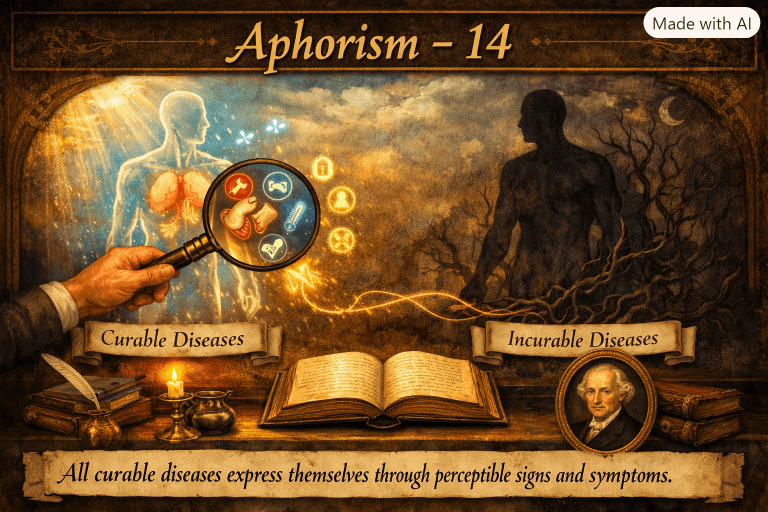
In this aphorism, Dr. Samuel Hahnemann elucidates a fundamental law of observation in medicine: that every curable disorder within the human organism necessarily reveals itself through perceptible signs and symptoms. Nothing curable remains hidden from the discerning physician, for the divine order has ordained that disease must express its presence outwardly to invite cure. Thus, the physician’s art depends entirely upon the faithful interpretation of these manifestations. The morbid phenomena are not mere disturbances but the visible language of Nature, guiding the healer toward restoration. Those affections that grow silently within, without perceptible symptoms, belong to the realm of the incurable; for where no sign is given, no curative response can be awakened. In essence, Hahnemann reminds us that symptoms are the thread of cure—the only bridge between the inner disorder and the physician’s understanding. To grasp that thread is to hold the possibility of healing; to lose it is to stand before disease without remedy.

HHomeoEra Journal Editorial Team
3m292
Doctrine of Homoeopathy: From Vitalism to Healing
Organon & Philosophy

Doctrine of Homoeopathy: From Vitalism to Healing

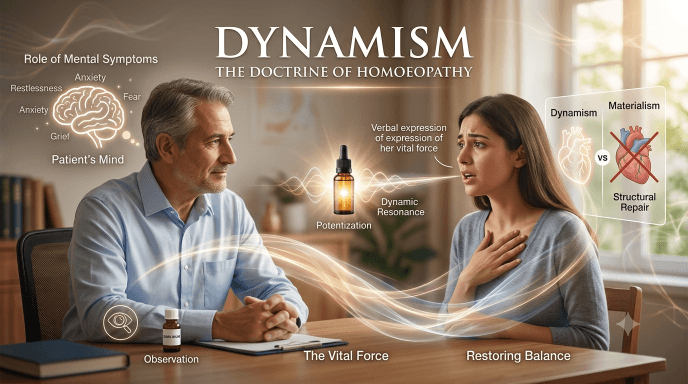
The doctrine of Homoeopathy is inseparably bound with the principle of dynamism. It does not aim at repairing the material body in isolation, but rather seeks to restore the vital force—the dynamic essence that animates life. Disease, in this philosophy, is not merely a structural defect or chemical imbalance; it is a disturbance on the dynamic plane, a disharmony of the spirit‑like energy that governs sensation and function. Homoeopathic medicine, therefore, is not material in its curative action. Prepared through potentization, it transcends crude substance and becomes a dynamic remedy, capable of resonating with the disturbed vital force. Cure is achieved not by suppressing symptoms or altering tissues directly, but by stimulating the inner harmony, allowing the body to reorganize itself from within outward. Thus, the true aim of Homoeopathy is not to treat the corporeal frame, but to re‑establish balance in the living dynamis, from which health naturally flows into the material body.

HHomeoEra Journal Editorial Team
7m324
Surgical Intervention in Homoeopathy: Necessity, Limits, and Integration
Organon & Philosophy

Surgical Intervention in Homoeopathy: Necessity, Limits, and Integration

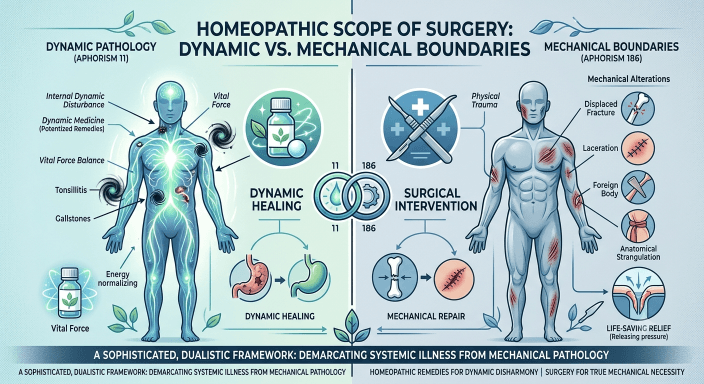
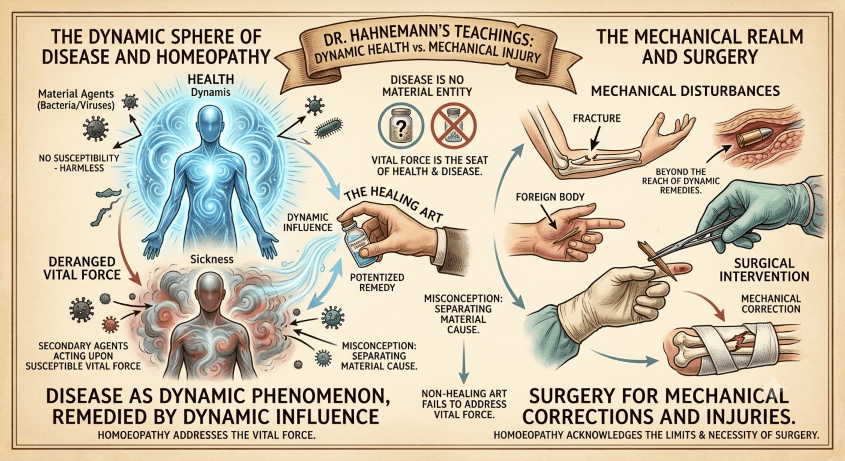
Surgery represents one of the most decisive acts in medical practice—an intervention that seeks immediate relief by removing or altering diseased tissue. Yet, within the philosophy of homoeopathy, surgery is not regarded as a primary mode of cure but rather as a necessary measure when the natural laws of healing cannot be invoked. Homoeopathy emphasizes restoration through the vital force, aiming to correct internal imbalance rather than mechanically excising its manifestations. The scope of surgery in homoeopathy lies in emergencies, irreparable structural damage, or conditions where mechanical obstruction threatens life. Its limitations, however, are evident when surgery is employed as a substitute for true cure, ignoring the deeper dynamic disturbance that gave rise to pathology. Thus, surgery may save life or prevent immediate danger, but it cannot address the underlying susceptibility that homoeopathy seeks to harmonize. In this way, surgery and homoeopathy are not adversaries but complementary disciplines. Surgery provides mechanical aid where necessary, while homoeopathy ensures the restoration of health by addressing the vital force. The ethical challenge lies in discerning when surgical intervention is indispensable and when reliance on the body’s healing potential, guided by homoeopathic remedies, is sufficient.

HHomeoEra Journal Editorial Team
4m253
Aphorism - 13, limitation of medicine and scope for surgery in Homoeopathy.
Organon & Philosophy

Aphorism - 13, limitation of medicine and scope for surgery in Homoeopathy.

Disease is not a material thing lodged in the body but a dynamic disturbance of the vital force, the invisible principle that sustains life. When this vital force is in harmony, health prevails; when disturbed, it manifests as altered sensations and functions that we call disease. Thus, disease is not a foreign substance but an immaterial imbalance, and cure lies in restoring the vital force to its natural equilibrium.

HHomeoEra Journal Editorial Team
2m150

Comments (0)

Sign in or sign up to join the discussion

No comments yet. Be the first to share your thoughts!

Newsletter

Stay Updated with Latest Research

Get weekly digests of new articles, case studies, and homeopathic insights delivered to your inbox

By subscribing, you agree to our Privacy Policy. Unsubscribe anytime.