HomeoEra
Back to Blogs

Side affinity of Homoeopathic Medicine: an explanatory note.

The vital force manifests itself in diverse ways, shaping the organism’s responses to health and disease. One of its remarkable expressions is side affinity—the tendency of certain remedies to act predominantly on one side of the body. Some medicines exert their influence chiefly on the right side, while others demonstrate a marked preference for the left. A select group of remedies reveals an even more distinctive pattern: they alternate their action, sometimes affecting the left, at other times the right, but never both sides simultaneously. This alternating affinity reflects the dynamic and intelligent nature of the vital force, which governs the organism with precision and balance. Lac caninum stands as the classical example of such alternating side action, illustrating how the vital force channels its energy in a polarized yet orderly manner. Thus, side affinity is not merely a clinical observation but a profound indication of the vital force’s role as the operative principle of life—directing, regulating, and expressing itself through lateral tendencies that guide the homoeopathic physician in remedy selection.

H

HomeoEra Journal Editorial Team

Updated 5 min read1000 views
Side affinity of Homoeopathic Medicine: an explanatory note.

An overview:

The vital force expresses itself in many ways. One of its manifestations is side affinity: certain medicines act predominantly on the right side of the body, while others act on the left. A few remedies possess a special affinity, alternating their action—sometimes on the left, at other times on the right—but never on both sides simultaneously. Lac caninum is the classical example of this distinctive pattern.

If we confine ourselves to purely materialistic reasoning, we fail to find any satisfactory explanation for the unique action of medicine or the peculiar manifestations of disease.

Recently, I encountered and successfully treated a case of articular rheumatism. In this patient, both knee joints were affected, but never simultaneously. When one joint became inflamed—hot, red, and painful—the other remained cold, normal in appearance, and fully functional. After some time, the condition would reverse: the previously affected joint would return to normal, while the opposite knee became inflamed.

This alternating pattern of affection vividly illustrates the dynamic and immaterial nature of disease expression, which cannot be explained by material pathology alone. Lac-caninum successfully cured this case. 

Only through a profound understanding and knowledge of the vital force can this mystery be resolved. every curious mind must ask to themself, why some medicine have affinity for right side and some for left? the answer is philosophical concerning with nature of vital force. 

Nature of vital force:

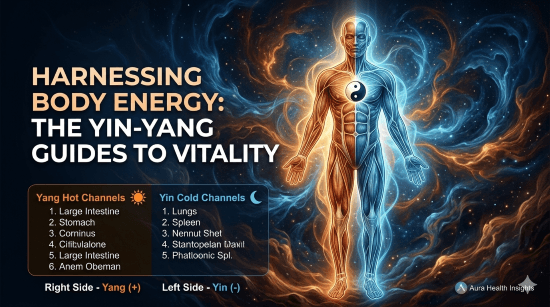
The Vital Force is present throughout the body, yet it circulates through specific energy channels. Some of these channel's flow in a clockwise direction, while others move anticlockwise. This dual circulation creates two opposite poles within the organism: the right half of the body, which is positively charged, and the left half, which is negatively charged.

A balanced condition between these charges constitutes health. Conversely, any disruption or uneven flow—termed the derangement of the Vital Force—manifests as disease. so simply, "Derangement of the Vital Force is nothing but the uneven flow—the disruption of Yin and Yang—within the living organism." The Vital Force not only circulates in clockwise and anticlockwise directions, but it also manifests itself through centrifugal and centripetal forces.

1. Centrifugal force represents the outward movement, dispersing energy toward the periphery. (indicate peripheral action of the medicine)

2. Centripetal force represents the inward movement, drawing energy back toward the center. (Indicate central action of the medicine)

Together, these dual expressions illustrate the dynamic balance of the Vital Force, sustaining harmony within the organism. the 12 energy channels are represented the human body as.


 Vital force as a vector: 

In homeopathic philosophy, the vital force may be conceptualized as a vector—a dynamic entity possessing both magnitude and direction.

* Magnitude represents the intensity or strength of life energy, manifesting in vitality, resilience, and the ability to maintain equilibrium.

* Direction signifies the orientation of this force, guiding physiological processes, emotional states, and adaptive responses.

 By treating vital force as a vector, one can appreciate its dual nature: it not only sustains life quantitatively but also channels it qualitatively toward health or disease.  

Disturbance in magnitude (weakening) or misdirection (perversion of flow) results in pathological states. Conversely, restoration of proper magnitude and alignment reflects cure.

This vectorial view bridges philosophical abstraction with scientific analogy, offering a symbolic framework to understand how vital energy circulates, balances polarities, and expresses itself through symptoms. It emphasizes that health is not merely the presence of force, but the correct orientation of that force within the living organism.

Cancer an abnormal expression of vital force:

Both the magnitude and direction of vital force can be altered or may be alter. Cancer of any organ or parts of the body, actually a mis-directional vital force, hence too an expression of vital force. 
Why Homoeopathic Medicine Shows Side Affinity:

The concept of side affinity in homoeopathic medicine can be understood through the polarity of energy channels. Remedies acting on the Yang channels correspond to right‑sided manifestations, indicating disturbance in the positive vital force. Conversely, remedies acting on the Yin channels correspond to left‑sided manifestations, reflecting disturbance in the negative vital force.

Peculiarity detection:

Comparative side affinity—whether a medicine acts on the right or left—is of limited significance in remedy selection. While such observations may enrich our understanding of the vital force, they hold little practical value in determining the appropriate prescription. it constitutes simply a general symptom, the important point is yet medicine is right sided, but which location are affected that is left too. it constitutes specific location pattern and forms a location totality. actually, needed for medicine selection. 

"Among the four bases of complete symptoms theory—location, sensation, modality, and concomitant—the most decisive is location. In Boenninghausen’s doctrine, location serves as the foundation for Organopathic practice, since every remedy demonstrates a natural affinity for particular organs or systems. Thus, identifying the seat of disease provides the primary anchor upon which the completeness of symptoms rests."
Have a Question?
Ask HomeoEra Journal Editorial Team about "Side affinity of Homoeopathic Medicine: an explanatory note." and get a personalized response directly to your email.

0/500 characters

0 characters (minimum 10 required)

🔒 Privacy Notice: Your information will only be used to respond to your query and won't be shared with third parties.

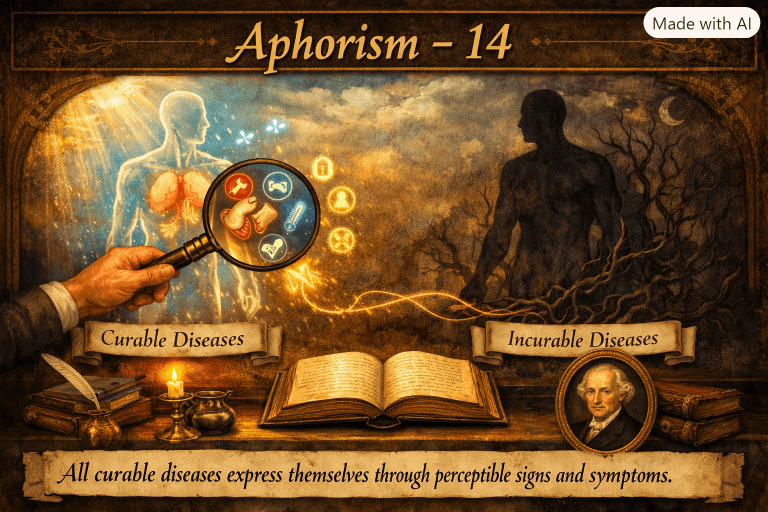
Aphorism - 14, Health as Harmony: Absence of Morbid Signs and Need for Cure.
Organon & Philosophy

Aphorism - 14, Health as Harmony: Absence of Morbid Signs and Need for Cure.

In this aphorism, Dr. Samuel Hahnemann elucidates a fundamental law of observation in medicine: that every curable disorder within the human organism necessarily reveals itself through perceptible signs and symptoms. Nothing curable remains hidden from the discerning physician, for the divine order has ordained that disease must express its presence outwardly to invite cure. Thus, the physician’s art depends entirely upon the faithful interpretation of these manifestations. The morbid phenomena are not mere disturbances but the visible language of Nature, guiding the healer toward restoration. Those affections that grow silently within, without perceptible symptoms, belong to the realm of the incurable; for where no sign is given, no curative response can be awakened. In essence, Hahnemann reminds us that symptoms are the thread of cure—the only bridge between the inner disorder and the physician’s understanding. To grasp that thread is to hold the possibility of healing; to lose it is to stand before disease without remedy.

HHomeoEra Journal Editorial Team
3m292
Doctrine of Homoeopathy: From Vitalism to Healing
Organon & Philosophy

Doctrine of Homoeopathy: From Vitalism to Healing

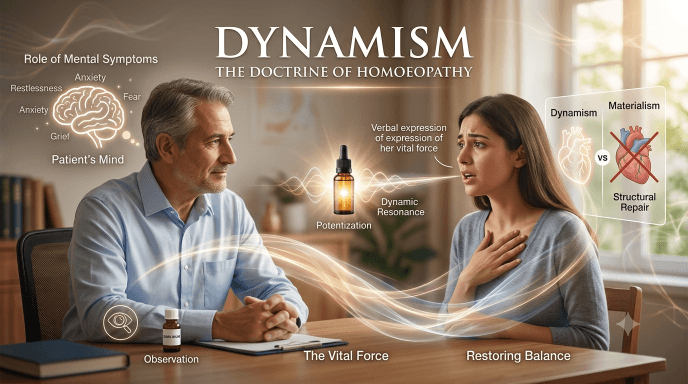
The doctrine of Homoeopathy is inseparably bound with the principle of dynamism. It does not aim at repairing the material body in isolation, but rather seeks to restore the vital force—the dynamic essence that animates life. Disease, in this philosophy, is not merely a structural defect or chemical imbalance; it is a disturbance on the dynamic plane, a disharmony of the spirit‑like energy that governs sensation and function. Homoeopathic medicine, therefore, is not material in its curative action. Prepared through potentization, it transcends crude substance and becomes a dynamic remedy, capable of resonating with the disturbed vital force. Cure is achieved not by suppressing symptoms or altering tissues directly, but by stimulating the inner harmony, allowing the body to reorganize itself from within outward. Thus, the true aim of Homoeopathy is not to treat the corporeal frame, but to re‑establish balance in the living dynamis, from which health naturally flows into the material body.

HHomeoEra Journal Editorial Team
7m324
Surgical Intervention in Homoeopathy: Necessity, Limits, and Integration
Organon & Philosophy

Surgical Intervention in Homoeopathy: Necessity, Limits, and Integration

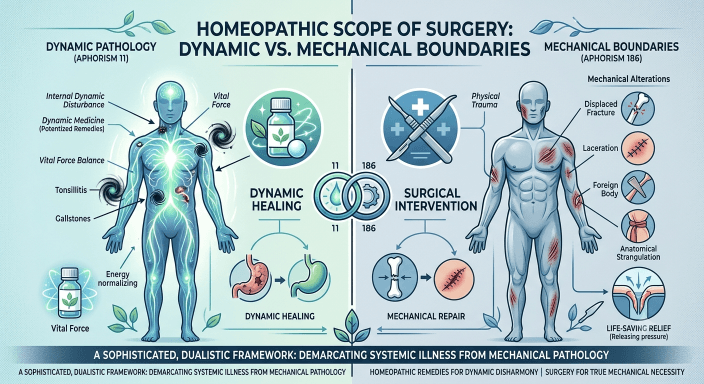
Surgery represents one of the most decisive acts in medical practice—an intervention that seeks immediate relief by removing or altering diseased tissue. Yet, within the philosophy of homoeopathy, surgery is not regarded as a primary mode of cure but rather as a necessary measure when the natural laws of healing cannot be invoked. Homoeopathy emphasizes restoration through the vital force, aiming to correct internal imbalance rather than mechanically excising its manifestations. The scope of surgery in homoeopathy lies in emergencies, irreparable structural damage, or conditions where mechanical obstruction threatens life. Its limitations, however, are evident when surgery is employed as a substitute for true cure, ignoring the deeper dynamic disturbance that gave rise to pathology. Thus, surgery may save life or prevent immediate danger, but it cannot address the underlying susceptibility that homoeopathy seeks to harmonize. In this way, surgery and homoeopathy are not adversaries but complementary disciplines. Surgery provides mechanical aid where necessary, while homoeopathy ensures the restoration of health by addressing the vital force. The ethical challenge lies in discerning when surgical intervention is indispensable and when reliance on the body’s healing potential, guided by homoeopathic remedies, is sufficient.

HHomeoEra Journal Editorial Team
4m253
Aphorism - 13, limitation of medicine and scope for surgery in Homoeopathy.
Organon & Philosophy

Aphorism - 13, limitation of medicine and scope for surgery in Homoeopathy.

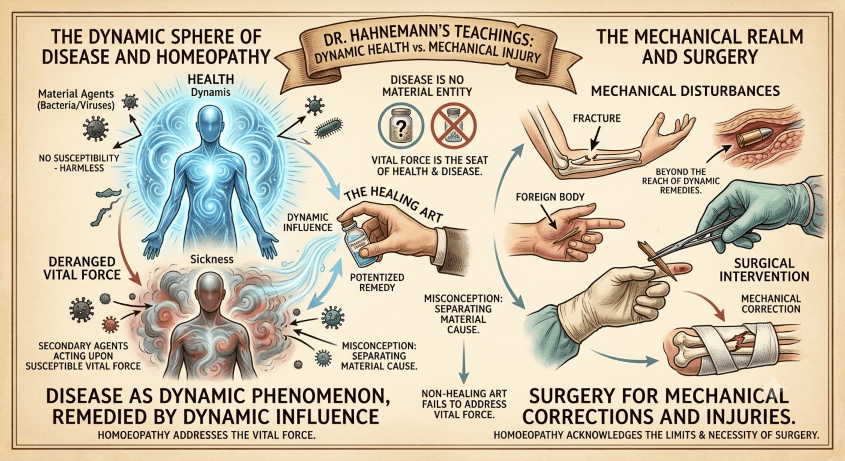
Disease is not a material thing lodged in the body but a dynamic disturbance of the vital force, the invisible principle that sustains life. When this vital force is in harmony, health prevails; when disturbed, it manifests as altered sensations and functions that we call disease. Thus, disease is not a foreign substance but an immaterial imbalance, and cure lies in restoring the vital force to its natural equilibrium.

HHomeoEra Journal Editorial Team
2m151

Comments (0)

Sign in or sign up to join the discussion

No comments yet. Be the first to share your thoughts!

Newsletter

Stay Updated with Latest Research

Get weekly digests of new articles, case studies, and homeopathic insights delivered to your inbox

By subscribing, you agree to our Privacy Policy. Unsubscribe anytime.