HomeoEra
Back to Blogs

Mother Tincture or Dynamic Medicine? A Philosophical Clarification

Homoeopathy is based on the idea of dynamics, where both illness and medicine are seen as living, active forces rather than just material things. The rule of similia similibus curentur “like cures like”—works only when remedies act through their dynamic power, not through raw substance. Yet, confusion often arises when mother tinctures are used as if they were the same as potentized medicines. A mother tincture still holds the crude drug in its material form, while a true homoeopathic remedy is freed from matter and turned into dynamic energy through potentization. To call the use of tinctures homoeopathy is to miss its real foundation. True homoeopathy is not about giving raw drugs, but about using their dynamic imprint to awaken the vital force. The line between crude and dynamic medicine is not small—it is the very mark that separates real homoeopathy from simple herbal practice.

H

HomeoEra Journal Editorial Team

Updated 7 min read1023 views
Mother Tincture or Dynamic Medicine? A Philosophical Clarification

The Dynamicity of the Homoeopathic medicine

Homoeopathic medicine as a powerhouse:

Homoeopathy deals with energy rather than matter. Frouom the very beginning, Dr. Hahnemann recognized this truth and therefore introduced the term “Potency” to denote the dynamic power of a homoeopathic medicine. The term potency is derived from the word potent, meaning static power or energy. In physics, this root is frequently encountered in the study of electricity, where it denotes static energy or potential force. Dr. Hahnemann adopted the term potency to describe the stored power present in homoeopathic medicines. Hence, it is useless to make any effort to prove that homoeopathic preparations contain molecules—whether macro, micro, or nano—since their essence lies not in material particles but in dynamic energy. Therefore, our small globules are not placebo but a powerhouse of energy, acquiring their dynamicity when introduced into the body of a living organism, including human beings. 

How Homoeopathic medicine act? an explanation.

A very important yet misguided question is often raised by modern scientists and those who think in a purely materialistic way: If homoeopathic medicine does not contain any molecule of drug material, how does it act or work?

The answer is simple and logical, though best expressed through questioning. How does your body gain strength when you eat food? Or how does an electric bulb glow when it is switched on? Is a molecule consumed in these processes? The answer is No.

When we eat food, it is the binding energy of carbohydrates, fats, or proteins molecules that is released during digestion and provides us energy. Similarly, when a bulb is switched on, it is electricity that makes it glow—not the molecules of wire. In fact, the molecular parts of food are soon expelled from the body as fecal matter.


I hope, it is now become clear from the above examples that it is energy which acts, not molecules. The true agent of transformation—whether in digestion or in the illumination of a bulb—is the release and transmission of energy. Molecules serve merely as carriers or mediums, but they themselves are not the operative force. In the same way, homoeopathic medicines act through their dynamic energy, not through the presence of material particles. it is proven fact energy is needed for work, not molecules, and cure is a work. 

How Matter Transforms into Energy:

In the era of Dr. Hahnemann, the prevailing worldview often treated matter and energy as distinct and independent entities. The scientific tools of his time did not yet reveal their deeper unity. However, in the modern scientific era, even a student at the secondary level understands that matter and energy are not separate fractions but interchangeable forms of the same reality. This transformation is elegantly expressed in modern physics, most famously through Einstein’s equation E=mc2, which demonstrates that matter can be converted into energy and vice versa.

Further refinement of this idea came through the work of Louis de Broglie, whose equation established the wave–particle duality of matter. According to de Broglie, every particle of matter possesses a wavelength, linking the tangible substance of matter with the intangible nature of energy. This insight bridged the gap between classical mechanics and quantum theory, showing that matter itself is imbued with dynamic, energetic properties.

We may say: when a particle of matter is in constant motion at very high speed—approaching the speed of light—it begins to exhibit wave-like behavior. A wave, by its very nature, is a form of energy. Thus, matter under such conditions reveals its dual character: it can behave like energy when in motion at light-speed.

In the process of trituration and potentization, matter undergoes continuous division and dynamic motion. Through this, mechanical energy the particles of the crude substance are reduced beyond the molecular level, and their dynamic essence is liberated. In this state, matter no longer behaves as inert substance but as pure energy, resonating with Einstein’s principle that matter and energy are interchangeable (E=mc²)

As the potency of a homoeopathic preparation increases, the material molecules are progressively diminished, while the dynamic power of the remedy is amplified at every step. Thus, potentization transforms matter into energy, aligning with both modern scientific understanding and Hahnemann’s vision of medicine acting on the vital force. Accordingly, the often‑repeated objection that “homoeopathic medicines do not work because higher potencies contain not even a single molecule of the original substance” must be completely eradicated. This objection rests on a purely materialistic view of medicine, ignoring the transformation that occurs during trituration and potentization.


Two different properties of same substance:

Every matter possesses two types of the properties, can be understood by discussion. we may call it, external or internal property, visible or invisible property, matristic or energetic property. Whatever we could say, doesn't matter, important is difference between both. for the convenience of discussion, I will use here external and internal property. 

1. External property:  we could say it physical property, - it is visible, measurable, and material characteristics such as weight, volume, shape, and chemical composition. These are the matristic or physical attributes of matter, accessible to direct observation and experimentation. it is considered; this property depends on atomic number of that matter. periodic table of Elements arranged according to this property, well known for Scientific world. Allopathic medicine works on the principle. 

2. Internal property: more accurately we can call it Meta-physical property - it is just opposite in nature of physical property, thus not visible, unmeasurable, has no weight, no shape, not take parts in chemical reaction, still I don't know which particle of atom determine this property. but surely exist. Homoeopathic medicine works on this principle. 

Example: 

The classical example of the existence of a metaphysical property is the use of Digitalis in both the Allopathic and Homoeopathic systems of treatment. In Allopathy (physical quantity), Digitalis is used to treat tachycardia (high pulse rate), while in Homoeopathy (metaphysical phase), the same drug is used to treat bradycardia (low pulse rate).

Now, this raises a significant question: How can the same drug exhibit two different and opposite properties? The answer lies in the fact that every matter possesses two types of properties in its nature. One is exerted directly, while the other is revealed through the process of potentization or dynamization. this is not only true about the Digitalis but also for other drugs like Arsenic, Apocynum, Quinine Etc. 

Uses of Mother tincture:

From the ongoing discussion, it becomes evident that homoeopathy is rooted in dynamic principles. In accordance with this rule, the cruder a preparation remains, the less truly homoeopathic it becomes. Gradually when we increase the potency of medicine the homoeopathicity of the medicine also increases. in this respect 200 potency is more Homoeopathic than the potency of 6 or 30. Materialistic mind always thinks that, if us preparation do not have molecule, how it will act? but fact is far apart from the thinking, and the fact is Homoeopathic medicine works miraculously in hinger potency even in 50M or CM. 

Conclusion:

Hence, there are two distinct schools of Homoeopathy. One belongs to the use of low potencies, while the other emphasizes higher potencies. One is based on pathological prescriptions, whereas the other follows dynamic concepts and focuses on the treatment of the sick.

As Homoeopathic physicians and true followers of Master Hahnemann, our sole duty is to detect the dynamic changes in the organism and prescribe accordingly. These dynamic changes can be observed in the form of sensations and modalities—whether symptomatic or thermal—at a particular location. If more than one location is affected; the case must be completed in a systematic way.

The concomitant symptom is the final brick that completes the building block of a true prescription.
Have a Question?
Ask HomeoEra Journal Editorial Team about "Mother Tincture or Dynamic Medicine? A Philosophical Clarification" and get a personalized response directly to your email.

0/500 characters

0 characters (minimum 10 required)

🔒 Privacy Notice: Your information will only be used to respond to your query and won't be shared with third parties.

Aphorism - 14, Health as Harmony: Absence of Morbid Signs and Need for Cure.
Organon & Philosophy

Aphorism - 14, Health as Harmony: Absence of Morbid Signs and Need for Cure.

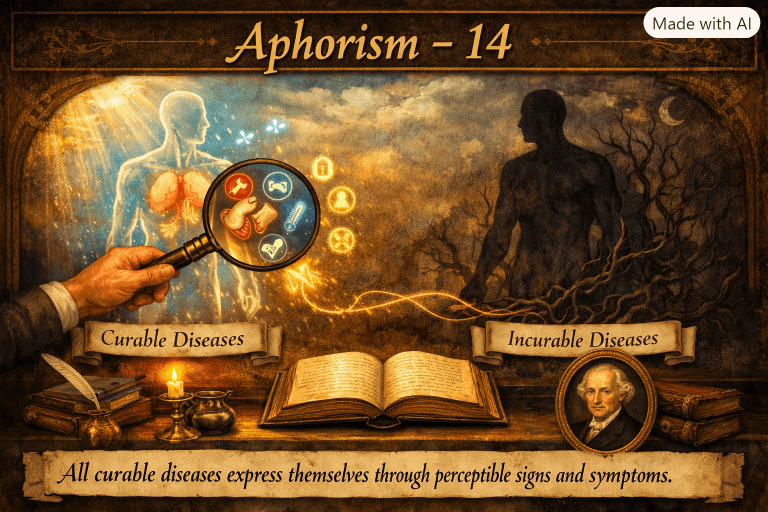
In this aphorism, Dr. Samuel Hahnemann elucidates a fundamental law of observation in medicine: that every curable disorder within the human organism necessarily reveals itself through perceptible signs and symptoms. Nothing curable remains hidden from the discerning physician, for the divine order has ordained that disease must express its presence outwardly to invite cure. Thus, the physician’s art depends entirely upon the faithful interpretation of these manifestations. The morbid phenomena are not mere disturbances but the visible language of Nature, guiding the healer toward restoration. Those affections that grow silently within, without perceptible symptoms, belong to the realm of the incurable; for where no sign is given, no curative response can be awakened. In essence, Hahnemann reminds us that symptoms are the thread of cure—the only bridge between the inner disorder and the physician’s understanding. To grasp that thread is to hold the possibility of healing; to lose it is to stand before disease without remedy.

HHomeoEra Journal Editorial Team
3m292
Doctrine of Homoeopathy: From Vitalism to Healing
Organon & Philosophy

Doctrine of Homoeopathy: From Vitalism to Healing

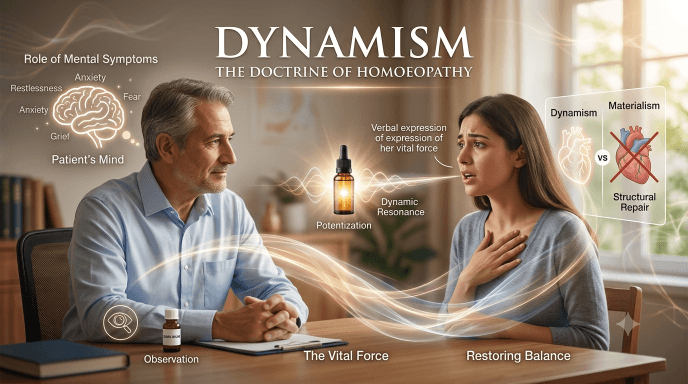
The doctrine of Homoeopathy is inseparably bound with the principle of dynamism. It does not aim at repairing the material body in isolation, but rather seeks to restore the vital force—the dynamic essence that animates life. Disease, in this philosophy, is not merely a structural defect or chemical imbalance; it is a disturbance on the dynamic plane, a disharmony of the spirit‑like energy that governs sensation and function. Homoeopathic medicine, therefore, is not material in its curative action. Prepared through potentization, it transcends crude substance and becomes a dynamic remedy, capable of resonating with the disturbed vital force. Cure is achieved not by suppressing symptoms or altering tissues directly, but by stimulating the inner harmony, allowing the body to reorganize itself from within outward. Thus, the true aim of Homoeopathy is not to treat the corporeal frame, but to re‑establish balance in the living dynamis, from which health naturally flows into the material body.

HHomeoEra Journal Editorial Team
7m324
Surgical Intervention in Homoeopathy: Necessity, Limits, and Integration
Organon & Philosophy

Surgical Intervention in Homoeopathy: Necessity, Limits, and Integration

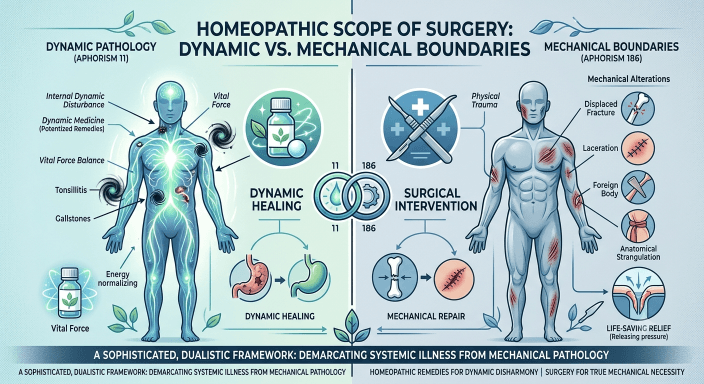
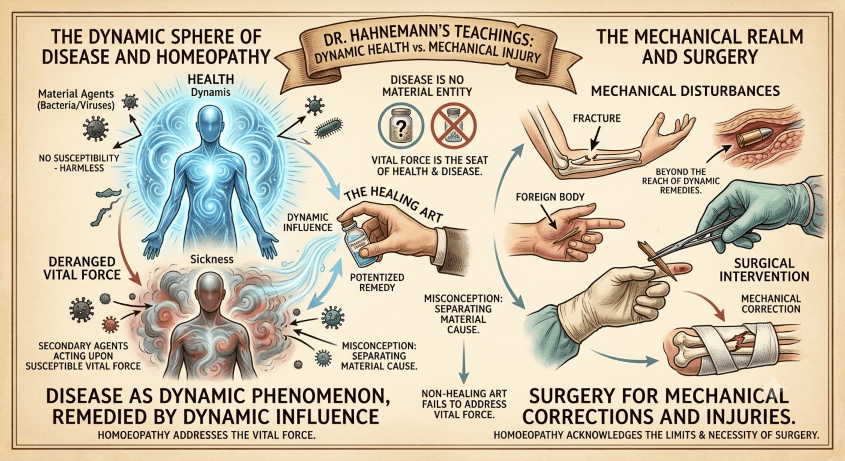
Surgery represents one of the most decisive acts in medical practice—an intervention that seeks immediate relief by removing or altering diseased tissue. Yet, within the philosophy of homoeopathy, surgery is not regarded as a primary mode of cure but rather as a necessary measure when the natural laws of healing cannot be invoked. Homoeopathy emphasizes restoration through the vital force, aiming to correct internal imbalance rather than mechanically excising its manifestations. The scope of surgery in homoeopathy lies in emergencies, irreparable structural damage, or conditions where mechanical obstruction threatens life. Its limitations, however, are evident when surgery is employed as a substitute for true cure, ignoring the deeper dynamic disturbance that gave rise to pathology. Thus, surgery may save life or prevent immediate danger, but it cannot address the underlying susceptibility that homoeopathy seeks to harmonize. In this way, surgery and homoeopathy are not adversaries but complementary disciplines. Surgery provides mechanical aid where necessary, while homoeopathy ensures the restoration of health by addressing the vital force. The ethical challenge lies in discerning when surgical intervention is indispensable and when reliance on the body’s healing potential, guided by homoeopathic remedies, is sufficient.

HHomeoEra Journal Editorial Team
4m253
Aphorism - 13, limitation of medicine and scope for surgery in Homoeopathy.
Organon & Philosophy

Aphorism - 13, limitation of medicine and scope for surgery in Homoeopathy.

Disease is not a material thing lodged in the body but a dynamic disturbance of the vital force, the invisible principle that sustains life. When this vital force is in harmony, health prevails; when disturbed, it manifests as altered sensations and functions that we call disease. Thus, disease is not a foreign substance but an immaterial imbalance, and cure lies in restoring the vital force to its natural equilibrium.

HHomeoEra Journal Editorial Team
2m150

Comments (0)

Sign in or sign up to join the discussion

No comments yet. Be the first to share your thoughts!

Newsletter

Stay Updated with Latest Research

Get weekly digests of new articles, case studies, and homeopathic insights delivered to your inbox

By subscribing, you agree to our Privacy Policy. Unsubscribe anytime.