Totality of the symptoms, a mysterious term, difficult to understand, and moreover difficult to apply in practice. What is totality of the symptom, actually? this question is still unresolved. Though many stalwarts of homeopathy have offered their interpretations, none has yet provided a view that is universally accepted, steady, and fully comprehensible. One truth I wish to emphasize is that merely "assembling a group of symptoms collected from the patient, through head‑to‑foot investigation, does not constitute the totality of symptoms."
In order to resolve this mystery, many homeopathic physicians have made earnest efforts and offered their views on this subject. the theory of the evolution and classification of the symptoms is the very first effort the achieve the goal for exclusion of the totality of the symptoms.
Boenninghausen view: According to Boenninghausen, “the totality of symptoms is simply the complete picture of the disease.” To evaluate this totality, he introduced the theory of complete symptoms. It is therefore the physician’s duty, during case‑taking, to search for symptoms in their complete form. In principle, Boenninghausen described seven points necessary for a symptom to be truly complete; however, achieving completeness on all seven points is nearly impossible in practice. In such circumstances, the physician must ensure at least four essential bases are covered: Location, Sensation, Modality, and Concomitant. These four elements form the ‘four legs of a chair,’ upon which the case can safely rest. While this framework appears simple, its practical application is not easy. Physicians often find that completing symptoms is difficult, particularly because concomitants are frequently absent. To address this limitation in the theory of complete symptoms, Dr. Boenninghausen introduced the Doctrine of Analogy. Thus, the doctrine does not represent a special innovation in itself, but rather a compensatory measure to overcome the inherent drawback of the complete‑symptom approach.
Dr. Hahnemann's view: Dr. Hahnemann clearly expressed his view regarding the selection of medicine on the basis of the totality of symptoms in Aphorism 153. Here he states that the most peculiar, striking, and characteristic symptoms of the case are the ones that must chiefly be kept in view when choosing the remedy. These characteristic features, rather than vague or general complaints, form the true foundation for accurate prescription. so According to Dr. Hahnemann S.R.P. symptoms are, that form the totality of symptoms. Actually, the totality of symptoms word misguides us, right word should be use, Volumetric-Geometry of the disease. because disease poses all three dimensions length, width and hight.
A very logical question arises here, Are Boenninghausen’s concept of complete symptoms and Dr. Hahnemann’s concept of SRP (strange, rare, peculiar) symptoms two distinct approaches that exclude the totality of symptoms? or is the SRP implicitly embedded within the theory of complete symptoms?
The correct understanding is the latter. Dr. Hahnemann’s SRP symptoms are indeed present within Boenninghausen’s theory of complete symptoms, though not always visible at first glance. They exist in the structure just as:
1. Butter is hidden within milk, awaiting extraction,
2. or as value is concealed within a mathematical formula, only revealed when the equation is solved.
In the same way, SRPs are not separate from the complete symptom framework; rather, they are latent gems that emerge when the physician carefully analyzes the symptom in its four essential dimensions—location, sensation, modality, and concomitants. The SRP shines forth as the peculiar essence of the case, but it is inseparably woven into the completeness of the symptom.
Thus, the theory of complete symptoms and the concept of SRP (strange, rare, peculiar) symptoms are not two separate or contradictory approaches. Rather, they represent different expressions of the same principle in relation to the totality of symptoms. The SRP is not external to Boenninghausen’s framework; it is inherently embedded within the completeness of the symptom.
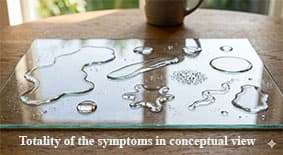
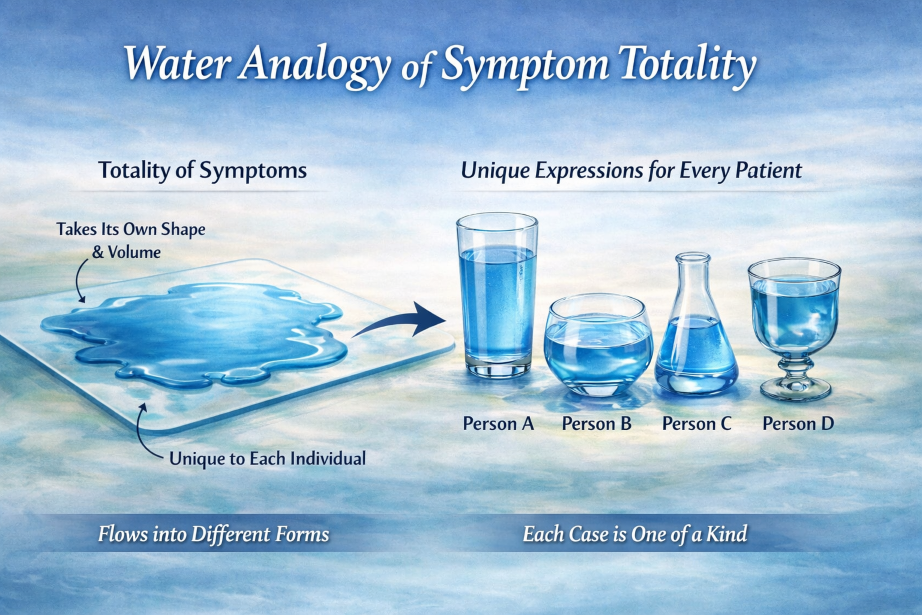
If I were allowed to express my view regarding the totality of symptoms, I would illustrate it through a water analogy theory. In this theory:
* The container (vessel)
represents the material body.
* The water inside
symbolizes the vital force.
* Pouring water onto
a glass surface
is like the dynamic cause, which gives vibration to vitality.
*As water spreads
across the surface, it always assumes different shapes and volumes—just as disease
manifests uniquely in each individual. This analogy clearly illustrates the
concept of individualization
and the essence of SRP
(strange, rare, peculiar) symptoms.
Here, the water spreading across the glass surface is always single in origin, yet peculiar in shape and individualized (rare) in manner. In the same way, each patient’s symptom-picture arises from one vital disturbance but expresses itself in a distinctive, uncommon form that defines the true individuality of the case. Another very important question arises here: What should be our case‑taking format?
The answer rests upon a philosophical foundation. Indeed, the blank paper remains the best format for case taking. because it allows fluidity without restrictions. (Leading question) Thus, disease may be conceived as a kind of volumetric geometry—it always assumes the shape of its container. When case taking is forced into a predetermined format, the disease is given an artificial shape, and its true nature remains concealed. that's why Dr. Hahnemann instruct us do not ask leading question during case taking.
Disease does not arise in fragments but as the impact of a single, striking subversive force. This results in one fundamental derangement of the spiritual vital force. Therefore, at any given time, a single remedy is required to restore balance and effect a cure. that's why we need only single remedy to cure our patient at a time. of, course two or more dissimilar disease can exist in single organism, but it must be different in origin by time. in that condition we have need to use medicine in series. This type of diseases is better term as complex disease Bry Dr. Hahnemann in Organon of medicine.
1. James Tyler Kent: Removal of the totality = removal of the cause. Stressed that mental generals (will, emotions, memory) are the highest priority. Totality is not a jumble but an organized whole reflecting vital force disturbance.
2. Constantine Hering: Saw totality as the unique portrait of disease, guiding the simillimum. Linked it to the “direction of cure” (from above downward, within outward). Emphasized individualization and the dynamic disturbance of vital force.
3. P. P. Wells: Totality is not the sum of symptoms but the depth and meaning of each symptom. Qualitative evaluation over quantitative listing.
4. Richard Hughes: Declared that for the homeopathic physician, the totality itself is the disease. Totality is the disease portrait, not pathology alone.
5. Stuart Close: Defined totality as all symptoms logically combined into a harmonious whole. Coherence and individuality of the case.
6. H. A. Roberts: Saw totality as a concrete, individualized form recognizable by those familiar with drug pictures. Practical recognition of disease-remedy correspondence.
7. William Boericke: The more complete the totality, the better the prescription. Completeness ensures accuracy in remedy choice.
8. Dr. Johan Henry Allen: Totality of the symptoms entirely form by the symptoms of Miasmatic Origin, rest of the symptoms forming foam like a top of sea water and creating confusion only, for the selection of medicine.
It may thus be concluded that the totality of symptoms constitutes the true portrait of the disease. At present, this remains entirely a matter of perception, for we possess no medical instrument capable of measuring the deranged vital force or calculating it in any definable unit.
The physician’s insight alone bridges this gap, discerning the dynamic disturbance through the constellation of symptoms, which serve as the only accessible reflection of the inner essence of disease.