Is Homoeopathy really a placebo?
To measure gold in milligrams, you need a very sensitive
scale. If you try to weigh it on an ordinary scale and see no change, that
doesn’t mean the gold does not exist. It only means the tool you are using is
not fine enough to detect it. In the same way, when science cannot measure the
effects of homoeopathy with its usual instruments, it does not mean the
medicine has no effect—it simply works on a level that those tools cannot
reach.
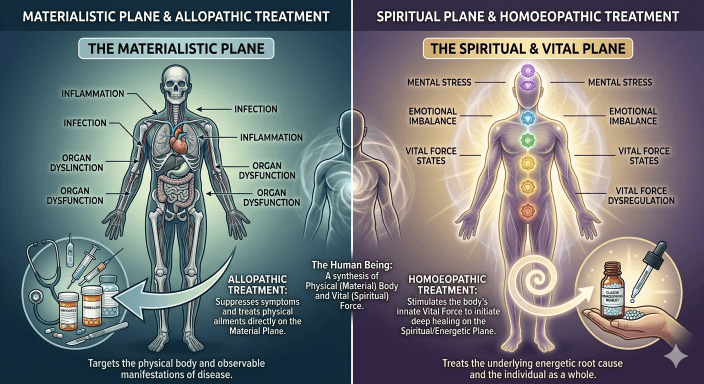
The main reason homoeopathic medicine is often called a
placebo is that it works on a different level than conventional medicine.
Conventional medicine acts on the physical or material plane—organs, tissues,
and chemistry. Homoeopathy, on the other hand, works on the meta‑physical or
spiritual plane, influencing the vital force and energy patterns. Because these
two planes are different, they require different scales of measurement. When
the wrong scale is used, homoeopathy becomes invisible to conventional
science.
Claims against Homoeopathy:
1. Placebo Effect Argument
* Claims: Critics say
homoeopathic remedies work only because of patient belief, not because of any
active medicinal property.
2. Absence of Molecules
* Claims: Higher
potencies are diluted beyond Avogadro’s limit, leaving no detectable molecules
of the original substance.
3. Lack of Scientific Evidence
* Claims: Many clinical
trials fail to show results beyond placebo, leading to skepticism in mainstream
medicine.
4. Unclear Mechanism of Action
* Claims: Conventional science cannot explain how remedies without molecules could influence health.
5. Regulatory Concerns
* Claims: Some health authorities argue that
homoeopathy should not be promoted as medicine without stronger evidence.
Comprehensive Anwers against Claims:
The most common claim against homoeopathic medicine is the
“absence of molecules” in its preparations. This objection can be rejected by
understanding that regaining health from disease is a transformation, and every
transformation requires work. No work can be accomplished without energy.
Therefore, cure depends on energy, not on molecules. The fact that highly
diluted homoeopathic medicines contain no detectable molecules does not mean
they are ineffective—it simply means their action is energetic rather than
material.
(Or, we can say)
“Healing is a transformation, and every transformation
requires energy. Just because highly diluted homoeopathic medicines contain no
detectable molecules does not mean they lack power. Cure depends on energy, not
matter—and energy cannot be measured by the same scale as molecules.”
If homoeopathic medicine works just because of patient
belief, then I would like to ask: why do we need medicine or any medical system
at all? Just improve the patient’s mental status, give him a placebo, and he
will be cured. Why, then, are you still using the newest antibiotics if
patients can be cured merely on the basis of belief?
Conventional medicine treats the physical or material body,
so it operates on a different ground. Homoeopathy deals with the spiritual
body, which animates the material body; without spiritual energy, the material
body has no power of animation and is therefore considered dead. We can measure
the weight of any material with a physical balance, but can you measure energy
with the same tool? The logical answer is no. The same principle applies to the
physical and metaphysical bodies: both require different tools. Clinical trials
fail because you are using the wrong tool. You are trying to search for
molecules in homoeopathic medicine, but homoeopathic medicine is simply a power
(potency), and Dr. Hahnemann was aware of this truth from the very beginning.
Note: One very important thing must be
remembered by every human being: the human mind has limits, but God’s creation
is limitless.