
An Overview:
By 2026, India has approximately 40,000 registered homoeopaths and 291 recognized homoeopathic institutions in operation. Yet only a limited number of practitioners are truly capable of practicing Classical Homoeopathy. This shortfall arises primarily from the complexity of understanding the cardinal principles of homoeopathy and the insufficient grasp of Hahnemann’s Organon of Medicine.
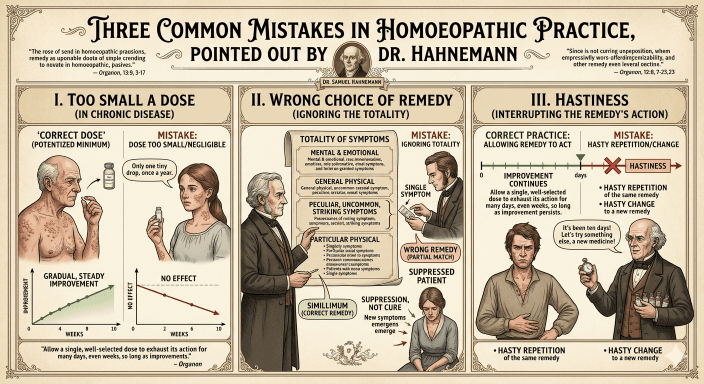
Dr. Hahnemann observed that homoeopathic physicians often fall into three common mistakes which lead to failure in practice. It must be noted, however, that there is no single chapter or section in his writings where these errors are discussed collectively. Instead, they are scattered across the Organon of Medicine and The Chronic Diseases, appearing in different contexts. Later commentators and teachers of homoeopathy synthesized these scattered instructions into the well-known triad of errors.
These most common three errors that are discussed by Dr. Johan henry Allen in his famous work Chronic miasms, Pg. N0 34.
1.Selection of improper remedy – prescribing without a full grasp of the totality of symptoms.
2. Improper Dose and Potency – neglecting the principle of the minimum dose, either by over-dosing or misjudging potency.
3. Not letting the remedy act sufficient length of time – failing to wait for the remedy’s action, and hastily changing prescriptions before the vital force has responded.
1. Improper selection of medicine:
Explanation: (Improper selection of medicine)
Symptoms, when taken in isolation, often fail to furnish the true picture of the disease. This may sound unacceptable, but it is indeed true. The physician must recognize that the apparent symptoms do not always represent the underlying dynamic disturbance. I present two evidence in support of this statement—one from Hahnemann and another from Kent:
A. From Hahnemann side:
1. In this concern, Aphorism 7 is particularly noteworthy.
Aphorism 7
" Now, as in a disease, from which no manifest exciting or maintaining cause (Causa occasionalis) has to be removed we can perceive nothing but the morbid symptoms, it must be the symptoms alone by which the disease demands and points to the remedy suited to relieve it - and moreover, the totality of these its symptoms, of this outwardly reflected picture of the internal essence of the disease, that is of the affection of the vital force, must be the principal, or the sole means, whereby the disease can make known that remedy it requires - the only thing that can determine the choice of the most appropriate remedy - and thus in a word, the totality of the symptoms must be the principal, indeed the only thing the physician has to take note of in every case of disease and to remove by means of his art, in order that the disease shall be cured and transformed into health."
Illustration of Aphorism 7: A thorough reading of Aphorism 7 creates in the reader’s mind the understanding that symptoms are the mirror image of the deflection of the vital force under the influence of dynamic disease, which Dr. Hahnemann termed the internal essence. Thus, symptoms alone do not furnish the true picture of the disease. That is why, on many occasions, we select a medicine based on symptom-similarity, yet the remedy fails to act—even though all the symptoms appear to match.
In counterpart, there are also many cases experienced by the busy physician where not a single symptom seems to agree with the selected medicine, and yet the remedy acts wonderfully. This paradox highlights the deeper dynamic nature of disease and cure, reminding us that the physician must look beyond superficial symptom-matching to grasp the true essence of the case.
B. From Dr. Kent side:
Lecture on Homoeopathic Philosophy
1. Lecture 32 & 33: “The Value of Symptoms” Kent explains that while symptoms are the physician’s only observable data, mere symptom totals are inadequate. He stresses that symptoms must be interpreted in light of the patient’s individuality and the dynamic disturbance of the vital force.
2. Lecture 23–26: “The Examination of the Patient” Kent warns that superficial symptom collection leads to failure. He insists that the physician must perceive the inner state of the patient, not just a catalogue of complaints.
From the above discussion, it becomes evident that symptomatology alone cannot serve as the true basis for remedy selection. For a successful prescription, the physician must possess a deep power of perception—as emphasized by Hahnemann in Aphorism 3.
Too often, physicians rely merely on symptoms, and worse, on indistinct or nonsensical symptoms, which inevitably leads to improper remedy selection and, consequently, failure in prescription. The art of healing demands that the physician looks beyond superficial symptom-matching, toward the dynamic essence of disease, if the prescription is to be truly curative.
2. Minimum dose: improper selection of dose.
3. Chronic condition, Vital organs do not involve: Prescribe higher potency like in skin disease, but single dose is the rule.
You can use in series of potency, from 30 to CM or higher, when you found Similimum, all potency does definitely work. if remedy is only partially similar, it will act in only and or two potencies: then the symptoms will change and a new remedy will be demanded.
Dose repetition:
Classical way: In the introduction to the Systematic Alphabetical Repertory of Homoeopathic Remedies, Dr. Hahnemann writes: “The homoeopathic physician should generally let the carefully selected remedy act upon the patient in a single dose at a time and allow it to exhaust its action.”
This statement is unequivocal: the physician must administer only a single dose of the indicated remedy, in the appropriate potency, and refrain from repetition until the action of the first dose has been fully exhausted. Any premature repetition—whether of the same medicine or of another—risks disturbing or even spoiling the curative action already set in motion. Thus, undue interference undermines the very principle of the minimum dose and obstructs the natural course of cure.
In certain acute and serious illnesses, repetition of the dose becomes necessary to adequately stimulate the vital force. In such cases, remedies in lower potencies—commonly the 30th—may require frequent repetition. There are also acute states with marked pathological involvement, such as encephalitis or cerebral dropsy, where even higher potencies, like the 200th, may demand repetition.
Yet, the question of repetition is not governed by rigid rules; it rests entirely upon the physician’s judgment and skill. No clear-cut guideline exists. To prescribe repetition mechanically—such as administering the 30th daily, the 200th weekly, or the 1M monthly—is nothing but a fallacy. Such routine schedules disregard the individuality of the patient, the nature of the disease, and the dynamic action of the remedy. True homoeopathic practice demands discernment, not dogma, in the matter of dose repetition.