
Medical Blog Articles
Explore evidence-based homeopathic insights and articles from our expert practitioners
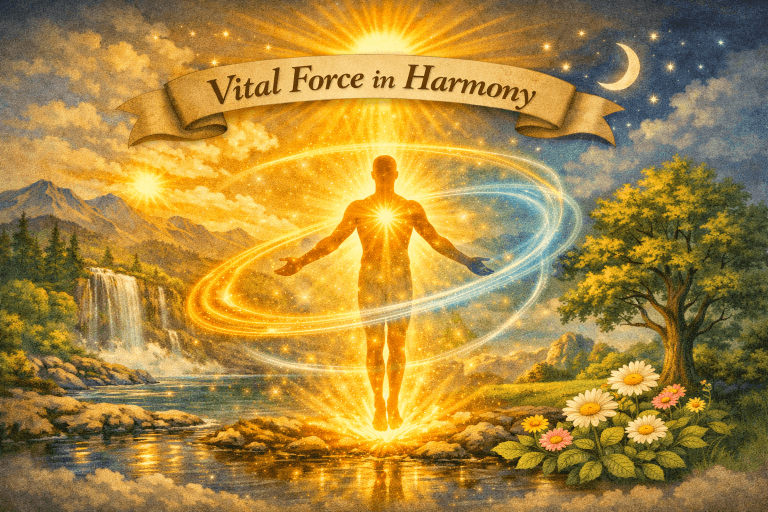
Aphorism - 10, " Without vital force the Organism must be consider as dead"
The vital force, when healthy, rules with unbounded sway and keeps all parts of the organism in harmony. As long as this force is undisturbed, the body performs its functions freely and maintains life. But when this vital force is deranged by disease, the harmony is lost, and the body shows signs and symptoms of disorder.
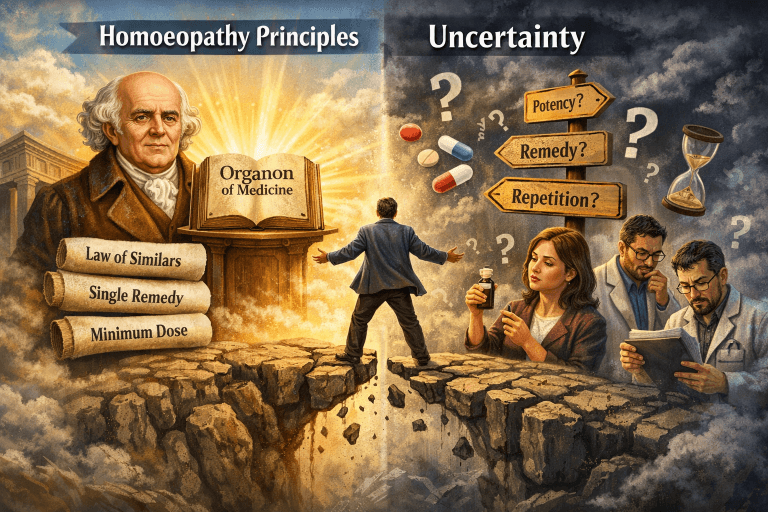
Navigating the Shadows of Certainty: Exploring Uncertainty in Homoeopathy
Undoubtedly, the practice of allopathy during the time of Dr. Hahnemann was quite different from the present era. Procedures such as drug proving had not yet been conceived, and medicine was largely clinical and experience based. In such circumstances, Dr. Hahnemann developed and established a system of treatment firmly founded upon principles now recognized as the cardinal laws of Homoeopathy. Within this system, assumption was eradicated; everything was fixed, precise, and guided by rule. Yet, followers of this great system, instituted by our master, often appear confused. They encounter uncertainty at every step—whether in the selection of medicine, the choice of potency, the repetition of doses, or the application of complementary and chronic remedies. Even today, many practitioners continue to struggle with the practical application of these principles. The pressing question, therefore, is: Why are the followers of Hahnemann so confused, despite Homoeopathy being founded upon strict principles and fully guided by the Organon of Medicine? The answer lies not in the principles themselves, but in the imperfect understanding and inconsistent application of those principles. The Organon provides clarity, yet practitioners frequently misinterpret its guidance, neglect its depth, or fail to adapt it to the complexities of modern cases. Thus, uncertainty is not inherent in Homoeopathy—it is born of human limitation in grasping and applying its laws. That is why all followers of Dr. Hahnemann are not of the same mind, even though simple guidance lies before them.
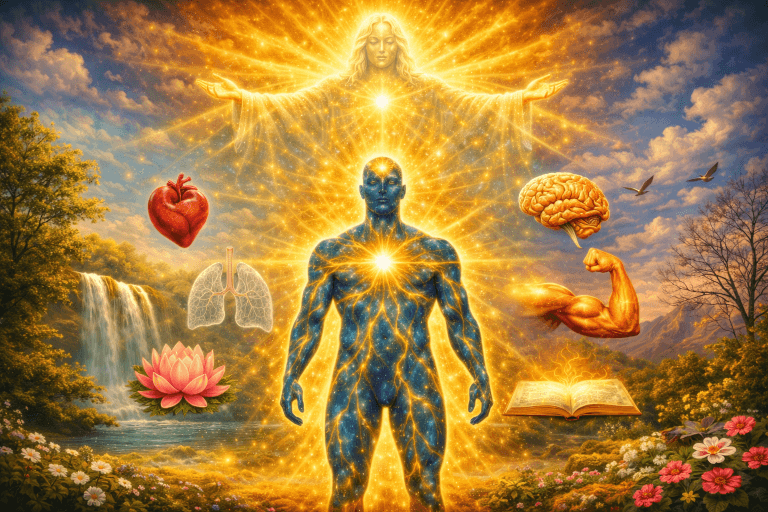
Aphorism - 9, " Vital force determines the quality of life:
Everything in the world is composed of two fundamental elements: matter and energy. Matter organizes physical structures and preserves integrity, while energy imparts vibration and motion, animating material parts. The same principle applies to the biological device we call the human body. The Vital Force, spiritual in origin and dynamic in nature, animates the material body in its state of health. Aphorism 9 is wholly concerned with the role of this force in both health and disease. When the vital force—autocratic, dynamic, and spiritual—remains in harmony, it governs with unbounded sway and produces pleasurable sensations. Conversely, when deranged, it manifests as abnormal sensations and disordered functions, which we recognize as disease. The vital force inherently strives to maintain harmony, for only in such balance can we use our body—this precious, divinely gifted instrument—for the higher purposes of our existence.
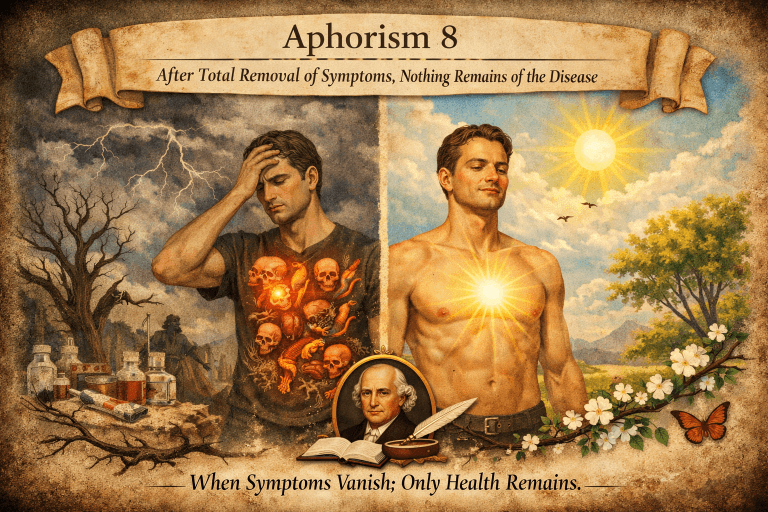
Aphorism - 8: Cure Defined by the Total Extinction of Symptoms.
It is well worthy to understand the concept of symptomatology entirely in its true essence by reading Aphorisms 7 and 8 collectively. In Aphorism 7, Dr. Hahnemann says that "symptoms do not furnish the true picture of the disease"; they are only the outward reflection of the internal essence of the disease. But in Aphorism 8, he says, "after removal of the total perceptible signs and symptoms of the patient, nothing remains in the patient that we can call disease." It seems to contradict the statement of Dr. Hahnemann given in the previous aphorism, but actually it does not. Dr. Hahnemann simply wanted to say that, since we have no means to understand the internal deflection of the vital force in the interior of man, we must rely totally on the symptoms produced by the vital force in response to the derangement that occurs in our spiritual vital force. Hence, it should be considered that the removal of the symptoms in toto is the removal of disease, and this must be termed as cure. Prescription on the basis of symptomatology is not our choice, but we are compelled to prescribe our medicine on symptomatology
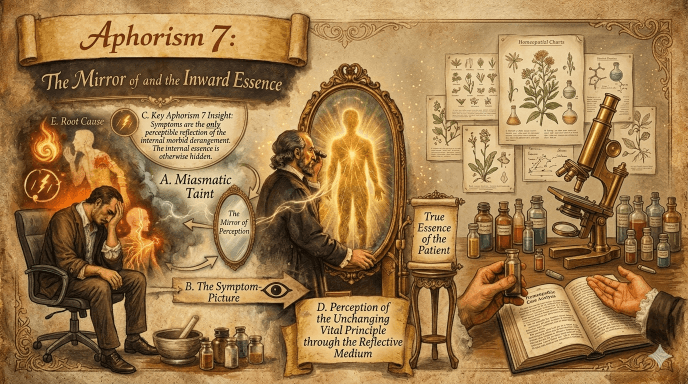
Aphorism - 7, "Symptoms as the mirror of Disease’s Dynamic essence."
The only way a physician can truly know a disease is through the careful collection of all its symptoms. These symptoms, however, are not the disease itself; rather, they are the outward reflections of the inner disturbance of the vital force. Since the dynamic essence of disease cannot be observed or measured directly, the physician must rely upon the complete constellation of symptoms to guide the choice of remedy. Yet, symptomatology alone does not furnish the true portrait of the disease. Success in treatment depends not merely on assembling symptoms, but on the physician’s power of perception—the ability to discern what lies behind the outward signs, to penetrate beyond superficial similarity, and to grasp the dynamic essence that constitutes the real totality of the patient’s condition. This aphorism clarifies, why physician need power of perception.
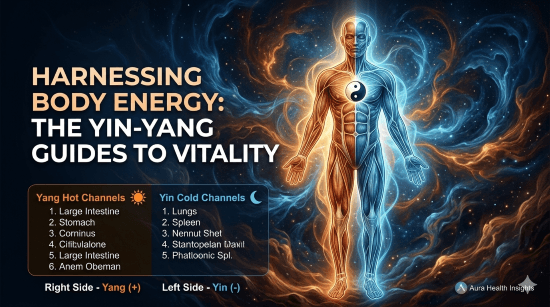
Side affinity of Homoeopathic Medicine: an explanatory note.
The vital force manifests itself in diverse ways, shaping the organism’s responses to health and disease. One of its remarkable expressions is side affinity—the tendency of certain remedies to act predominantly on one side of the body. Some medicines exert their influence chiefly on the right side, while others demonstrate a marked preference for the left. A select group of remedies reveals an even more distinctive pattern: they alternate their action, sometimes affecting the left, at other times the right, but never both sides simultaneously. This alternating affinity reflects the dynamic and intelligent nature of the vital force, which governs the organism with precision and balance. Lac caninum stands as the classical example of such alternating side action, illustrating how the vital force channels its energy in a polarized yet orderly manner. Thus, side affinity is not merely a clinical observation but a profound indication of the vital force’s role as the operative principle of life—directing, regulating, and expressing itself through lateral tendencies that guide the homoeopathic physician in remedy selection.
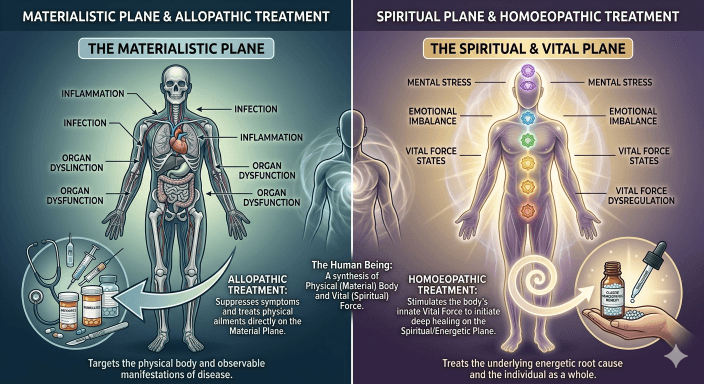
Beyond the Placebo: A Deeper Dive into Homoeopathy
The debate around homoeopathy and the placebo effect has long been a point of contention in modern science. Conventional medicine, grounded in material analysis, often dismisses homoeopathic remedies as inert because they contain no measurable molecules. Yet, clinical experience spanning decades reveals that homoeopathy operates on a different plane—one that transcends the physical body. It does not act upon organs, tissues, or biochemical pathways, but rather upon the vital force, the subtle energy pattern that animates life. Allopathy treats the material body, seeking to correct pathology through measurable interventions. Homoeopathy, by contrast, seeks to restore harmony in the patient’s spiritual essence, arranging energy patterns that manifest as health. This divergence explains why the scientific community frequently labels homoeopathy as placebo: its effects are invisible to molecular science, but profoundly evident in lived experience. To practitioners and patients alike, homoeopathy is not a myth but a dynamic healing art, addressing the human being as a whole—body, mind, and spirit.
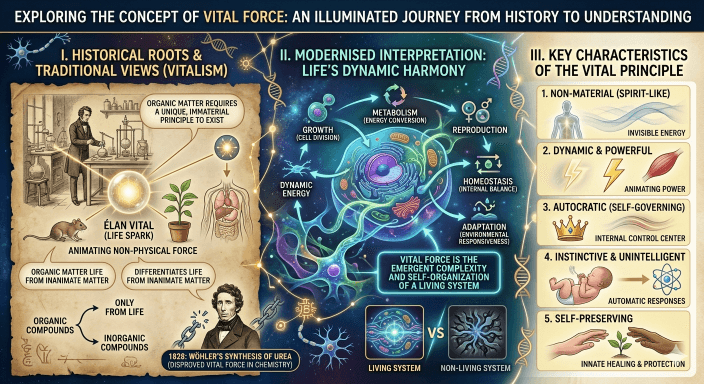
Vital force: The invisible Architect of Health and its various Operation.
The Vital Force is the fundamental operative principle within the body of a living organism. It flows through various energy channels and performs essential vital operations. It is classified into two types: Yin (Negative) and Yang (Positive). When these remain in balanced form across the left and right halves of the body, the state is termed health. When the flow is disturbed, the Vital Force becomes deranged. Dr. Samuel Hahnemann described this deranged condition of the Vital Force as disease. The Vital Force is dynamic in nature, more unstable than the material body, and thus capable of producing disease. It is both autocratic and automatic. In health, it harmonizes the organism; in disease, it generates morbid sensations. Transformation from disease back into health can occur only through the Vital Force. Hence, the Vital Force is solely responsible for the restoration of health, while the material body possesses no such power.
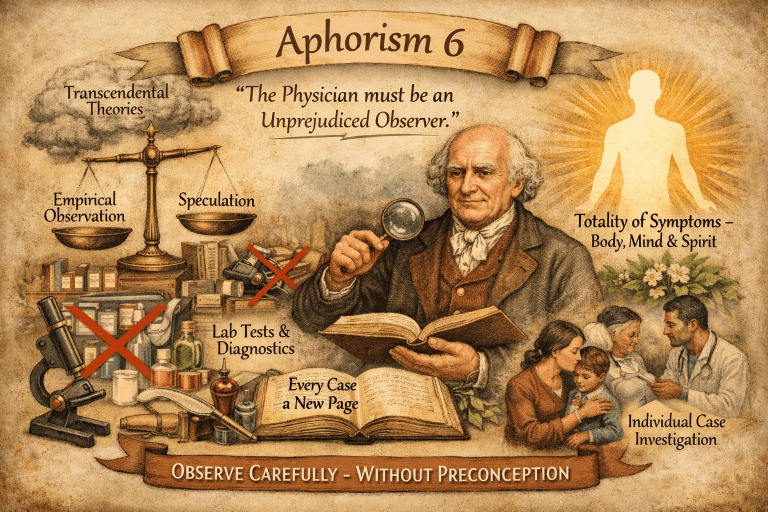
Aphorism - 6, "A physician must be unprejudiced observer" (Every sick maintain individuality)
In Aphorism 6 of the Organon of Medicine, Dr. Samuel Hahnemann defines the essential character of the true physician — the unprejudiced observer. He instructs that the physician must approach every case as entirely new, free from preconceived notions or reliance on past experiences. Observation, not speculation, is the foundation of true healing. This Aphorism illuminates the futility of transcendental theories and emphasizes the principle of individuality. The physician’s duty is to perceive and record every deviation from health — whether of body, mind, or spirit — through signs and symptoms that are perceptible, observable, and felt. These manifestations form the totality of symptoms, the only reliable portrait of disease in its full extent. Thus, Hahnemann’s teaching in Aphorism 6 transcends mere technique; it is a moral and intellectual discipline. It calls upon the physician to cultivate purity of perception, humility before nature, and fidelity to experience — the true spirit of homeopathic investigation.
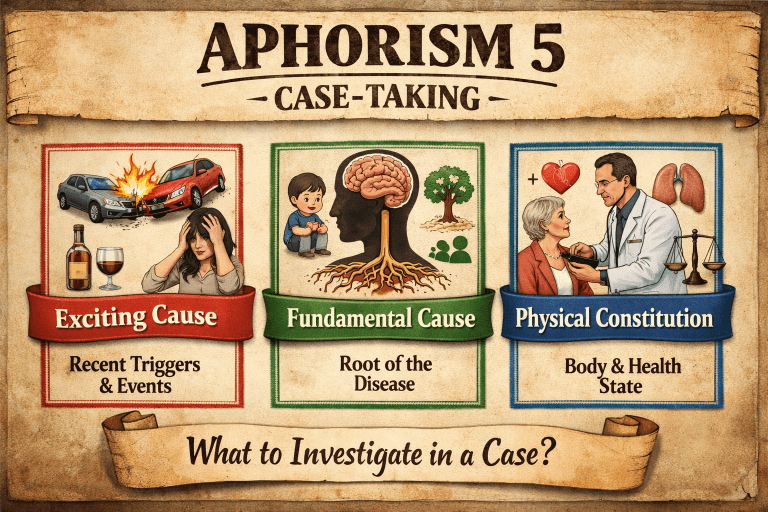
Aphorism - 5, "The Investigation of Causes: A Guide to Case Taking in Acute and Chronic Diseases"
In Aphorism 5, Hahnemann emphasizes that the physician must carefully investigate not only the present symptoms but also the possible exciting and maintaining causes of disease. He points out that in many cases, especially chronic ones, external factors such as lifestyle, habits, occupations, and environmental influences may perpetuate illness. He writes: “Useful to the physician in assisting him to cure are the particulars of the most probable exciting cause of the acute disease, as also the ascertainable occasion of the chronic malady.” Thus, Aphorism 5 serves as a guiding principle for case taking, reminding practitioners to look beyond the immediate symptom picture and to consider the broader causal context—whether acute triggers or chronic maintaining factors. actually, teaching on the case taking starting from aphorism 5.
Mother Tincture or Dynamic Medicine? A Philosophical Clarification
Homoeopathy is based on the idea of dynamics, where both illness and medicine are seen as living, active forces rather than just material things. The rule of similia similibus curentur “like cures like”—works only when remedies act through their dynamic power, not through raw substance. Yet, confusion often arises when mother tinctures are used as if they were the same as potentized medicines. A mother tincture still holds the crude drug in its material form, while a true homoeopathic remedy is freed from matter and turned into dynamic energy through potentization. To call the use of tinctures homoeopathy is to miss its real foundation. True homoeopathy is not about giving raw drugs, but about using their dynamic imprint to awaken the vital force. The line between crude and dynamic medicine is not small—it is the very mark that separates real homoeopathy from simple herbal practice.
Totality of Symptoms: From Mystery to Meaning.
The “totality of symptoms” remains a term shrouded in mystery—difficult to define and even more difficult to apply in practice. What, in fact, constitutes the totality of symptoms? The question is still unresolved. Though many stalwarts of homeopathy have offered their interpretations, none has yet provided a view that is universally accepted, consistent, and fully intelligible. One truth must be emphasized: merely assembling a group of symptoms collected from the patient through head‑to‑foot investigation does not constitute the true totality of symptoms. In order to resolve this enigma, many homeopathic physicians have made earnest efforts and contributed their perspectives. The theory of the evolution and classification of symptoms was the very first attempt to achieve clarity in defining the totality of symptoms.
Stay Updated with Latest Research
Get weekly digests of new articles, case studies, and homeopathic insights delivered to your inbox
By subscribing, you agree to our Privacy Policy. Unsubscribe anytime.