HomeoEra
Back to Blogs

Aphorism - 8: Cure Defined by the Total Extinction of Symptoms.

It is well worthy to understand the concept of symptomatology entirely in its true essence by reading Aphorisms 7 and 8 collectively. In Aphorism 7, Dr. Hahnemann says that "symptoms do not furnish the true picture of the disease"; they are only the outward reflection of the internal essence of the disease. But in Aphorism 8, he says, "after removal of the total perceptible signs and symptoms of the patient, nothing remains in the patient that we can call disease." It seems to contradict the statement of Dr. Hahnemann given in the previous aphorism, but actually it does not. Dr. Hahnemann simply wanted to say that, since we have no means to understand the internal deflection of the vital force in the interior of man, we must rely totally on the symptoms produced by the vital force in response to the derangement that occurs in our spiritual vital force. Hence, it should be considered that the removal of the symptoms in toto is the removal of disease, and this must be termed as cure. Prescription on the basis of symptomatology is not our choice, but we are compelled to prescribe our medicine on symptomatology

H

HomeoEra Journal Editorial Team

Updated 4 min read711 views
Aphorism - 8: Cure Defined by the Total Extinction of Symptoms.

Eradication of the symptoms in toto, should be considered cure.

Aphorism - 8:

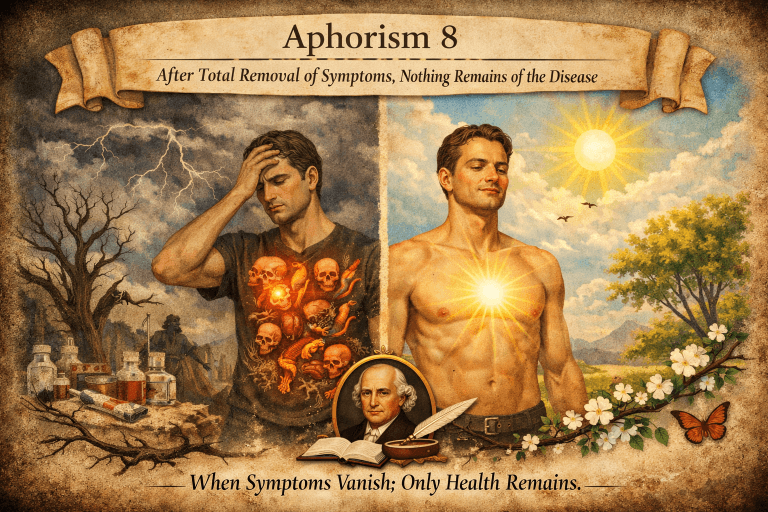
" It is not conceivable, nor can it be proved by any experience in the world, that, after removal of all the symptoms of the disease and of the entire collection of the perceptible phenomena, there should or could remain anything else besides health, or that the morbid alteration in the interior could remain uneradicated." 

Note: [When a patient has been cured of his disease by a true physician, in such a manner that no trace of the disease, no morbid symptom remains, and all the signs of health have permanently returned, how can anyone, without offering an insult to common sense, affirm in such an individual the whole bodily disease still remains in the interior? And yet the chief of the old school, Hufeland, asserts this in the following words. " Homoeopathy can remove the symptoms, but the disease remains." (Vide Homeopathy, p. 27, 1, 19.). This he maintains partly from mortification at the progress made by homoeopathy to the benefit of mankind, partly because he still holds thoroughly material notions respecting disease, which he is still unable to regard as a state of being of the organism wherein it is dynamically altered by the morbidly deranged vital force, as an altered state of health, but he views the disease as a something material, which after the cure is completed, may still remain lurking in some corner in the interior of the body, in order, some day during the most vigorous health, to burst forth at its pleasure with its material presence! so dreadful is still the blindness of the old pathology! No wonder that it could only produce a system of therapeutics which is solely occupied with scouring out the poor patient.] 

Explanatory note:

In Aphorism 7$, Dr. Hahnemann clearly says that symptoms are the outward reflection of the internal essence of the disease. Symptoms do not furnish the true portrait of the disease but only a mirror image. Now a very important question arises here: should we assume that if we, as homoeopathic physicians, are capable of removing the total objective and subjective signs and symptoms from the patient, we are also capable of eradicating the internal disease?

The same question was pointed out by the Hufeland Journal at the time of Dr. Hahnemann. According to the Hufeland Journal, “Homoeopathy is capable of removing the symptoms, but the disease remains.”

As an answer to this question, in Aphorism 8$ Dr. Hahnemann addressed the physician, stating that “no sensible person, who is average in intelligence, can think that after complete eradication of all perceptible signs and symptoms anything remains besides health.” It is insensible and unintelligible to claim that after removing all perceptible phenomena the disease still remains—except in cases where material changes in the tissues or parts of the body have lost their integrity and strength during a compromised cure. 

They made that claims just because of, they think in materialistic ways. But Homoeopathy works on dynamic plane. According to Dr. Hahnemann Hufeland journal made these claims by two reasons. 

1. Just because they are against humanity - and Homoeopathy works for mankind. 

2. The other reason is that they are still thinking in materialistic way, and they think " still after eradication of all perceptible sign and symptoms there is something hidden in the interior of Organism"   

For that reason, in support of his so‑called materialistic concept, they developed a pathology system, continuously carrying out head‑to‑foot investigations, given various names like CT scan, MRI, blood, urine, stool, and many other investigations in order to find out the hidden material cause of disease, which actually does not exist.

But it works as a looting system for a poor patient.
Word meaning and explanation:

Lurking: hidden or canceled

Note: if readers want to know the meaning of any word, or feel difficulty to understand any parts of the Aphorism, please feel free to ask the question by ADMIN. You can directly write to us. by using form given below.  
Have a Question?
Ask HomeoEra Journal Editorial Team about "Aphorism - 8: Cure Defined by the Total Extinction of Symptoms." and get a personalized response directly to your email.

0/500 characters

0 characters (minimum 10 required)

🔒 Privacy Notice: Your information will only be used to respond to your query and won't be shared with third parties.

Aphorism - 14, Health as Harmony: Absence of Morbid Signs and Need for Cure.
Organon & Philosophy

Aphorism - 14, Health as Harmony: Absence of Morbid Signs and Need for Cure.

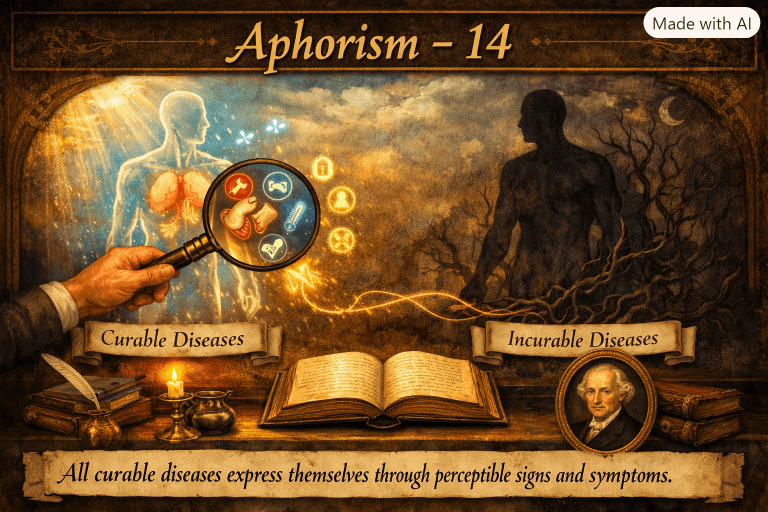
In this aphorism, Dr. Samuel Hahnemann elucidates a fundamental law of observation in medicine: that every curable disorder within the human organism necessarily reveals itself through perceptible signs and symptoms. Nothing curable remains hidden from the discerning physician, for the divine order has ordained that disease must express its presence outwardly to invite cure. Thus, the physician’s art depends entirely upon the faithful interpretation of these manifestations. The morbid phenomena are not mere disturbances but the visible language of Nature, guiding the healer toward restoration. Those affections that grow silently within, without perceptible symptoms, belong to the realm of the incurable; for where no sign is given, no curative response can be awakened. In essence, Hahnemann reminds us that symptoms are the thread of cure—the only bridge between the inner disorder and the physician’s understanding. To grasp that thread is to hold the possibility of healing; to lose it is to stand before disease without remedy.

HHomeoEra Journal Editorial Team
3m292
Doctrine of Homoeopathy: From Vitalism to Healing
Organon & Philosophy

Doctrine of Homoeopathy: From Vitalism to Healing

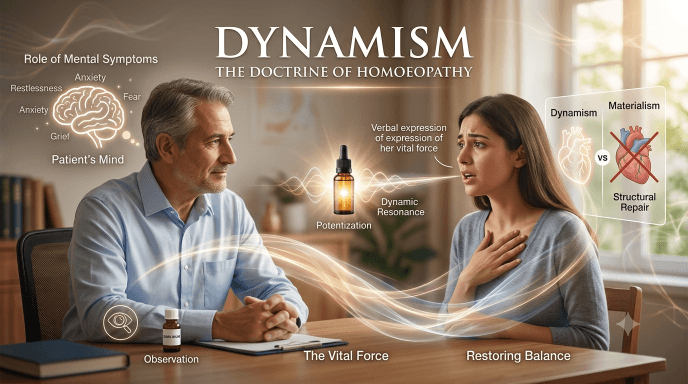
The doctrine of Homoeopathy is inseparably bound with the principle of dynamism. It does not aim at repairing the material body in isolation, but rather seeks to restore the vital force—the dynamic essence that animates life. Disease, in this philosophy, is not merely a structural defect or chemical imbalance; it is a disturbance on the dynamic plane, a disharmony of the spirit‑like energy that governs sensation and function. Homoeopathic medicine, therefore, is not material in its curative action. Prepared through potentization, it transcends crude substance and becomes a dynamic remedy, capable of resonating with the disturbed vital force. Cure is achieved not by suppressing symptoms or altering tissues directly, but by stimulating the inner harmony, allowing the body to reorganize itself from within outward. Thus, the true aim of Homoeopathy is not to treat the corporeal frame, but to re‑establish balance in the living dynamis, from which health naturally flows into the material body.

HHomeoEra Journal Editorial Team
7m324
Surgical Intervention in Homoeopathy: Necessity, Limits, and Integration
Organon & Philosophy

Surgical Intervention in Homoeopathy: Necessity, Limits, and Integration

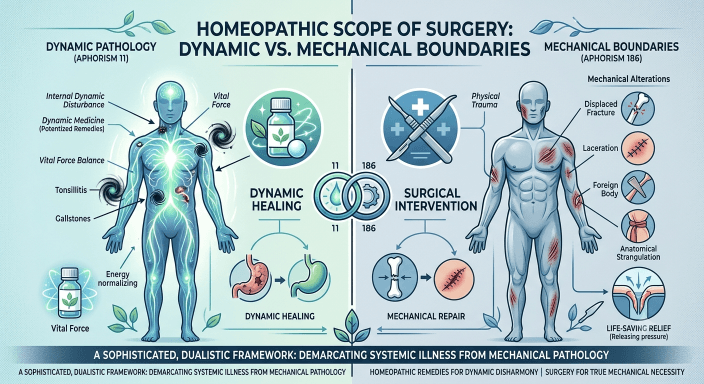
Surgery represents one of the most decisive acts in medical practice—an intervention that seeks immediate relief by removing or altering diseased tissue. Yet, within the philosophy of homoeopathy, surgery is not regarded as a primary mode of cure but rather as a necessary measure when the natural laws of healing cannot be invoked. Homoeopathy emphasizes restoration through the vital force, aiming to correct internal imbalance rather than mechanically excising its manifestations. The scope of surgery in homoeopathy lies in emergencies, irreparable structural damage, or conditions where mechanical obstruction threatens life. Its limitations, however, are evident when surgery is employed as a substitute for true cure, ignoring the deeper dynamic disturbance that gave rise to pathology. Thus, surgery may save life or prevent immediate danger, but it cannot address the underlying susceptibility that homoeopathy seeks to harmonize. In this way, surgery and homoeopathy are not adversaries but complementary disciplines. Surgery provides mechanical aid where necessary, while homoeopathy ensures the restoration of health by addressing the vital force. The ethical challenge lies in discerning when surgical intervention is indispensable and when reliance on the body’s healing potential, guided by homoeopathic remedies, is sufficient.

HHomeoEra Journal Editorial Team
4m253
Aphorism - 13, limitation of medicine and scope for surgery in Homoeopathy.
Organon & Philosophy

Aphorism - 13, limitation of medicine and scope for surgery in Homoeopathy.

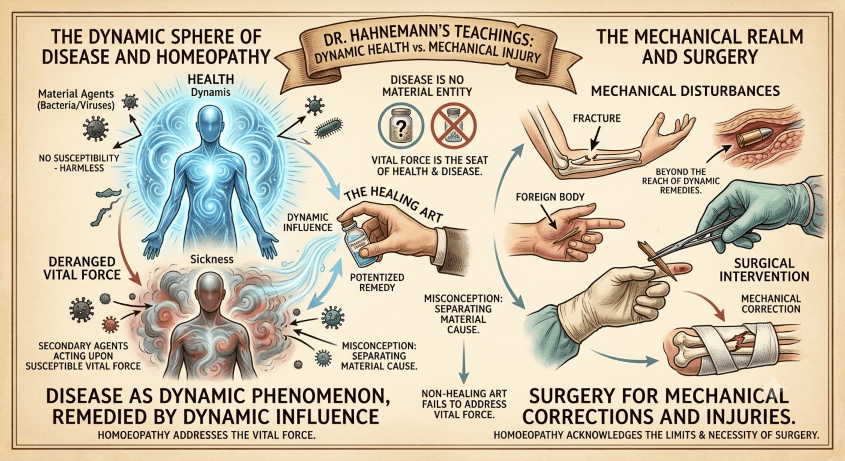
Disease is not a material thing lodged in the body but a dynamic disturbance of the vital force, the invisible principle that sustains life. When this vital force is in harmony, health prevails; when disturbed, it manifests as altered sensations and functions that we call disease. Thus, disease is not a foreign substance but an immaterial imbalance, and cure lies in restoring the vital force to its natural equilibrium.

HHomeoEra Journal Editorial Team
2m150

Comments (0)

Sign in or sign up to join the discussion

No comments yet. Be the first to share your thoughts!

Newsletter

Stay Updated with Latest Research

Get weekly digests of new articles, case studies, and homeopathic insights delivered to your inbox

By subscribing, you agree to our Privacy Policy. Unsubscribe anytime.