Fever: An Expression of vital force and Dynamic Resonance.
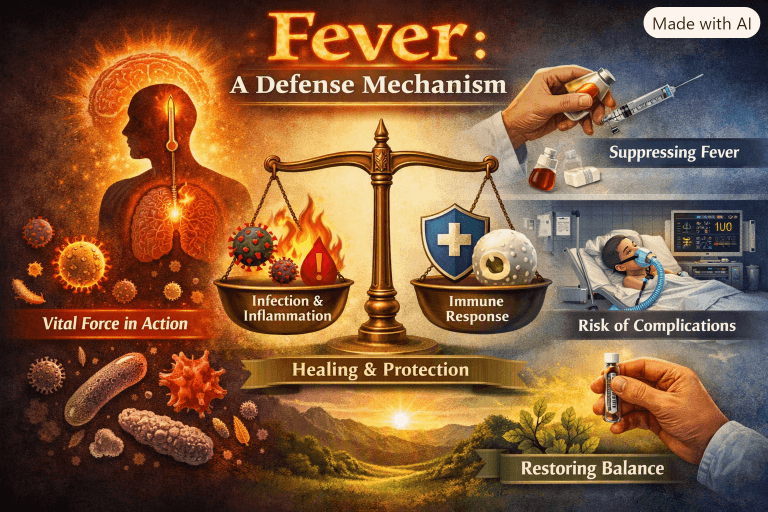
Fever is not just a rise in body temperature. It shows that the body’s inner life force is at work. In homoeopathy, fever is seen as the body’s way of responding and trying to bring itself back into balance. Instead of treating fever as something harmful to be stopped, it can be understood as the body’s way of speaking—showing its effort and strength. Fever activates the body’s defenses, makes us more aware of our condition, and proves that the body can regulate itself. When we see fever as a kind of resonance, we realize it is not random. The heat, restlessness, and changes we feel are part of a natural plan to help healing.
Fever is not a disease in itself but an expression of the vital force — a dynamic defense mechanism, that must be handled with care. It arises as the body’s regulated response to infectious agents, inflammation, or other stressors. Medically, fever represents the hypothalamus resetting the body’s thermostat under the influence of pyrogens, while philosophically it is the organism’s testimony of resilience and its effort to overcome crisis. Thus, fever should be understood not merely as pathology, but as the body’s purposeful language of defense and healing.
An effort by a physician to merely reduce the temperature without addressing the underlying cause of fever is a serious error. It can lead to severe complications, and even death. I have seen one patient who died after the rapid suppression of fever accompanied by joint pain during Chikungunya fever.
Case Insight: This patient contracted Chikungunya fever in 2006. At that time, he was treated with allopathic medicine; the joint pain was reduced but not completely cured. About six years later, he developed the same fever with similar joint pain. Again, he was treated with allopathy. but this time, due to the rapid suppression of fever, the patient entered a state of stupor, his body became icy‑cold, and he required life support with an oxygen mask. Unfortunately, he did not survive. This tragic outcome illustrates the dangers of suppressing fever abruptly without addressing its underlying cause.
A rise in temperature is not itself the subject of treatment; rather, the underlying cause must be addressed, for it is always dynamic. In this case too, the underlying condition was dynamic — fever was merely an expression of the vital force, a call for help. What was required was the careful selection of the correct homoeopathic medicine, based on the totality of symptoms. Timely administration of CAMPHOR - 1M can save such type of patient. As I mentioned previously, fever is not a disease but an expression of the vital force, seeking help through symptomatology.
Guideline for the selection of medicine:
Managing a case of fever is a difficult task for a Homoeopathic physician. Thermic (thermographic) symptoms play an important role; the intensity of symptoms alone is not the guiding factor, but rather the thermic pattern that emerges.
Thermic patterns exhibit themselves in multiple forms and expressions.
1. Thermic pattern: Normally, the head is slightly warm, and the feet are naturally cold, according to the body’s life priorities. However, extraordinary heat of the head combined with extreme coldness of the feet indicates the need for medicine. In the same manner, thermic patterns in fever manifest themselves through thirst — whether during the heat, sweat, or chill stage. Time modality is also a type of thermic pattern; aggravation of fever during day or night provides an important clue for remedy selection. Likewise, when joints are affected, the worsening of joint pain, as experienced and described by the patient, offers another valuable hint for choosing the correct medicine.
2.Inner Essence: The resonance between the body’s surface and the inner state — such as restlessness or calmness — must also be considered by the physician during fever. This subtle dimension marks a fine line that provides a clear guideline for remedy selection.
Dynamic resonance: case insight:
A 32-year-old male presented with rheumatic complaints, primarily joint pains accompanied by a history of fever. The patient expressed a marked desire for open air, yet his joint pains were aggravated by exposure to cold. Notably, his rheumatic symptoms recurred annually during winter, though paradoxically he enjoyed the winter season.
This paradox illustrates a phenomenon of thermic resonance between the patient’s external environment and inner essence, a keynote reminiscent of Eupatorium perfoliatum.
The patient was prescribed a single dose of Eupatorium perfoliatum 200C. Within seven days, significant improvement was observed—joint pains subsided almost completely. However, a slight relapse occurred just prior to his follow-up visit. A second dose of Eupatorium perfoliatum 200C was administered, reinforcing the curative response. here clear resonance between heat and cold is present. Patient himself desires for cold while his symptoms like joint pain get worse by cold.
Have a Question?
Ask HomeoEra Journal Editorial Team about "Fever: An Expression of vital force and Dynamic Resonance." and get a personalized response directly to your email.
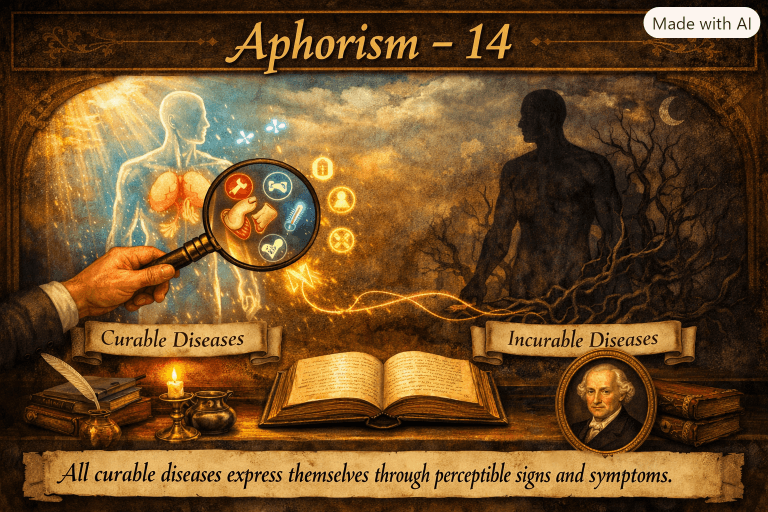
In this aphorism, Dr. Samuel Hahnemann elucidates a fundamental law of observation in medicine: that every curable disorder within the human organism necessarily reveals itself through perceptible signs and symptoms. Nothing curable remains hidden from the discerning physician, for the divine order has ordained that disease must express its presence outwardly to invite cure.
Thus, the physician’s art depends entirely upon the faithful interpretation of these manifestations. The morbid phenomena are not mere disturbances but the visible language of Nature, guiding the healer toward restoration. Those affections that grow silently within, without perceptible symptoms, belong to the realm of the incurable; for where no sign is given, no curative response can be awakened.
In essence, Hahnemann reminds us that symptoms are the thread of cure—the only bridge between the inner disorder and the physician’s understanding. To grasp that thread is to hold the possibility of healing; to lose it is to stand before disease without remedy.
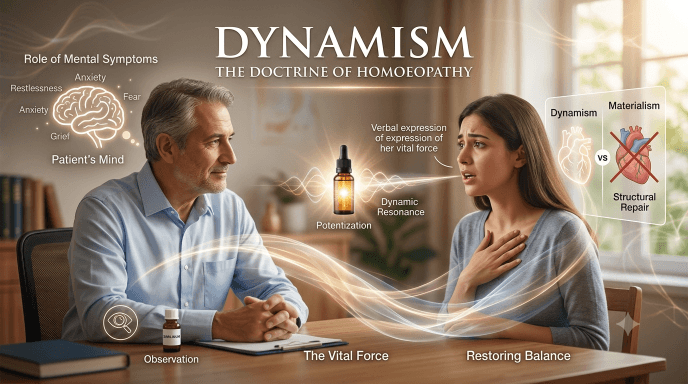
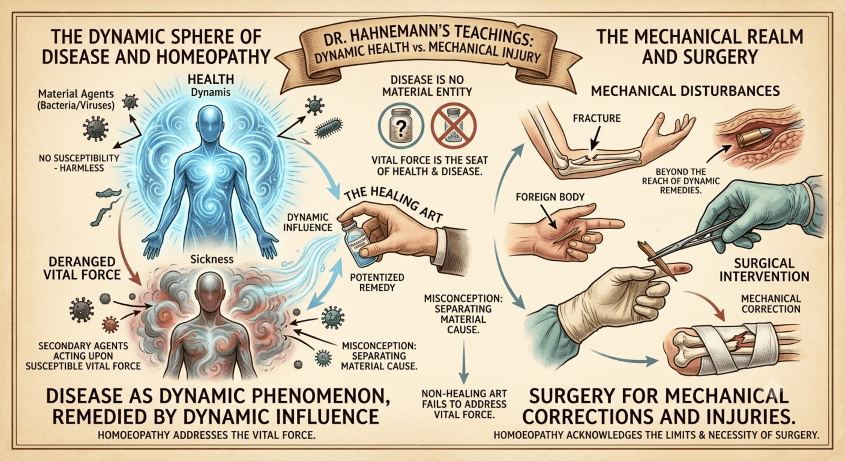
The doctrine of Homoeopathy is inseparably bound with the principle of dynamism. It does not aim at repairing the material body in isolation, but rather seeks to restore the vital force—the dynamic essence that animates life. Disease, in this philosophy, is not merely a structural defect or chemical imbalance; it is a disturbance on the dynamic plane, a disharmony of the spirit‑like energy that governs sensation and function.
Homoeopathic medicine, therefore, is not material in its curative action. Prepared through potentization, it transcends crude substance and becomes a dynamic remedy, capable of resonating with the disturbed vital force. Cure is achieved not by suppressing symptoms or altering tissues directly, but by stimulating the inner harmony, allowing the body to reorganize itself from within outward.
Thus, the true aim of Homoeopathy is not to treat the corporeal frame, but to re‑establish balance in the living dynamis, from which health naturally flows into the material body.
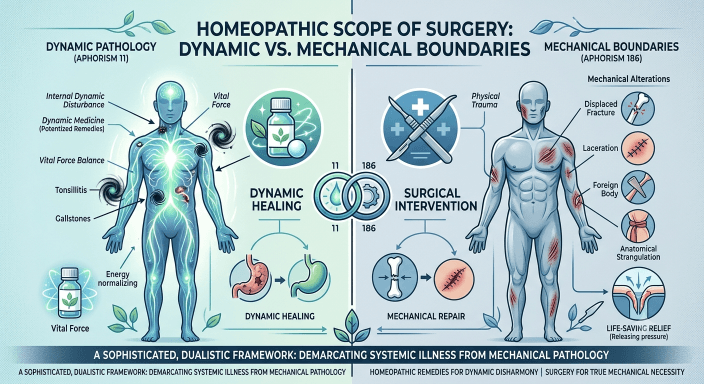
Surgery represents one of the most decisive acts in medical practice—an intervention that seeks immediate relief by removing or altering diseased tissue. Yet, within the philosophy of homoeopathy, surgery is not regarded as a primary mode of cure but rather as a necessary measure when the natural laws of healing cannot be invoked. Homoeopathy emphasizes restoration through the vital force, aiming to correct internal imbalance rather than mechanically excising its manifestations.
The scope of surgery in homoeopathy lies in emergencies, irreparable structural damage, or conditions where mechanical obstruction threatens life. Its limitations, however, are evident when surgery is employed as a substitute for true cure, ignoring the deeper dynamic disturbance that gave rise to pathology. Thus, surgery may save life or prevent immediate danger,
but it cannot address the underlying susceptibility that homoeopathy seeks to harmonize.
In this way, surgery and homoeopathy are not adversaries but complementary disciplines. Surgery provides mechanical aid where necessary, while homoeopathy ensures the restoration of health by addressing the vital force. The ethical challenge lies in discerning when surgical intervention is indispensable and when reliance on the body’s healing potential, guided by homoeopathic remedies, is sufficient.
Disease is not a material thing lodged in the body but a dynamic disturbance of the vital force, the invisible principle that sustains life. When this vital force is in harmony, health prevails; when disturbed, it manifests as altered sensations and functions that we call disease. Thus, disease is not a foreign substance but an immaterial imbalance, and cure lies in restoring the vital force to its natural equilibrium.