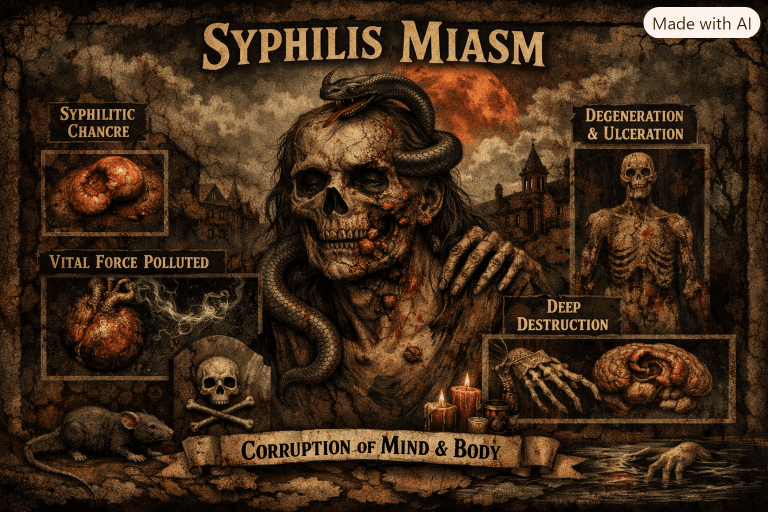
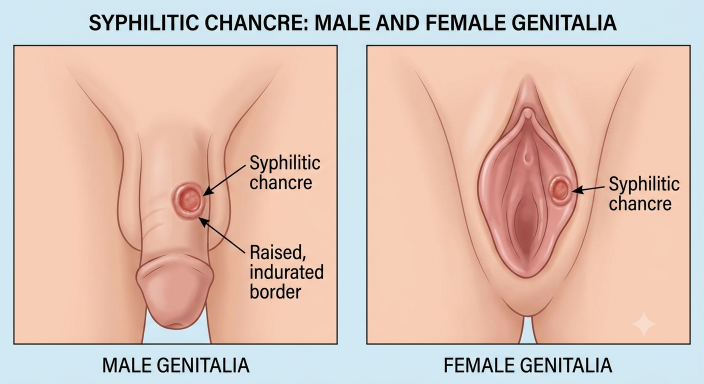
Syphilis is a chronic miasm, distinct from psora, and is also referred to as the Hunterian miasm. Dr. John Hunter confirmed Dr. Hahnemann’s experimental observations. Since syphilis is a sexually transmitted disease, its primary site of manifestation is the genital organs, whether male or female. From the allopathic perspective, syphilis is caused by a bacterium known as Treponema pallidum. However, Dr. Hahnemann’s miasmatic theory is far broader and deeper in concept, transcending the comparatively simple notion of a syphilitic chancre.
Syphilis is a venereal miasm; hence, it does not spread simply by casual touch. Being a sexually transmitted disease, its primary seat is the genital organs, where it produces the characteristic ulcer, well known as the syphilitic chancre.
The syphilitic chancre is usually painless and exhibits an auto-resolving nature. If left untreated, it may disappear spontaneously within a few weeks, though the infection itself persists and continues to progress internally. Dr. Hahnemann specifically used the term miasm to describe this stage, emphasizing that while the external ulcer may vanish, the disease penetrates deeper into the organism, advancing along its chronic course. Just as psora manifests in two phases—active and chronic—so too does syphilis, with its initial external activity followed by a deeper, enduring miasmatic progression.
Syphilitic chancre is the primary state of syphilis, appeared usually as the painless ulcer with auto-resolving tendency. it is a painless, single, round oval ulcer with clean base, and raised indurated hard edge. painless in most cases but may be slight painful in rare cases. typically located on genital, it primary site, but also may be present on the tongue, lips or other site where mucus membrane is present.
Treatment: Treatment of the syphilis miasma is very easy in this stage of infection, if appropriate Homoeopathic medicine administered timely, ridge from this deadly miasma is possible.
The term miasma is particularly applied to this stage, and it is equally valid in reference to Psora, Syphilis, and Sycosis alike. When the primary manifestation of Syphilis, such as the syphilitic chancre, is left untreated and disappears spontaneously, the disease penetrates deeper and pollutes the vital force. Under the influence of Psora, this polluted vitality produces secondary manifestations in other sites or organs of the body. It must be emphasized that without the support of Psora, Syphilis remains powerless; it cannot produce any manifestations on its own.
The action of Syphilis upon the human organism is exceedingly broad and far‑reaching; a complete account of its destructive influence is scarcely possible. Its effects extend far beyond the visible lesions and ulcerations, penetrating deeply into the vital force and disturbing the harmony of both physical and mental functions. The syphilitic miasm acts insidiously, corroding tissues, impairing the integrity of organs, and gradually undermining the moral and intellectual faculties. In its chronic form, it manifests as a slow yet relentless process of degeneration—an inward corruption symbolizing the disintegration of vitality itself. Therefore, to comprehend the malignant action of the syphilitic miasm, only a brief description of its effects upon certain regions of the body can be presented here.
Head & Skull:
In its action upon the head and its bony structures, Syphilis produces profound pathological changes. It gives rise to caries of the cranial bones, progressive softening of the skull, and the development of osseous tumors. These destructive processes not only compromise the mechanical integrity of the skull but also exert pressure upon the delicate structures of the brain, thereby disturbing both physical and mental functions. The syphilitic miasm, through its corrosive influence, symbolizes a deeper disintegration of vitality, manifesting outwardly in the decay of bone and inwardly in the decline of intellectual and moral faculties
Ear & nose:
Syphilis, in its action upon the nasal and auditory passages, produces acrid, corrosive discharges from the nose and ears. These secretions are not merely irritating but actively destructive, gradually eroding and carrying away the delicate bones of the nasal cavity and the auditory structures. The corrosive nature of the discharge symbolizes the deeper miasmatic tendency of Syphilis—its relentless drive toward disintegration and decay. Clinically, such manifestations highlight the insidious progression of the disease, where local ulceration and bone destruction reflect the inward corruption of vitality itself
Mouth and tongue:
Ulceration of the mouth and gums, characterized by hard, indurated, and elevated margins, is a distinctive feature of the syphilitic ulcer. The oral cavity stands as the second most favorable site for its manifestation, following the genital organs. Within the mouth, Syphilis produces pinched, wound‑like ulcers, often deep‑seated and corrosive in nature. These lesions not only erode the mucous membranes but also extend to the underlying tissues, gradually impairing the structural integrity of the oral cavity. The induration and elevation of the ulcer margins serve as diagnostic hallmarks, distinguishing syphilitic ulcers from other forms of oral ulceration. Symbolically, such manifestations reflect the insidious tendency of the syphilitic miasm to penetrate vitality, leaving behind marks of destruction that are both local and constitutional.
Glands around neck:
The scrofulous diathesis takes its origin from the combined action of Psora and Syphilis. This psoro‑syphilitic susceptibility may rightly be regarded as the mother of scrofula. Hidden or latent syphilis often reveals itself through the sign of enlarged glands, which serve as a clinical marker of its insidious presence. Behind many disorders of the endocrine system, one can discern the subtle workings of latent syphilis, acting silently yet persistently to disturb the delicate balance of internal secretions. Thus, scrofula is not merely a local manifestation but a deeper expression of the miasmatic interplay, where Psora provides the fertile soil and Syphilis contributes the destructive force, together shaping a constitutional tendency toward chronic disease.
Chest & bones: Syphilis profoundly affects the natural development of the bones, resulting in deformities such as a narrowed chest, which in turn prepares the ground for pulmonary tuberculosis. The constricted thoracic cavity suppresses vital capacity, thereby reducing oxygen intake and weakening the respiratory system. Pulmonary tuberculosis, in this context, emerges as the combined outcome of Psora and Syphilis, where Psora provides the susceptibility and Syphilis contributes the destructive force. The condition becomes almost incurable when complicated by Sycosis, for the sycotic element adds a layer of obstinate proliferation and resistance, further obstructing the healing process. Thus, the tri‑miasmatic interplay—Psora, Syphilis, and Sycosis—creates a constitutional terrain where chronic disease flourishes and vitality is progressively undermined.
Heart & circulation: In its latent stage, syphilis silently infiltrates the cardiovascular system, often taking two to three decades before its destructive influence becomes clinically evident. Once established in the heart and surrounding tissues, the syphilitic miasm manifests through progressive structural damage. It may produce
mitral regurgitation, aortic aneurysm, mitral stenosis, and aortic stenosis, each contributing to a gradual decline in cardiac function.
The insidious nature of this process lies in its slow but relentless progression: the valves thicken and lose their integrity, the aortic wall dilates and weakens, and the chambers of the heart struggle against regurgitant flow. Over time, these changes culminate in congestive heart failure, a state where the heart can no longer sustain the vital circulation of blood. In many cases, this terminal stage arrives abruptly, with sudden cardiac death as the final outcome of decades of hidden pathology.
Thus, syphilitic heart disease stands as a stark reminder of the long-term consequences of untreated infection—an inward corrosion that undermines both the structure and vitality of the heart itself.
Abdomen & its content: Enlargement of the abdominal gland, digestive gland, as we seen in the Hodgkin’s Disease is the action of latent syphilis. Hodgkin’s Disease and Glandular Enlargement
In Hodgkin’s disease, one of the characteristic pathological features is the progressive enlargement of lymphoid structures. This may involve the abdominal lymph nodes and the digestive glands (such as the liver and spleen), producing a striking clinical picture.
The disease process begins with lymphoid hyperplasia and infiltration by Reed–Sternberg cells, leading to firm, rubbery glandular swellings. As the condition advances, the abdominal glands enlarge, sometimes forming palpable masses that compress surrounding organs. The digestive glands—particularly the liver and spleen—may also become enlarged (hepatosplenomegaly), reflecting systemic dissemination of the disease.
Genital organs: The genital organs represent the primary site of syphilitic manifestation, where the disease first declares itself in a visible and destructive form. At this seat, syphilis produces ulceration and necrosis, leading to the characteristic syphilitic chancre—a hard, indurated ulcer with sharply defined margins.
As the infection progresses, the destructive tendency of the syphilitic miasm extends deeper into the tissues, eroding vitality and leaving behind areas of degeneration. Chronic irritation and necrosis in the genital organs may predispose to malignant transformation, and historically, syphilis has been associated with the development of cancer of the genital organs.
This progression illustrates the dual nature of syphilis:
Pathologically (allopathic view): Treponema pallidum invades tissues, producing ulceration, fibrosis, and eventual malignant change.
Philosophically (miasmatic view): The syphilitic miasm embodies destruction and decay, manifesting as ulceration, necrosis, and cancerous degeneration when unchecked.
Thus, the genital organs stand as the initial battlefield of syphilitic pathology, where the disease begins its long course of devastation, often culminating in incurable states if left untreated.
Extremities: In advanced syphilitic states, the destructive miasm extends its influence to the bones, joints, and nails, producing a distinctive clinical picture. The extremities often exhibit relaxed joints, reflecting the loss of ligamentous tone and muscular support. The bones become softened and fragile, a condition akin to syphilitic osteomalacia, leading to deformities and impaired locomotion.
The extremities appear over-flexed, as weakened joints fail to maintain their natural alignment. This abnormal posture is compounded by the softening of nails, which lose their firmness and resilience, symbolizing the degenerative tendency of the disease. Together, these features form a striking tableau of syphilitic pathology:
Relaxed joints → instability and deformity.
Soft bones → bending, curving, and susceptibility to fracture.
Over-flexed extremities → abnormal gait and posture.
Soft nails → trophic degeneration of appendages.
Philosophically, this reflects the syphilitic miasm’s destructive essence: a relentless drive toward decay, disintegration, and deformity, manifesting outwardly in the extremities as visible signs of inner corrosion.
1. Nightly aggravation, particularly night bones pain.
2. Itching less skin eruption.
3. Softening of the bones with over-flexed extremities
4. Destruction of the internal organ and bones necrosis.
5. Tendency of ulceration, deep, hard-edge ulcer.
6. Generalised cachexia - a metabolic syndrome.
7. Glandular enlargement like tonsilitis and swelling of other exo and endocrine gland.
8. Early decay teeth.
9. Intrauterine death of fetus.
10. Metastatic lymphadenopathy.
11. Nasal bones caries or softening.
12. Copper coloured spot on the skin.