Aphorism -12: Healing Beyond Pathogenesis — The Homoeopath’s Capability to Cure Without Exact Knowledge of Disease Mechanism.
Aphorism 12 is intimately connected with the footnote of Aphorism 1 and with Aphorism 8; in fact, it serves as a complement to both. A crucial question raised by Dr. Hahnemann here is: “Is it the morbidly affected vital energy alone that produces disease?”
In response, Hahnemann explains how the vital force gives rise to morbid symptoms—how disease originates. Yet he firmly emphasizes that such knowledge holds no practical utility for the physician. Speculation on the inner origin of disease belongs to theoretic medicine and will forever remain concealed, more a matter of prophecy than of healing practice.
The physician’s duty is not to waste time and talent in investigating hidden mechanisms within the interior of man. His sole moral responsibility is to remove the disease in its entirety. Since all disease phenomena reveal themselves only through perceptible signs and symptoms, the removal of these signs and symptoms as a whole must be regarded as the removal of the disease itself.
By stating this, Dr. Hahnemann effectively closed the door to modern speculative investigation, reminding physicians that cure lies not in abstract theorizing but in the faithful observation and removal of symptoms.
Dr. Hahnemann: Prophet of Healing and His Prophecy
Aphorism - 12,
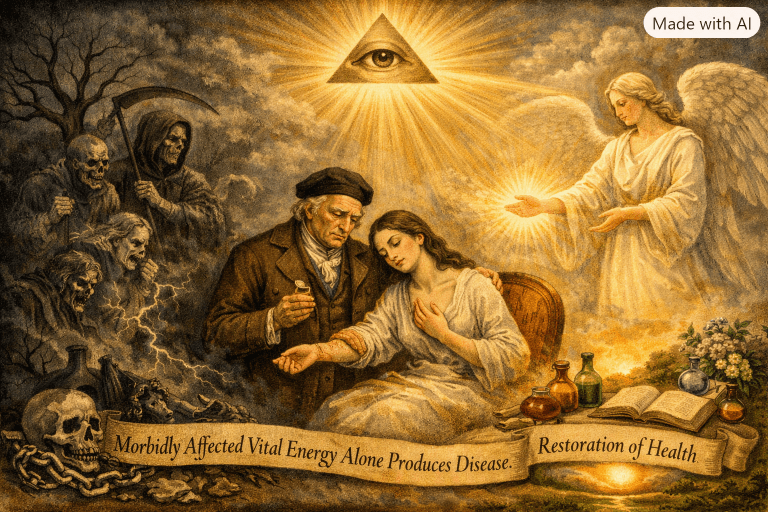
It is the morbidly affected vital energy alone that produces disease [How the vital force causes the organism to display morbid phenomena, that is, how it produces disease, it would be of no practical utility to the physician to know, and will forever remain concealed from him, only what it is necessary for him to know of the disease and what is fully sufficient for enabling him to cure it, has the Lord of life revealed to his senses.] So that the morbid phenomena perceptible to our senses express at the same time all the internal change, that is to say, the whole morbid derangement of the internal dynamis; in a word, they reveal the whole disease; also, the disappearance under treatment of all the morbid phenomena and of al the morbid alterations that differ from the healthy vital operations, certainly affects and necessarily implies the restoration of the integrity of the vital force and therefore, the recovered health of the whole organism.
Explanatory note:
This aphorism is closely connected with the footnote ofAphorism -1 and with Aphorism -8; in fact, it serves as a complement to both. A very important question raised by Dr. Hahnemann in this aphorism is: “Is it the morbidly affected vital energy alone that produces disease?”
In response, Dr. Hahnemann further explains how the vital force produces morbid symptoms—meaning how disease originates. Yet he emphasizes that knowing the answer to this question would be of no practical utility for the physician. Such speculation belongs to theoretic medicine and will forever remain concealed, a matter of prophecy rather than practice.
It is not the physician’s duty to waste time and talent in investigating how disease originates in the interior of man. His sole moral duty is to remove the disease in its entirety. All disease phenomena reveal themselves only through perceptible signs and symptoms. Therefore, the removal of these perceptible signs and symptoms as a whole must be regarded as the removal of the disease itself. by stating that Dr. Hahnemann closed the door for Morden investigation.
Word meaning and explanation:
Morbid phenomena: this word has very similar meaning to Pathogenesis but not exactly, morbid phenomena mean something apart from health or a disease condition.
Have a Question?
Ask HomeoEra Journal Editorial Team about "Aphorism -12: Healing Beyond Pathogenesis — The Homoeopath’s Capability to Cure Without Exact Knowledge of Disease Mechanism." and get a personalized response directly to your email.
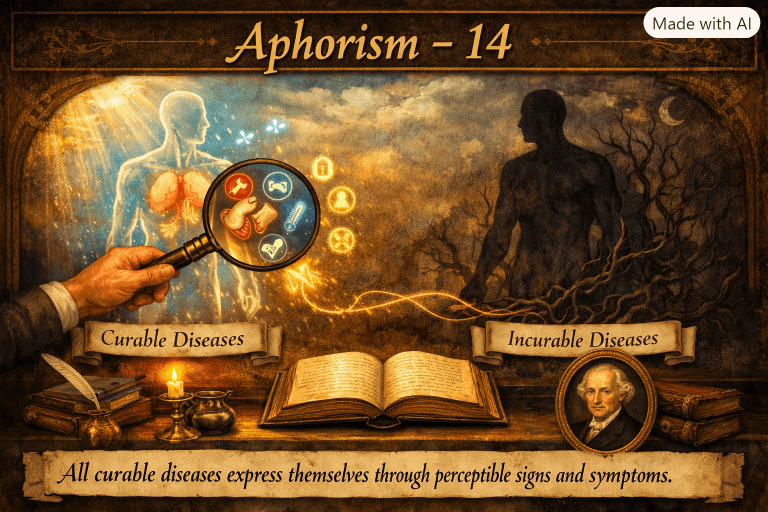
In this aphorism, Dr. Samuel Hahnemann elucidates a fundamental law of observation in medicine: that every curable disorder within the human organism necessarily reveals itself through perceptible signs and symptoms. Nothing curable remains hidden from the discerning physician, for the divine order has ordained that disease must express its presence outwardly to invite cure.
Thus, the physician’s art depends entirely upon the faithful interpretation of these manifestations. The morbid phenomena are not mere disturbances but the visible language of Nature, guiding the healer toward restoration. Those affections that grow silently within, without perceptible symptoms, belong to the realm of the incurable; for where no sign is given, no curative response can be awakened.
In essence, Hahnemann reminds us that symptoms are the thread of cure—the only bridge between the inner disorder and the physician’s understanding. To grasp that thread is to hold the possibility of healing; to lose it is to stand before disease without remedy.
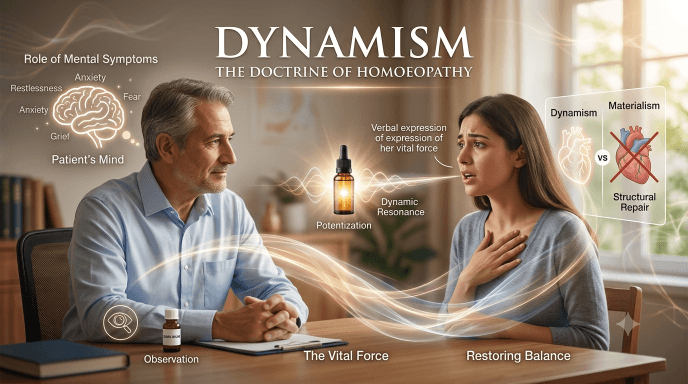
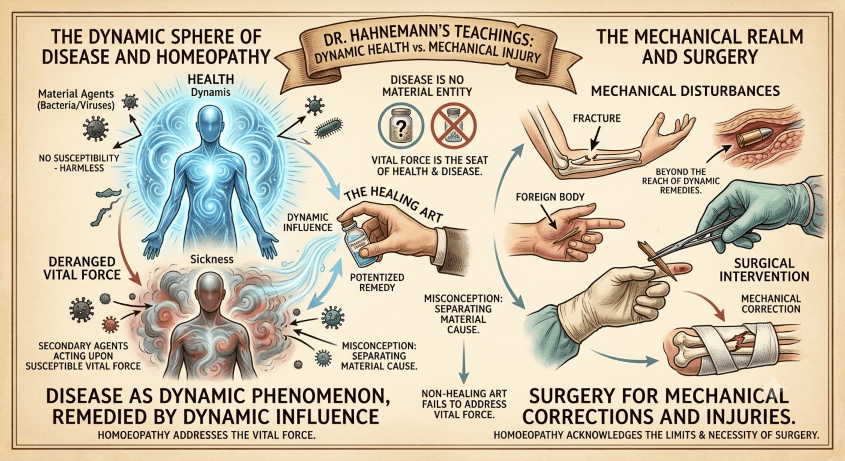
The doctrine of Homoeopathy is inseparably bound with the principle of dynamism. It does not aim at repairing the material body in isolation, but rather seeks to restore the vital force—the dynamic essence that animates life. Disease, in this philosophy, is not merely a structural defect or chemical imbalance; it is a disturbance on the dynamic plane, a disharmony of the spirit‑like energy that governs sensation and function.
Homoeopathic medicine, therefore, is not material in its curative action. Prepared through potentization, it transcends crude substance and becomes a dynamic remedy, capable of resonating with the disturbed vital force. Cure is achieved not by suppressing symptoms or altering tissues directly, but by stimulating the inner harmony, allowing the body to reorganize itself from within outward.
Thus, the true aim of Homoeopathy is not to treat the corporeal frame, but to re‑establish balance in the living dynamis, from which health naturally flows into the material body.
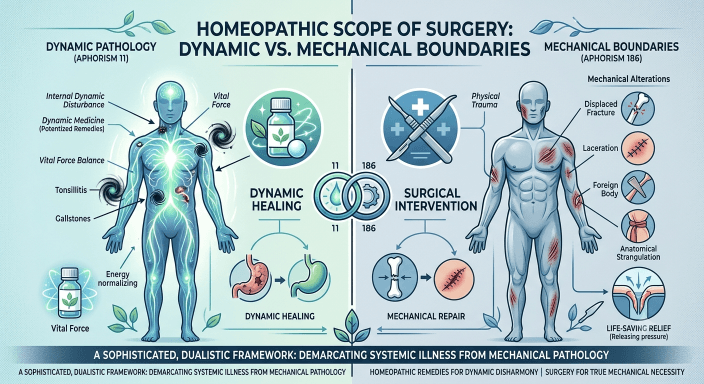
Surgery represents one of the most decisive acts in medical practice—an intervention that seeks immediate relief by removing or altering diseased tissue. Yet, within the philosophy of homoeopathy, surgery is not regarded as a primary mode of cure but rather as a necessary measure when the natural laws of healing cannot be invoked. Homoeopathy emphasizes restoration through the vital force, aiming to correct internal imbalance rather than mechanically excising its manifestations.
The scope of surgery in homoeopathy lies in emergencies, irreparable structural damage, or conditions where mechanical obstruction threatens life. Its limitations, however, are evident when surgery is employed as a substitute for true cure, ignoring the deeper dynamic disturbance that gave rise to pathology. Thus, surgery may save life or prevent immediate danger,
but it cannot address the underlying susceptibility that homoeopathy seeks to harmonize.
In this way, surgery and homoeopathy are not adversaries but complementary disciplines. Surgery provides mechanical aid where necessary, while homoeopathy ensures the restoration of health by addressing the vital force. The ethical challenge lies in discerning when surgical intervention is indispensable and when reliance on the body’s healing potential, guided by homoeopathic remedies, is sufficient.
Disease is not a material thing lodged in the body but a dynamic disturbance of the vital force, the invisible principle that sustains life. When this vital force is in harmony, health prevails; when disturbed, it manifests as altered sensations and functions that we call disease. Thus, disease is not a foreign substance but an immaterial imbalance, and cure lies in restoring the vital force to its natural equilibrium.