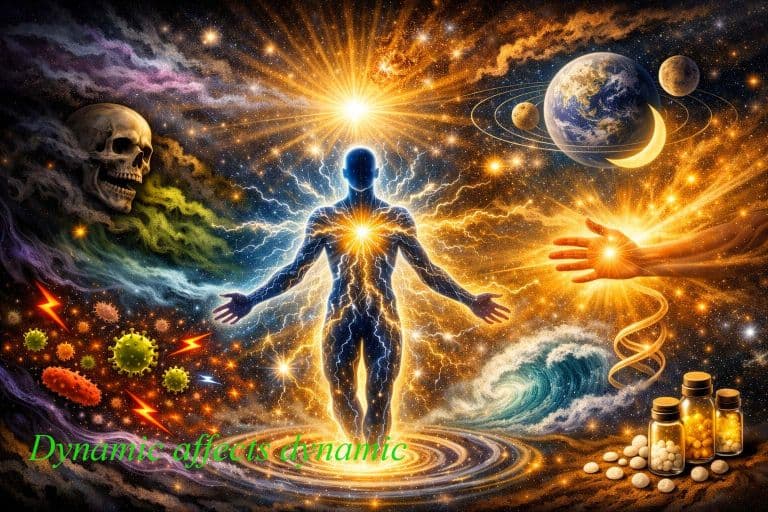
"When a person falls ill, it is only this spiritual, self-acting (automatic) vital force, everywhere present in the organism, that is primarily deranged by the dynamic [Materia peccans] influence upon it of a morbific agent inimical to life, it is only the vital force, deranged to such an abnormal state, that can furnish the organism with its disagreeable sensation, and incline it to the irregular processes which we call disease; for, as a power invisible in itself, and only cognizable by its effects on the organism, its morbid derangement only makes itself known by the manifestation of disease in the sensations and functions of those parts of the organism exposed to the sense of the observer and physician, that is, by morbid symptoms, and in no other way can it make itself known.
Foot note: [ What is dynamic influence, - dynamic power? Our earth, by virtue of hidden invisible energy, carries the moon around her in twenty-eight days and several hours, and the moon alternately, in definite fixed hours (deducting certain differences which occur with the full and the new moon) raises our northern seas to flood, tide and again correspondingly lowers them to ebb. apparently, this takes place not through material agencies, not through mechanical contrivances, as are used for products of human labor; and so, we see numerous other events about us as results of the action of one substance in another substance without being able to recognize a sensible connection between cause and effect. Only the culture, practiced in comparison and deduction, can form for himself a kind of supra-sensual idea sufficient to keep all that is material or mechanical in his thoughts from such concepts. he calls such effects dynamic, virtual, that is such as result from absolute specific, pure energy and action of the one substance upon the other substance.
For instance, the dynamic effect of the sick-making influences upon healthy man, as well as the dynamic energy of the medicines upon the principle of life in the restoration of health is nothing else then infection and so not in any way material, not in any way mechanical. just as the energy of a magnet attracting a piece of iron or steel is not material, not mechanical. One sees that the piece of iron is attracted by ne pole of the magnet, but how it is done is not seen. This invisible energy of the magnet does not require mechanical (material) auxiliary means hook or lever, to attract the iron. the magnet draws to itself and this acts upon the piece of iron or upon steel needle by means of a purely immaterial, invisible, conceptual, inherent energy, i.e, dynamically, and communicates to the steel needle the magnetic energy equally invisibly (dynamically). the steel needle becomes itself magnetic, even at a distance when the magnet does not touch it, and magnetizes other steel needles with the same magnetic property (dynamically) with which it had been endowed previously by the magnetic rod, just as a child with smallpox or measles communicates to a near, untouched healthy child in an invisible manner (Dynamically) the smallpox or measles, that is, infects it at a distance without anything material from the infective child going or capable of going to the one to be infected. A purely specific, conceptual influence communicated to the near child smallpox or measles in the same way as the magnet communicated to the near needle the magnetic property.
In a similar way, the effect of medicines upon living man is to be judged. substances, which are used as medicines, are medicines, only in so far as they possess each its own specific energy to alter the well-being of man through dynamic, conceptual influence, by means of the living sensory fibre, upon the conceptual, controlling principle of life. The medicinal property of those material substances which are call medicines proper, relates only to their energy to call out alterations in the well-being of animal life. Only upon this conceptual principle of life, depends on their medicinal health altering, conceptual (Dynamic) influence. Just as the nearness of a magnetic pole can communicate only magnetic energy to the steel (namely, by a kind of infection) but cannot communicate other properties (for instance, more hardness or ductility, etc) And thus every special medicinal substance alters through a kind of infection, that well-being of man in a peculiar manner, exclusively its own, and not in a manner peculiar to another medicine, as certainly as the nearness of the child ill with smallpox. will communicate to a healthy child only smallpox and not measles. These medicines act upon our well-being wholly without communication of material parts of the medicinal substance, thus dynamically, as if through infection. Far more healing energy is expressed in a case in point by the smallest dose of the best dynamized medicines, in which there can be, according to calculation, only so little of material substance that its minuteness cannot be thought and conceived by the best arithmetical mind, than by large doses of the same medicine in substance. That smallest dose can therefore contain almost entirely only the pure, freely developed conceptual medicinal energy, and bring about only dynamically such great effects as can never be reached by the crude medicinal substance itself taken in large doses.
it is not in the corporeal atoms of these highly dynamized medicines, nor their physical or mathematical surfaces (with which the higher energies of the dynamized medicines are being interpreted but vainly as still sufficiently material) that the medicinal energy is found more likely, there lies invisible in the moistened globule or in its solution, and unveiled, liberated specific medicinal force contained in the medicinal substance which act dynamically by contact with the living animal fibre upon the whole organism (without communicating to it anything material however highly attenuated) and act more strongly the more free and more immaterial the energy has become through the dynamization.
is it then so utterly impossible for our age celebrated for its wealth in clear thinkers to think of dynamic energy as something non corporeal, since we see daily phenomena which cannot be explained in any other manner? if one looks upon something nauseous and becomes inclined to vomit, did a material emetic come into his stomach which compels him to this anti peristaltic movement? was it not solely the dynamic effect of the nauseating aspect upon his imagination? And if one raises his arm, does it occur through a material visible instrument? A lever? is it not solely the conceptual dynamic energy of his will which raises it?]
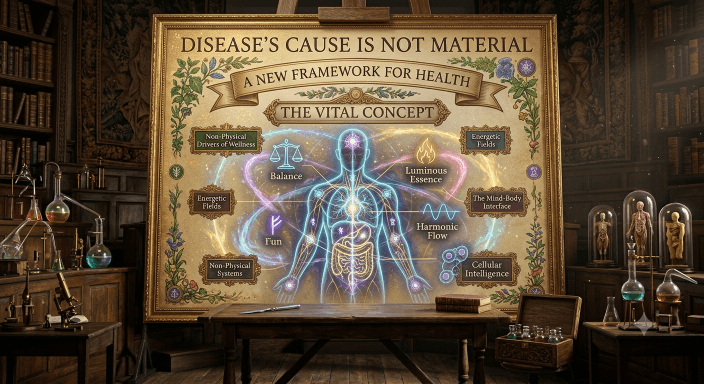
This aphorism is wholly concerned with the infectious nature of disease. According to Dr. Hahnemann, the transformation from health to disease and from disease back to health is entirely a dynamic phenomenon. As we know from chemistry, every substance on earth is composed of two elements: matter and energy. Comparatively, energy is far more susceptible to disease than matter. Hence, it can be concluded that “disease and health are dynamic phenomena.” Therefore, investigations carried out solely on the material plane to determine the exact cause of disease are ultimately useless.
The life force and the inimical force are both dynamic in nature. They require no physical pathway for transmission; they can affect each other at a distance, just like a magnet. Similar or opposite poles of a magnet attract or repel without tangible contact. In the same way, this aphorism explains the infectious nature of disease—how one patient with smallpox can transmit smallpox to another.
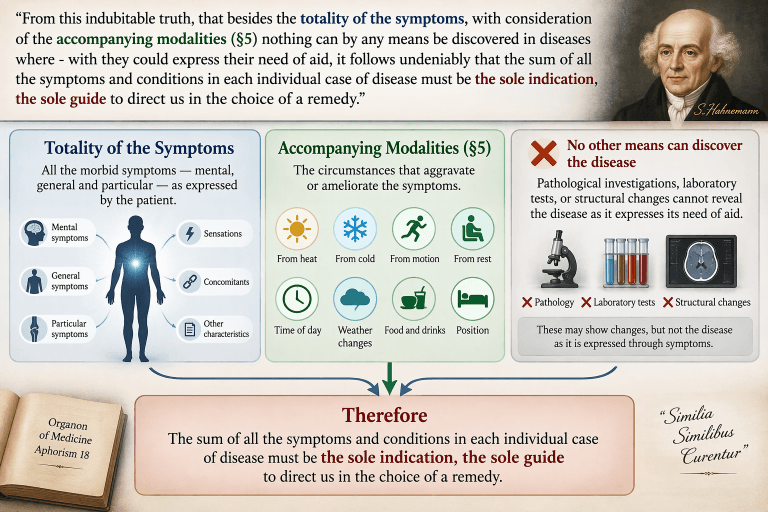
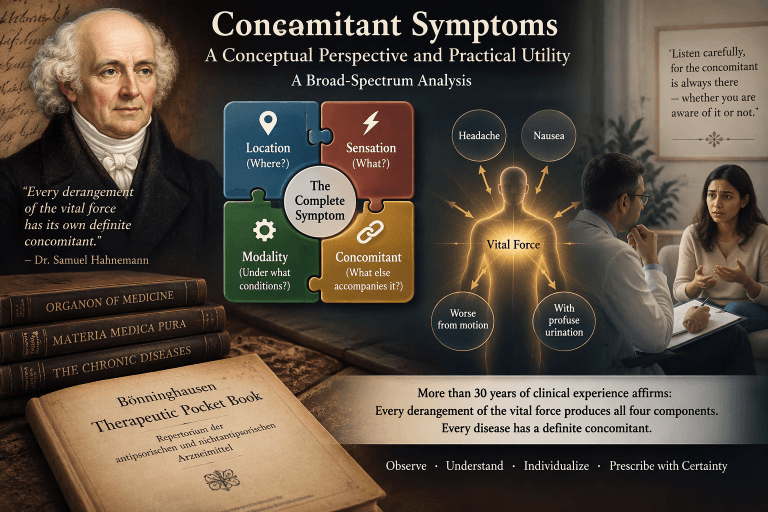
When our spiritual vital force is infected by any subversive influence (miasm), it produces morbid sensations. As the disease progresses, it causes physiological disturbances, which we recognize as disease. Thus, all perceptible signs and sensations—manifested as symptoms—are the only medium by which we can identify the disease phenomena present within the interior of the organism, and which exhibit themselves externally in the form of symptoms.
Word meaning and Explanation:
1. Materia peccans: This word is used for "dynamic cause of disease" known by various name like Miasm, subversive force, evil force, etc.