
Case story:
On 24 September 2021, 38 years old female patient visited at my evening clinic. She presented with multiple complaints. she was already under treatment of an eminent Homoeopathic physician, who employed a mind base technique. The patient expressed dissatisfaction, stating that, the physician questions were nonsensical and that he had told her all her complaint were of purely mental origin.
I asked her to describe all her complaints. She replied, Doctor I have series of complaints, in my medical history. I suffered from Typhoid and jaundice, which were treated with Allopathic medicine. Since then, I have not been well and continue to experience numerous complaints. At present I am suffering from..............
Presenting complaints:
1. Haemorrhoid last from 3 month with constipation and ineffectual desire for stool.
2. Pulsating headaches worsens after exposure to cold air.
3. Coryza develop every winter and persists throughout entire cold season.
4. Leucorrhoea of acrid nature, that produce itching and irritation on affected parts.
5. Face marks of Cloasma.
6. Head hair falling.
7. Want to close her eyes,
8. General soreness particularly of extremities.
9. Eruption as if filled with water, around genital organ.
MENSTRUAL SYMPTOMS
Menstrual blood dark, clotted, attending with heaviness and pain in lower abdomen (Dysmenorrhoea) this happen during every menses.
Medical history:
1. History of Typhoid and jaundice.
2. History of induced abortion.
3. History of coryza develop every winter.
Sycotic background:
She is an allergic patient, who experiences recurrent attack every winter, aggravated by exposure to cold. These episodes manifest as paroxysm of sneezing. such a history suggests that presence of an active Sycotic miasm. Influencing her metabolism. Infect allergic tendency of any kind are generally rooted in Sycotic miasm, supported by underlying Psoric tent.
MENSTRUAL HISTORY
1. Cycle - 28 days,
2. Bleeding - 3 days,
3. Menstrual blood - dark clotted, profuse with dysmenorrhoea.
PATHOLOGY
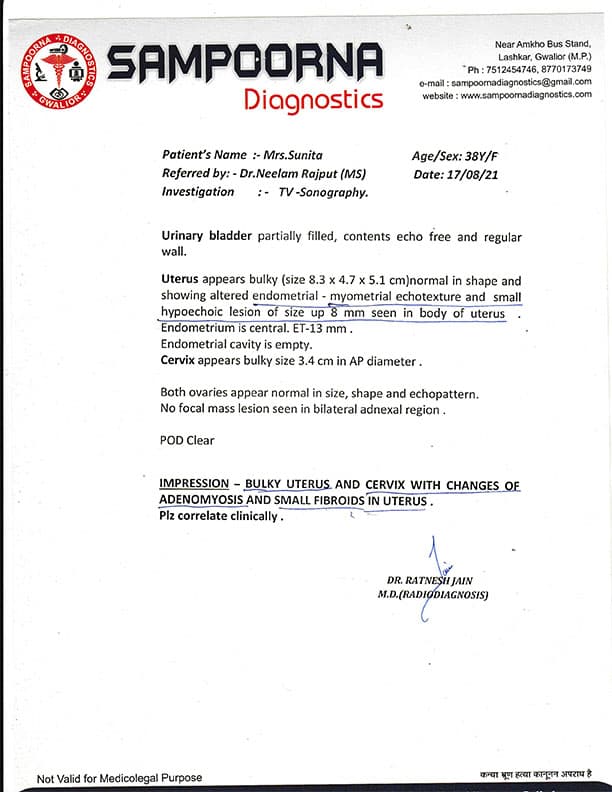
Uterine fibroid -
Generalities:
1. Sleep - deep sleep in the morning.
2. Dream - nightmares.
3. Appetite - stomach distension feeling after little eating.
4. Thirst - less with complaint of frequent urination, especially in the morning.
5. Perspiration - scanty with burning urination.
6. Thermal modality - heat sensation with tendency to take cold.
Prescription:
1. 1st PRESCRIPTION (24/09/2021)
- Lycopodium 1M (Single dose)
2. 2nd PRESCRIPTION (02/12/2021)
- Nitric acid 30 (Repeated dose)
- Palladium 200 (Single dose)
FOLLOW UP (02/12/2021)
1. Haemorrhoid - reduced in size, ineffectual desire for stool not now.
2. Leucorrhoea - reduced, acridity present but in less form.
3. Marked - improvement in hair falling.
4. She is feeling calm (Irritability reduc
Prognosis:
Prognosis is very good under the effect of Lycopodium 1M, and followed by Nitric acid 30, case is closed with Palladium 200, single dose.
INVESTIGATION (for confirmation)
1. USG performed on date 30/12/2021. Uterine fibroid disappeared, under the effect of medicine. (Report are attached)
Conclusion:
it is to be thought that Uterine fibroids are purely surgical disease, is wrong, any growth including uterine fibroid which can take growth in our body, can be disappear under the effect of appropriate Homoeopathic medicine. this case is an example of My thought, diseases that can considred surgical, not necessary that may be surgical.