Case reception:
This case was received on 20 May 2025. The patient was a resident of Delhi, India. She was fair-complexioned, physically healthy, soft-spoken, and exhibited a gentle and amiable disposition during the consultation.
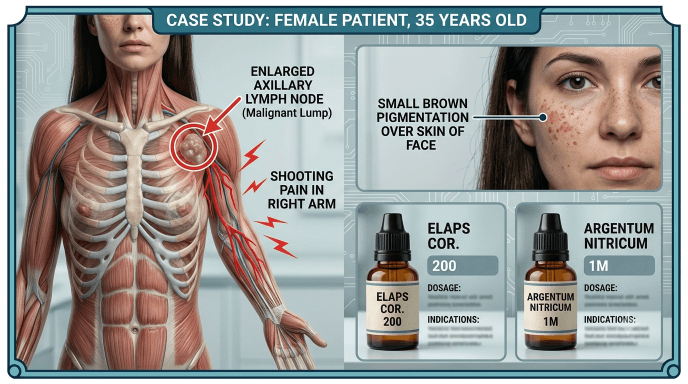
On physical examination, numerous small, light-brown pigmented spots were observed over various parts of the body, particularly on the face. Upon inquiring about their origin, the patient stated that these spots were familial in nature and had been present in several members of her family. She regarded them as a hereditary trait rather than a pathological condition.
Case taking procedure:
Having noted the patient's background and general appearance, I commenced the case-taking procedure. As a matter of routine, I begin every consultation with the question, "What complaints do you have?" This enables the patient to narrate the history of the illness in their own words and helps reveal the most characteristic features of the case.
Doctor, I have a lump in my right axilla. I consulted a surgeon, who suspected it to be a malignant growth. The lump is bluish in color and extremely painful. The pain is of a shooting character, radiating down the arm to the tips of the fingers."
Upon further inquiry, she emphasized that the pain was severe and frequently extended along the entire course of the upper limb, causing considerable discomfort in her daily activities.
I then proceeded to my next question:
"Could you describe any natural or environmental circumstances that aggravate or ameliorate your complaint, particularly the pain?"
In homoeopathic case taking, the modalities of a symptom often provide valuable clues for individualization. Therefore, I routinely inquire about the factors that influence the patient's suffering, seeking to identify the conditions under which the complaint becomes better or worse.
She replied, "Of course, Doctor. The pain almost invariably becomes worse after consuming cold foods, particularly curd. It is also aggravated by sour substances, such as lemon juice."
On further questioning, the patient repeatedly emphasized that even small quantities of cold or sour foods were sufficient to aggravate her complaints. This modality appeared to be a marked and consistent feature of the case and was therefore given considerable importance during case analysis.
Following the administration of Elaps corallinus 200C, this characteristic modality gradually disappeared, and the patient experienced significant relief. However, despite the improvement, the case was not completely cured, and a relapse occurred after some time. Upon re-evaluation, it was observed that the former modality had vanished and a new characteristic symptom had emerged. The patient now reported a definite aggravation of her complaints after consuming sweets.
This change in the symptom picture indicated a shift in the case and necessitated a fresh analysis. Based on the newly developed modality and the totality of symptoms then present, Argentum nitricum 1M was prescribed. The remedy acted favorably, leading to the complete disappearance of the axillary lump and all associated pain. Furthermore, the persistent fear of malignancy that had occupied the patient's mind was entirely removed.
During the subsequent follow-up period of eighteen months, no recurrence of the complaint was observed. The patient remained in good health throughout, confirming the completeness and permanence of the cure
Procedure adopted:
This case was resolved on the basis of the theory of complete symptoms, as originally propounded by Dr. Samuel Hahnemann and subsequently elaborated by Dr. C. von Boenninghausen, Dr. H. C. Allen, and Dr. Constantine Hering.
The analysis of the case rested primarily upon three components of the complete symptom: location, sensation, and modality. According to Dr. Hering's concept of the "four-legged chair," the fourth element, namely the concomitant symptom, could not be elicited despite careful investigation. Nevertheless, the available symptomatology was sufficiently characteristic to guide the prescription.
In this case, the characteristic location of the complaint in the right axilla, the shooting pain radiating to the fingertips, and the well-defined modalities provided an adequate basis for remedy selection. Although the fourth leg of Hering's chair, the concomitant, was absent, the case was successfully managed and ultimately cured through a careful evaluation of the remaining three elements.
This case demonstrates that, while a complete symptom ideally consists of location, sensation, modality, and concomitant, a successful prescription may still be achieved when one component is lacking, provided that the remaining symptoms are clear, characteristic, and reliable enough to individualize the case.
Prescription & outcome:
After careful analysis of the case, the characteristic symptoms that guided the prescription were the right axillary location of the lump, the shooting pain radiating down the arm to the fingertips, and the marked aggravation from cold and sour foods. Based on this symptom totality, Elaps corallinus 200C was prescribed.
The response to the first dose was encouraging, with approximately 50% improvement in the pain. After fifteen days, the same potency was repeated, resulting in further relief. However, despite the favorable response, the improvement subsequently reached a standstill. To stimulate further progress, Elaps corallinus 1M was prescribed. Following this prescription, the pain almost completely disappeared, and the patient's condition improved considerably.
Approximately two months later, the patient returned with a relapse of the complaint. A fresh case analysis revealed that the previous modality, namely aggravation from cold and sour foods, had disappeared. In its place, a new and distinct modality had emerged: the complaints were now aggravated after the consumption of sweets. This change in the symptom picture indicated the need for a new prescription.
Based on the revised totality of symptoms, particularly the marked aggravation from sweets, Argentum nitricum 1M was prescribed. The remedy acted promptly and decisively. Gradually, the pain subsided completely, and the axillary lump disappeared. The patient's anxiety regarding the surgeon's suspicion of malignancy was also relieved as the condition steadily resolved.
During the subsequent follow-up period of eighteen months, no recurrence of the lump or pain was observed. The patient remained in good health and free from symptoms. The case was therefore considered completely cured under the sequential action of Elaps corallinus and Argentum nitricum, prescribed according to the evolving symptom totality and characteristic modalities of the case.
Case discussion:
This case highlights the importance of prescribing on the basis of characteristic symptoms and modalities, rather than relying solely on the pathological diagnosis. The patient presented with a painful bluish lump in the right axilla, which had raised a suspicion of malignancy. However, the prescription was based upon the individualizing features of the case, namely the location of the lesion, the shooting pain radiating to the fingertips, and the marked aggravation from cold and sour foods.
Elaps corallinus corresponded closely to the initial symptom picture and produced significant improvement. The disappearance of the original modalities under its action indicated that the remedy had acted deeply, yet the case was not completely resolved. Upon relapse, a new modality, aggravation from sweets, emerged and altered the totality of symptoms. This change called for a fresh evaluation rather than a routine repetition of the former remedy.
The subsequent prescription of Argentum nitricum on the basis of the newly developed modality completed the cure. The gradual disappearance of the lump, the cessation of pain, and the absence of recurrence during eighteen months of follow-up provide evidence of a lasting therapeutic result.
From a methodological standpoint, the case demonstrates the practical value of the doctrine of complete symptoms as elaborated by Hahnemann, Boenninghausen, Allen, and Hering. Although the concomitant symptom, the fourth leg of Hering's symptom-chair, could not be elicited, the remaining three components, namely location, sensation, and modality, were sufficiently characteristic to individualize the case and guide the curative prescription. The case therefore illustrates that a reliable prescription can often be made from a well-defined partial totality when the available symptoms are clear, characteristic, and consistent.