On 29 September 2026, a 40-year-old woman consulted me in the company of her husband. She presented with multiple chronic complaints accompanied by fever. Her younger sister had previously suffered from similar complaints and was diagnosed with a brain tumor, which ultimately resulted in her death. Owing to this family history, the patient was strongly apprehensive that she too might be suffering from a brain tumor and feared that she would meet the same fate as her sister. Consequently, an intense fear of death was constantly present in her mind.
While recording the symptoms, I observed that multiple organs were affected. The patient presented with numerous symptoms involving different locations and systems of the body. This illustrates a distinct merit of homoeopathic medicine: even when multiple organs are affected and a wide variety of symptoms are present, a homoeopathic physician who is able to select the correct similimum can often restore the patient's health with a single, simple remedy acting upon the entire economy.
In contrast, within the conventional allopathic system of treatment, each organ or body system is commonly managed by a separate specialist. From this perspective, homoeopathy does not require organ-based specialization; rather, it requires a physician who understands and treats the patient as a whole, recognizing the unity of the organism rather than its individual parts. She is presenting the following symptoms.
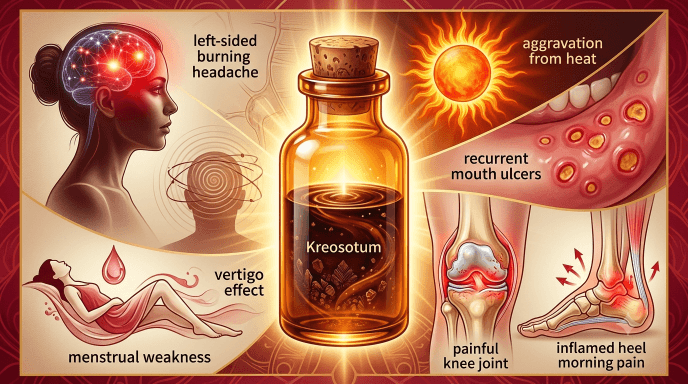
1. Head left side (internal): The patient has been suffering for the past five years from a very distressing headache attended by a burning sensation. The headache is accompanied by marked weakness and vertigo. A striking feature of this complaint is its definite concomitant symptom, namely burning during urination.
The modalities of the headache were clearly defined. The pain was aggravated by exposure to the heat of the sun, after taking warm food, and was particularly worse before and during menstruation. The presence of these characteristic concomitants and modalities provided important guidance in the individualization of the case.
2. Genitalia female: She also has the complaints of menstrual irregularities, has the disposition of early menses, accompanied with vertigo and weakness, that worse after exposure to sun heat.
3. Extremities: Rheumatic affections were present int the limbs, she is presenting trouble some pain in the heels of both sides, hardly able to walk in the morning, she also has the knee joint pain, with cracking sound that aggravate by ascending stairs.
4. Mouth: Remarkable tendency of ulceration in the mouth she is presenting with that was too five years old. want to be holding cold water in the mouth forever.
Medical history:
The patient had a previous history of epileptic seizures and long-standing fever. Notably, her younger sister had also suffered from similar complaints, including epileptic seizures and prolonged fever, before she was diagnosed with a brain tumor. This similarity in their clinical histories greatly intensified the patient's fear that she might be affected by the same condition.
Generalities:
1. Sleep
– over sleepy from childhood.
2. Dream
–
3. Appetite
– N.A.
4. Thirst
– N.A. thirst increase during fever.
5. Desire -
6. Aversion
–
7. Urine
– urination increase during fever.
8. Stool
– constipation.
9. Thermal
– Sensitive for heat.
Prescription:
After the complete anamnesis of the case, I prescribed her Kresote - 30, repeated dose alters every two hour, 4 to 5 time in a day, for 15 days.
This case illustrates the importance of the theory of complete symptoms. If a physician is able to identify even a single complete symptom within the entire case, that alone may be sufficient to guide a successful prescription. A symptom that is complete in its location, sensation, modalities, and concomitants often provides a reliable basis for selecting the similimum, even in otherwise complex cases presenting with numerous complaints. The prescription in this case was made entirely on the basis of artistic individualization, without recourse to repertorial analysis. The characteristic features of the case were so clearly defined that they directly pointed toward the similimum, demonstrating how a thorough understanding of symptom totality and homoeopathic principles can sometimes render repertorization unnecessary.
First (10/10/2026)
1. Headache - reduced, no burning.
2. Heel pain not now, knee joint pain reduced.
3. Mouth - Ulceration reduced.
Second (19/10/2026)
1. Menses - improved - weakness no more at the time of menses
2. Burning during urination - not now.
3. Slight knee joint pain remains.
4. Mouth ulceration - not now.
This case illustrates the practical importance of the homoeopathic theory of complete symptoms. Although the patient presented with numerous complaints involving different organs and systems, the prescription was not based upon the total number of symptoms but upon the identification of a characteristic and complete symptom. The headache was well defined in its sensation, modalities, and concomitant features, particularly its association with burning urination, aggravation from sun heat and warm food, and aggravation before and during menstruation. These peculiar features individualized the case and pointed clearly toward the similimum.
An important aspect of this case is that the prescription was made entirely on the basis of clinical judgment and Materia Medica knowledge, without the aid of repertorial analysis. It therefore represents an artistic prescription, where the physician relies upon careful observation, accurate interpretation of characteristic symptoms, and a thorough understanding of remedy pictures. The successful outcome further demonstrates that a single well-selected remedy, prescribed on the basis of a complete symptom, may be sufficient to address a complex symptomatology affecting multiple systems of the body. Such cases reaffirm the enduring value of Hahnemann's principles of individualization and the practical utility of complete symptoms in homoeopathic prescribing.
👉 In my clinical experience, I have repeatedly observed that Kreosotum acts remarkably well in affections of the head, particularly when the left side is involved. Its curative action appears to be especially pronounced when the headache is attended by a burning sensation, whether associated with burning urination or occurring independently. Such characteristic features have repeatedly guided me toward the selection of Kreosotum in similar cases. The present case further strengthened this observation, as the remedy was prescribed chiefly on the basis of these peculiar and characteristic symptoms. Experience suggests that Kreosotum is capable not only of relieving the symptom complex but also of addressing the underlying pathological condition associated with it when the totality of symptoms corresponds to the remedy picture.