HomeoEra
Back to Cases
Women HealthCase Study

Kali Iodatum in a Case of Lumps in the Breast Region

Some people believe that homoeopathic medicines act slowly. This is only a misconception. In fact, many homoeopathic physicians themselves repeat this claim, asserting that homoeopathy works at a sluggish pace. Yet such statements usually arise from the physician’s own inability to select the correct remedy. To say so is not only self‑deceptive but also undermines confidence in the system of medicine itself. When the right medicine is chosen with precision, homoeopathy demonstrates its power swiftly and effectively.

H

HomeoEra Journal Editorial Team

Updated 4 min read281 views
Kali Iodatum in a Case of Lumps in the Breast Region
Case Summary
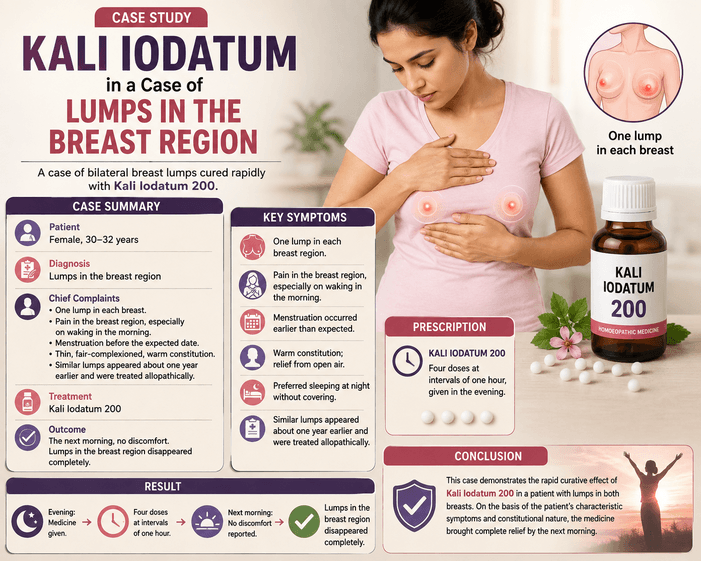
Patient: 32 Years, female
Diagnosis:

Lumps in the breast region (Fibroid growth)

Chief Complaints:

1. One lump in each breast region. 2. Pain in the breast region, particularly on waking in the morning. 3. Menstruation occurred earlier than the expected date. 4. Patient was thin and fair-complexioned. 5. Warm constitution; preferred sleeping without a covering at night. 6. The same type of lumps had appeared approximately one year earlier and had been treated allopathically.

Treatment:

Rx. (First Prescription) Kali Iodatum 200 – four doses at intervals of one hour, given in the evening.

Outcome:

From the next morning, the patient had no discomfort. lumps in the breast region had completely resolved.

Case Report: Rapid Resolution of Breast Lumps with Kali Iodatum

Case story:

A female patient, approximately 30–32 years of age, presented with complaints of lumps in both breast regions. Her husband reported the presence of one lump in each breast. On further inquiry, it was revealed that similar lumps had appeared about a year earlier and had been treated with allopathic medicines. At that time, the condition was suppressed, but not cured, by conventional treatment. This history indicated that the disease had assumed a chronic character.

Clinical Observations:

The patient was thin, fair-complexioned, and exhibited a tendency toward early menstruation. A striking symptom was considerable pain in the breast region upon rising in the morning. This symptom could easily be confused with the modality of Rhus toxicodendron, which also presents morning aggravation. However, a crucial distinction emerged: in Rhus tox, symptoms are aggravated by cold and relieved by warmth, whereas this patient experienced relief in open air and preferred sleeping uncovered at night. This pointed to a warm constitutional nature.

Prescription:

Taking into account the totality of symptoms and the patient’s constitution, Kali iodatum-200, was selected. The prescription was Kali iodatum- 200, four doses at hourly intervals in the evening.

Outcome:

By the following morning, the patient reported complete relief. The lumps had disappeared, and the pain was gone. This rapid resolution was remarkable, as conditions of this nature ordinarily take weeks or months to soften and resolve under conventional treatment. The case demonstrated the profound curative potential of the correctly chosen homoeopathic remedy.

Discussion:

This case underscores several important principles:

1. The danger of suppression: The earlier allopathic intervention had only masked the disease, allowing it to persist in a chronic form. Homoeopathy, by contrast, addressed the underlying susceptibility and restored balance. 

2. The importance of modalities: The distinction between Rhus tox and Kali iodatum hinged on the modality of relief in open air versus aggravation from cold. Such fine differentiations are the hallmark of homoeopathic prescribing. 

3. The speed of cure: Contrary to the widespread misconception that homoeopathy acts slowly, this case illustrates that when the remedy is well-selected, the curative action can be rapid and decisive.

Reflection:

Despite such evidence, many homoeopathic physicians still resort to allopathic medicines. This raises a critical question: to what extent is such practice appropriate, when homoeopathy itself possesses the power to cure swiftly, gently, and permanently?

Conclusion:

This case vividly illustrates the extraordinary rapidity with which homoeopathic remedies, when selected on the basis of the patient’s totality of symptoms and constitutional nature, can act upon deep-seated pathological conditions. A female patient, aged 30–32 years, presented with lumps in both breast regions. The history revealed that similar lumps had appeared a year earlier and had been suppressed by allopathic treatment, thereby rendering the condition chronic.

The patient’s constitution was thin, fair-complexioned, with a tendency toward early menstruation. A peculiar modality was observed: she experienced considerable pain in the breast region upon rising in the morning, yet obtained relief in open air and preferred sleeping uncovered at night. These modalities distinguished her case from Rhus toxicodendron, which is aggravated by cold and relieved by warmth. The warm constitution and characteristic symptoms pointed unmistakably toward Kali iodatum.

Accordingly, Kali iodatum 200 was prescribed—four doses at one-hour intervals in the evening. By the next morning, the patient reported complete disappearance of the lumps and total relief from discomfort. This outcome was remarkable, as such conditions ordinarily require weeks or months to soften and resolve under conventional treatment. The rapidity of cure demonstrated the immense dynamic power of the correctly chosen homoeopathic remedy.

Broader Implications:

1. Speed of action: This case challenges the misconception that homoeopathy acts slowly. When the similimum is selected, the curative effect can be immediate and striking. 

2. Suppression vs. cure: The earlier allopathic intervention had suppressed the disease, allowing it to persist in a chronic form. Homoeopathy, by contrast, restored balance by addressing the underlying susceptibility. 

3. Precision in prescribing: The differentiation between Rhus tox and Kali iodatum highlights the importance of modalities and constitutional features in remedy selection. 

4. Philosophical reflection: The case raises a critical question for practitioners: when homoeopathy itself possesses the power to cure swiftly, gently, and permanently, to what extent is reliance on allopathic medicines justified?

Have a Question?
Ask HomeoEra Journal Editorial Team about "Kali Iodatum in a Case of Lumps in the Breast Region" and get a personalized response directly to your email.

0/500 characters

0 characters (minimum 10 required)

🔒 Privacy Notice: Your information will only be used to respond to your query and won't be shared with third parties.

Uterine fibroid, curd with history of thyphoid and jaundice, a Case study.
Women Health

Uterine fibroid, curd with history of thyphoid and jaundice, a Case study.

38 years female consult me for her uterine fibroid; she has a series of complaints with the history of Typhoid fever and jaundice, after comprehensive case taking and analysis of symptomatology, I prescribed Lycopodium 1M and followed by Nitric acid 30 and Palladium 200 single dose. patient got complete relief on both plane symptomatic as well as pathologic. fibroid growth disappeared under the effect of Homoeopathic medicine.

HHabib khan
3m1795
Rhus tox in Segmental Vitiligo: Localized Depigmented Lesions in a Pediatric Patient.
Skin Disorders

Rhus tox in Segmental Vitiligo: Localized Depigmented Lesions in a Pediatric Patient.

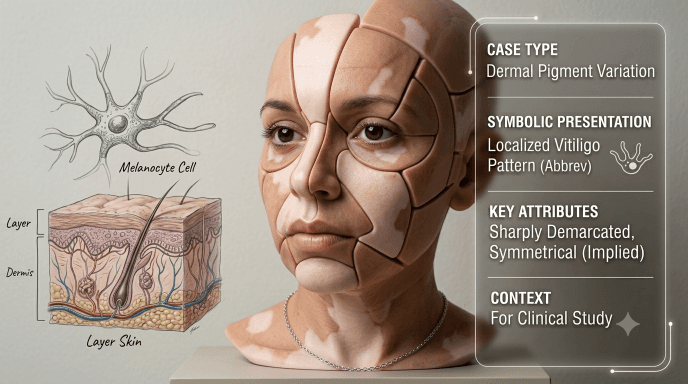
Vitiligo in pediatric patients often presents as localized depigmented patches with preserved sensation, occasionally accompanied by mild itching. In this case, a child presented with a small, depigmented area around the mouth, with normal tactile response and slight pruritus. The remedy Rhus tox was prescribed for one month. On follow‑up after three months, the lesion had to reduced up to great extent, demonstrating the curative potential of homoeopathic intervention in segmental vitiligo. This outcome highlights the importance of individualized remedy selection and supports the role of Rhus tox in cases where depigmentation is accompanied by itching and localized distribution.

HHabib khan
6m225
Pulsatilla in a Case of Excessive Gas Formation in the Stomach
Gastro-intestinal disorder

Pulsatilla in a Case of Excessive Gas Formation in the Stomach

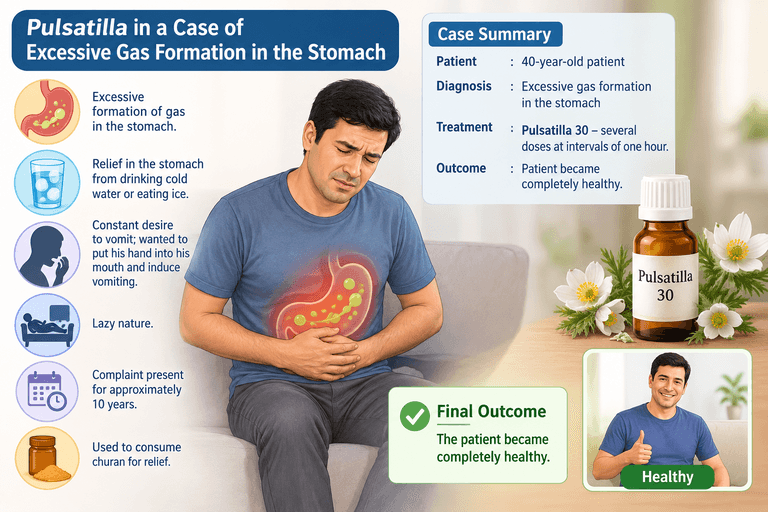
Generally, it is believed that Pulsatilla is only a medicine for women. However, this is a common misconception. It is true that Pulsatilla has provided relief to many women, and it suits complaints occurring in women that are aggravated by pregnancy. Yet, its therapeutic sphere is not confined to female constitutions alone. The remedy acts universally, provided the prescription is guided by the totality of symptoms rather than by gender stereotypes

HHomeoEra Journal Editorial Team
3m360
Aphorism 6 in Practice: The Physician Beyond Prejudice.
Gastro-intestinal disorder

Aphorism 6 in Practice: The Physician Beyond Prejudice.

A 40‑year‑old female presented with a constellation of chronic complaints reflecting both physical discomfort and constitutional imbalance. Urinary symptoms were marked by interrupted, scanty flow with burning, temporarily relieved by local oiling. Abdominal tympanites with frequent eructations failed to provide relief, while general soreness, laziness, and constipation added to her burden. Hair fall was noted, along with numbness and restlessness in the extremities (ameliorated by cold drinks), weakness and pain in the lower limbs, and monthly headaches beginning at the nape and settling at the vertex. Medical history revealed a tendency toward typhoid fever. Generalities included alternating sleep, diminished appetite and thirst, craving for salt, aggravation from food, and sensitivity to both heat and cold. The peculiar modalities — relief by oiling and cold drinks — provided key individualizing features for remedy selection.

HHomeoEra Journal Editorial Team
4m253

Comments (0)

Sign in or sign up to join the discussion

No comments yet. Be the first to share your thoughts!

Newsletter

Stay Updated with Latest Research

Get weekly digests of new articles, case studies, and homeopathic insights delivered to your inbox

By subscribing, you agree to our Privacy Policy. Unsubscribe anytime.