
HomeoEra
Back to Cases

Carbo Vegetabilis - Case Report: Vertigo and Vomiting: Importance of Symptom's location in Homeopathic Prescription

This case highlights the decisive role of symptom location in remedy selection. A 35‑year‑old female presented with persistent vertigo following an episode of vomiting during travel. Initial remedies—Gelsemium, Bryonia, and Ipecac—each reflected partial aspects of her symptom picture, yet none achieved lasting cure. Careful study revealed that the true seat of disease corresponded with the pathogenesis of Carbo Vegetabilis, which encompassed her constellation of drowsiness, motion‑aggravated headache, and constant nausea. Two doses administered at thirty‑minute intervals produced complete recovery without aggravation. This case illustrates that while sensation, modality, and concomitant symptoms contribute to remedy differentiation, location remains the prime determinant in successful prescription.

H

HomeoEra Journal Editorial Team

Updated 2 min read759 views
Carbo Vegetabilis - Case Report: Vertigo and Vomiting: Importance of Symptom's location in Homeopathic Prescription
Case Summary
Patient: 35 years, female
Diagnosis:

Cold settled on the Liver.

Chief Complaints:

1. Headache aggravated by motion. 2. Constant Nauses with drowsiness 3. Extrema prostration patient want to sleep forever. 3. Mild fever with chill.

Treatment:

1st prescription 1. Carbo veg - 200

Outcome:

Excellent recovery cure on the same day

Introduction:

Symptoms change according to location. Not every symptom carries equal importance in the selection of medicine; superficial or misleading symptoms often create confusion. This case illustrates how location, sensation, modality, and concomitant symptoms guide remedy choice, with location holding prime importance. 

Case background: 

1. Patient: Female, 35 years old

2. Incident: While traveling by bus to her mother’s home, she experienced sudden sickness with vomiting and vertigo.

3. Initial Management: After resting for one day without improvement, she consulted a physician. Vomiting subsided, but vertigo persisted unchanged. 

4.Outcome: Despite ten days of treatment, she reported no significant benefit.

Clinical presentation: 

When she consulted me, her symptom picture was shifting between several remedies:

1.   Drowsiness and weakness → Gelsemium

2.   Headache aggravated by motion → Bryonia

3.   Constant nausea → Ipecac

Other medicines, including Arsenicum Album, provided only temporary relief without cure.

Remedy differentiation: 

While studying Kent’s Materia Medica, I reviewed the chapter on Carbo Vegetabilis. The remedy picture aligned with her condition:

1. Chilliness with headache aggravated by motion (similar to Bryonia) 

2. Persistent nausea (like Ipecac)

3. Drowsiness and weakness (like Gelsemium) 

4. Pathological seat shifting toward liver and lungs, clarifying the location of disease, this was the case of combines characteristics of Ipecac, Bryonia, and Geslimium each has given but no relief. 

Outcome: 

Remedy:Carbo Vegetabilis - 200

Dosage: Two doses at 30‑minute intervals

Result: Complete cure on the same day, without aggravation.

Case discussion: 

This case demonstrates that symptom's location is the decisive factor in remedy selection. While sensation, modality, and concomitant symptoms contribute to completeness. Location provides the foundation. Remedies like Gelsemium, Bryonia, and Ipecac reflected partial pictures, but only Carbo Vegetabilis matched the true seat of disease. 

This case is also evident of the aphorism 7 which says, " symptomatology do not furnish the true image of the sickness, it creates only a mirror image of the internal disease" it clarifies that Dr. Hahnemann used this word "symptoms" in some specific sense.    

Have a Question?
Ask HomeoEra Journal Editorial Team about "Carbo Vegetabilis - Case Report: Vertigo and Vomiting: Importance of Symptom's location in Homeopathic Prescription" and get a personalized response directly to your email.

0/500 characters

0 characters (minimum 10 required)

🔒 Privacy Notice: Your information will only be used to respond to your query and won't be shared with third parties.

Bryonia in Tormenting Right sided‑Parietal Headache: Aggravation from Motion, Light, and Heat.
Headache & Disorder

Bryonia in Tormenting Right sided‑Parietal Headache: Aggravation from Motion, Light, and Heat.

On 29/05/2026, a 32‑year‑old female presented with persistent headache in the right parietal region, unrelieved by prior allopathic and homoeopathic treatments. Despite prescriptions of Belladonna, Ignatia, Spigelia, Sanguinaria, and Silicea, her condition remained unchanged. During case‑taking, two striking modalities emerged: pain ameliorated by firm pressure and aggravation from motion, morning rising, light, and heat. The headache was sudden in onset but deeply rooted in a suppressed febrile history. Careful observation revealed recurrent throbbing pain every 1–1.5 minutes, visibly affecting her facial expression. Based on the totality of symptoms—location, sensation, and modalities—the remedy Bryonia 30 was selected. Within three days, facial expression normalized and pain spells ceased; by the fifth day, complete relief was achieved. This case highlights the principle of prescribing on the portrait of complete symptoms, demonstrating Bryonia’s efficacy in right‑sided parietal headache with modalities of motion, light, and heat, ameliorated by pressure.

HHabib khan
4m1262
Rhus tox in Segmental Vitiligo: Localized Depigmented Lesions in a Pediatric Patient.
Skin Disorders

Rhus tox in Segmental Vitiligo: Localized Depigmented Lesions in a Pediatric Patient.

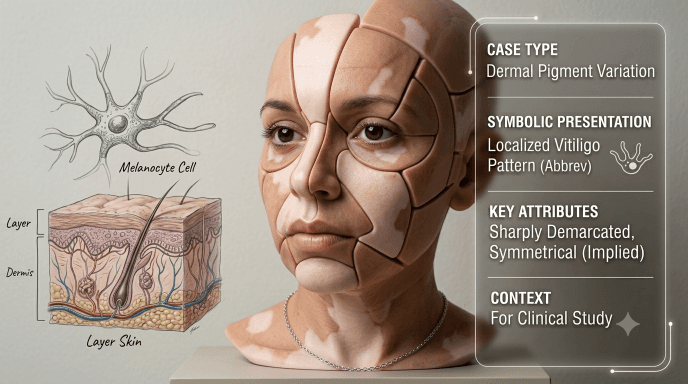
Vitiligo in pediatric patients often presents as localized depigmented patches with preserved sensation, occasionally accompanied by mild itching. In this case, a child presented with a small, depigmented area around the mouth, with normal tactile response and slight pruritus. The remedy Rhus tox was prescribed for one month. On follow‑up after three months, the lesion had to reduced up to great extent, demonstrating the curative potential of homoeopathic intervention in segmental vitiligo. This outcome highlights the importance of individualized remedy selection and supports the role of Rhus tox in cases where depigmentation is accompanied by itching and localized distribution.

HHabib khan
6m225
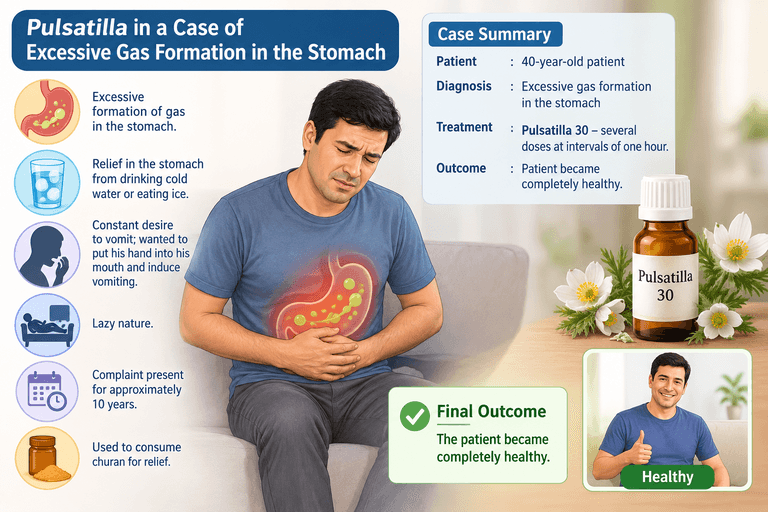
Pulsatilla in a Case of Excessive Gas Formation in the Stomach
Gastro-intestinal disorder

Pulsatilla in a Case of Excessive Gas Formation in the Stomach

Generally, it is believed that Pulsatilla is only a medicine for women. However, this is a common misconception. It is true that Pulsatilla has provided relief to many women, and it suits complaints occurring in women that are aggravated by pregnancy. Yet, its therapeutic sphere is not confined to female constitutions alone. The remedy acts universally, provided the prescription is guided by the totality of symptoms rather than by gender stereotypes

HHomeoEra Journal Editorial Team
3m360
Aphorism 6 in Practice: The Physician Beyond Prejudice.
Gastro-intestinal disorder

Aphorism 6 in Practice: The Physician Beyond Prejudice.

A 40‑year‑old female presented with a constellation of chronic complaints reflecting both physical discomfort and constitutional imbalance. Urinary symptoms were marked by interrupted, scanty flow with burning, temporarily relieved by local oiling. Abdominal tympanites with frequent eructations failed to provide relief, while general soreness, laziness, and constipation added to her burden. Hair fall was noted, along with numbness and restlessness in the extremities (ameliorated by cold drinks), weakness and pain in the lower limbs, and monthly headaches beginning at the nape and settling at the vertex. Medical history revealed a tendency toward typhoid fever. Generalities included alternating sleep, diminished appetite and thirst, craving for salt, aggravation from food, and sensitivity to both heat and cold. The peculiar modalities — relief by oiling and cold drinks — provided key individualizing features for remedy selection.

HHomeoEra Journal Editorial Team
4m253

Comments (0)

Sign in or sign up to join the discussion

No comments yet. Be the first to share your thoughts!

Newsletter

Stay Updated with Latest Research

Get weekly digests of new articles, case studies, and homeopathic insights delivered to your inbox

By subscribing, you agree to our Privacy Policy. Unsubscribe anytime.