HomeoEra
Back to Blogs

Miasm: Understanding the Invisible Threads of Chronic Illness.

Selection of medicine in homeopathic practice is often a challenging task. A thorough understanding of miasm makes this process easier; without it, prescribing is like hunting in the dark. In every case, numerous symptoms present themselves, but not all symptoms carry equal value. Hence, the valuation of symptoms becomes essential. Understanding miasm allows us to identify the true enemy of humanity—the underlying cause behind disease. Miasm reveals the real etiology of what we call illness. For this reason, it is imperative for every physician to grasp the concept of miasm, as it is the key to successful treatment.

H

Deals with Chronic diseases

Updated 5 min read2033 views
Miasm: Understanding the Invisible Threads of Chronic Illness.

Introduction:

The word “Miasm” has its origin in Greek. It signifies not merely a substance, but more suitably a dynamic power capable of polluting our vitality. This subtle force has the ability to produce abnormal—morbid—functional and structural changes within the organism, including human beings.

Miasm affects us in multiple ways and on various planes: the physical plane, the mental plane, and even the spiritual plane. Its influence is pervasive, shaping the very phenomena of disease.

Therefore, the study of miasm is of paramount importance for every physician. Without understanding miasm, the true nature of disease remains obscured; with it, the physician gains insight into the hidden roots of illness and the guiding principles for successful treatment.

WORD MEANING 

Miasm = Poision, polluting substance, subversive force, dynamic influencer, 

History of miasm:

Psora is regarded as the most ancient and primitive miasm in the history of mankind. It is believed to have originated around 3,000 years ago among the people of Greece, manifesting in the form of itch. If the earth was created by God, it follows that the first man formed by Him must have existed in the purest state of life. The first man created by God must have been without sin, free from evil thoughts, and dwelling in the purest form of life. How and when miasms were later introduced into humanity remains a mystery, a fact still unknown to this day.
According to Dr. Hahnemann, Psora is the miasm of itch, which has manifested in various forms within society over time. Its active expressions include scabies (itching watery eruptions), leukoderma (white spots), eczema, furuncles, and numerous other skin diseases. These conditions are considered outward manifestations of Psora, reflecting its deep-rooted presence in human pathology.

Type of miasm:

Fundamentally, the miasms are classified into three types
1. Psora (Miasm of itch)
2. Syphilis (Miasm of Huntarian disease)
4. Sycosis (Miasm of Gonorrhoea)
How miasms spreads: Among these, Psora is considered contagious, while Syphilis and Sycosis are regarded as venereal miasms. The contagious miasm is transmitted solely by touch. Even contact with the clothes of an affected person can spread Psora from the infected individual to a healthy one.The other two miasms—Syphilis and Sycosis—are classified as venereal miasms, transmitted primarily through sexual contact. Psora is the parents of all disease, without Psoric diathesis; Syphilis and Sycosis are helpless, they cannot harm humanity. 

Form of miasms: every miasms are found in two forms Active form and latent form.  

Active miasm: represents the acute form, which most often manifests on the skin—the outer protective layer of our body. It is generally less intense, less harmful, and can be managed with relative ease. 

Latent miasm: the word "Miasm" more accurately represents the latent form. because when active forms suppressed, it causes the irregular flow of vital energy in vital channel. in other word it infects   vitality, caused irregular heat pattern, hence produce disease. every disease has two types of manifestation. primary manifestation and secondary manifestation.  

Primary manifestation of the disease: this the is the primary outwardly reflected picture of the internal essence of the disease; can be treat easily with appropriate Anti-psoric medicine. but when these primary psoric manifestation suppressed by violent drugs or medicine, or by any other means. after some time, secondary manifestation develops. 

Secondary manifestation of the disease:  these are better known as the "Sequelae". difficult to treat, more dangerous to the life, in order to treat such type of manifestation, a careful observation and detailed case taking is needed. by using higher potency of Anti-psoric medicine, we can deal with such types of trouble.  

Factor that can arouse the slumbering miasm:

Often the psoric fire may be so latent or so inactive that one may deem himself healthy, or others may think that he is healthy until he receives some injury, or until something unusual happens. below mentioned factor are some of them. 
Excessive joy, Grief, over work either mental or physical, Mental shock or injury, fracture, sudden change of weather or temperature, excessive eating or drinking, error in diet, taking hot or mineral bath, exposure to sun heat or excessive cold. failure in business or in love, smoking, drinking wine are some of the causes that can arose the sleeping monster. 
Basic function: The basic function of Psora is to produce weakness hence susceptibility for the infection of Sycosis and Syphilis.  

Conclusion:

According to the homoeopathic concept of disease, all chronic illnesses originate from miasmatic influences. These miasms—Psora, Sycosis, and Syphilis—act as the fundamental causes of disease. Among them, Psora is regarded as the primary and essential miasm, the fertile ground upon which the others operate.

Without Psora, Sycosis and Syphilis lack the power to produce disease. Thus, every manifestation of chronic illness is understood as the action of mixed miasms, always supported by Psora. In this view, Psora provides the constitutional weakness, while Sycosis and Syphilis contribute proliferative or destructive tendencies. Together, they shape the diverse spectrum of chronic disease.

H

About Habib khan

B.H.M.S

Dr. Habib khan practising Homoeopathy in Gwalior, Madya Pradesh last from 25 years. He is a single remedy Practicnor. trusted by Thousand. Clinic address: 203 cosmo business, park, new city centre Gwalior,

Have a Question?
Ask Habib khan about "Miasm: Understanding the Invisible Threads of Chronic Illness." and get a personalized response directly to your email.

0/500 characters

0 characters (minimum 10 required)

🔒 Privacy Notice: Your information will only be used to respond to your query and won't be shared with third parties.

Aphorism 18: The Totality of Symptoms as the Fundamental Basis for Remedy Selection
Organon & Philosophy

Aphorism 18: The Totality of Symptoms as the Fundamental Basis for Remedy Selection

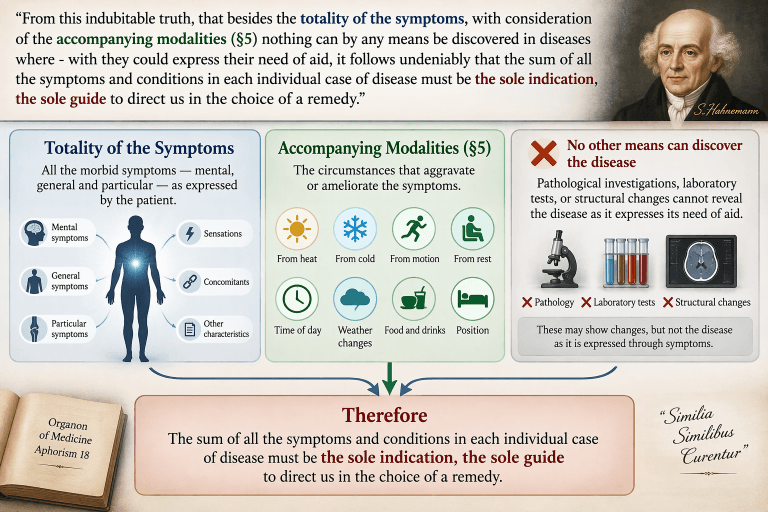
Aphorism 18 establishes that the totality of symptoms, together with their accompanying modalities, is the only reliable means of understanding disease and selecting the appropriate remedy. According to Hahnemann, disease cannot be perceived directly; it is known only through the signs and symptoms by which the disturbed vital force expresses itself. Therefore, every deviation from health has diagnostic and therapeutic significance.The physician must consider not only the symptoms themselves but also the circumstances that modify them, such as aggravations and ameliorations from motion, rest, weather, time, position, food, and other conditions. These modalities individualize the case and help distinguish one remedy from another.Hahnemann further teaches that pathological findings and structural changes may reveal the effects of disease, but they do not disclose the dynamic disturbance as clearly as the symptom totality. Consequently, the complete symptom-picture of the patient, rather than the disease name alone, must guide treatment.Thus, Aphorism 18 conveys two central truths: the totality of symptoms is the sole means of perceiving disease, and the same totality is the sole guide for selecting the curative remedy. It remains the foundation of individualization and successful homoeopathic prescribing.

HHomeoEra Journal Editorial Team
2m21
The Role of Autopsy in Investigating the Cause of Disease: A Homoeopathic Perspective
Organon & Philosophy

The Role of Autopsy in Investigating the Cause of Disease: A Homoeopathic Perspective

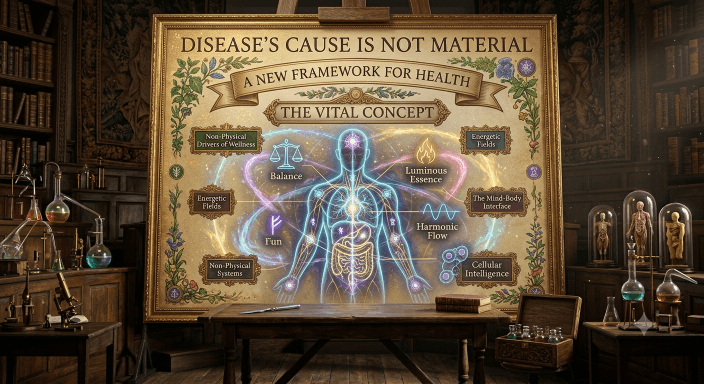
If disease originates primarily in the dynamic sphere of the living organism, then the true beginning of the disease process lies beyond the reach of post-mortem examination. An autopsy is performed upon the material body after the departure of the vital principle; therefore, it can reveal only the structural changes left behind by the disease and not the original dynamic disturbance that gave rise to them. It may demonstrate the location, extent, and pathological consequences of disease, but it cannot directly disclose the nature of the vital derangement from which those changes arose. In this sense, autopsy is invaluable for understanding the material effects and terminal expressions of disease, yet it remains limited as a means of investigating the primary dynamic cause. It informs us about the footprints of disease rather than the invisible force that first set the pathological process in motion

HHomeoEra Journal Editorial Team
6m18
Concomitant Symptoms: A Conceptual Perspective and Practical Utility - A Broad-Spectrum Analysis
Organon & Philosophy

Concomitant Symptoms: A Conceptual Perspective and Practical Utility - A Broad-Spectrum Analysis

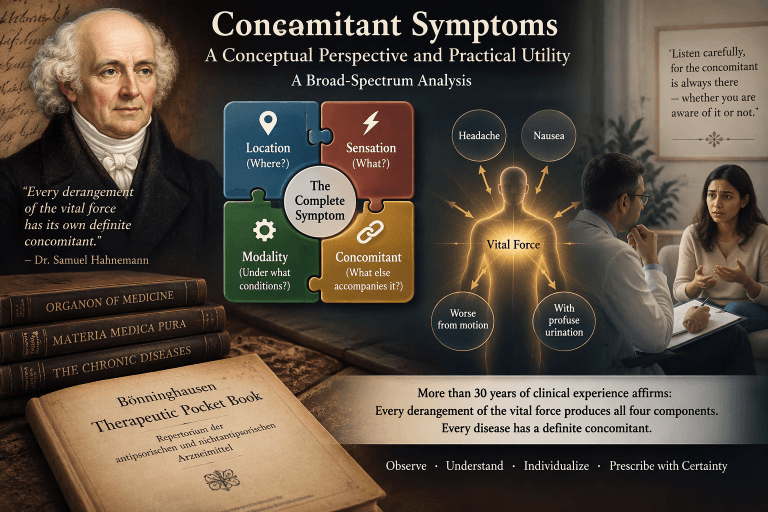
Concomitant symptoms occupy a unique position in homoeopathic philosophy and practice. While Bönninghausen regarded concomitants as the fourth indispensable element of the complete symptom, their practical application has often been misunderstood. A careful study reveals that concomitants are not merely incidental symptoms accompanying a chief complaint, nor can they be identified by a simple linguistic cue such as the word “with.” Rather, they represent definite manifestations arising from the same underlying derangement of the vital force. Drawing upon both Bönninghausen's theoretical framework and decades of clinical observation, this analysis explores the conceptual foundation, practical utility, and philosophical significance of concomitant symptoms. It argues that every genuine disease state possesses its own definite concomitant, whether readily recognized or not, and that the accurate perception of these accompanying symptoms remains one of the most important keys to individualization and successful remedy selection.

HHomeoEra Journal Editorial Team
7m22
Aphorism - 17, mission of the physician, continuation of the first aphorism: exclusion of the totality of disease.
Organon & Philosophy

Aphorism - 17, mission of the physician, continuation of the first aphorism: exclusion of the totality of disease.

Aphorism 17 emphasizes that disease can only be known through the totality of its perceptible signs and symptoms. Since the inner nature of disease is hidden from direct observation, the physician must carefully study the outward manifestations presented by the patient. These symptoms constitute the only reliable guide to understanding the disorder and selecting the appropriate remedy. Thus, successful treatment depends not upon speculative theories regarding the nature of disease, but upon an accurate appreciation of the complete symptom picture.

HHomeoEra Journal Editorial Team
6m25

Comments (0)

Sign in or sign up to join the discussion

No comments yet. Be the first to share your thoughts!

Newsletter

Stay Updated with Latest Research

Get weekly digests of new articles, case studies, and homeopathic insights delivered to your inbox

By subscribing, you agree to our Privacy Policy. Unsubscribe anytime.