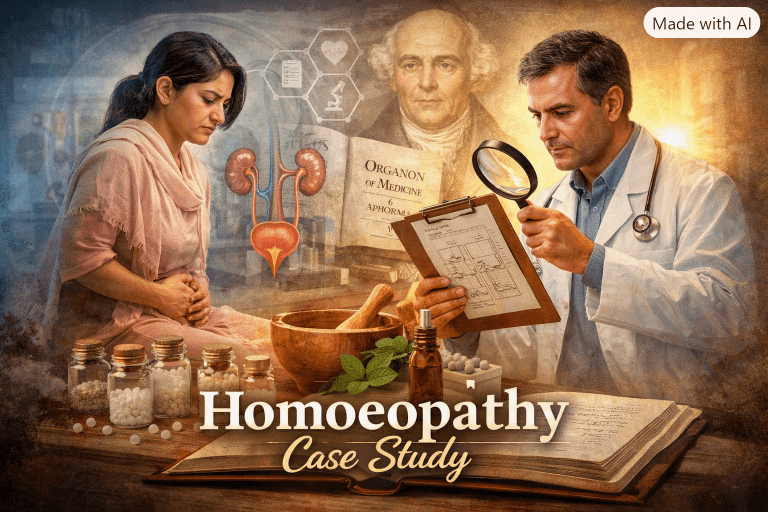
Prejudice is a natural disposition of the human mind, and in simple learning it often plays a role. We learn from our experiences — for example, when someone touches a hot glass of milk and gets burned, the experience teaches them not to touch it again with bare hands. Yet, in the context of Homoeopathy, Dr. Hahnemann reminds us in Aphorism 6 that a physician must never be prejudiced. Only through unbiased observation can true healing be achieved. Thus, learning in Homoeopathy is fundamentally different from general learning, and in this manner the Organon of Medicine always serves as a guiding light for the Homoeopathic physician.
“The ongoing case serves as a clear demonstration of how the principles of the Organon of Medicine can be implemented in daily practice. It illustrates that beyond theoretical study, the Organon provides practical guidance for the Homoeopathic physician in observing, individualizing, and treating without prejudice.
It has become our habit to recall a medicine immediately after hearing just a few words from the patient. While this tendency may arise naturally, it risks leading to prejudice in prescription. For instance, suppose a patient says, ‘Doctor, I have burning during urination.’ The physician’s mind may immediately recall the remedy Cantharis. This habitual tendency to associate a few words with a specific medicine reflects prejudice in practice. However, Homoeopathy, as guided by the Organon of Medicine, requires the physician to go beyond such instant associations and carefully observe the totality of symptoms before selecting the remedy.
A 40‑year‑old woman, with a past tendency toward typhoid fever, came to consultation with complaints of urinary tract infection accompanied by vulvinitis and abdominal discomfort. Her vitality appeared lowered, and she described alternating states of restlessness and weakness.
Her general condition revealed diminished appetite, reduced thirst, and a marked craving for salt. Food often aggravated her complaints, and she was sensitive to both heat and cold. Sleep was irregular — sometimes deep, sometimes disturbed. Interestingly, she found relief through simple modalities: oiling soothed her genital region because there is much itching, and cold drinks eased her restlessness.
Treatment was initiated, and when she returned after 15 days, she reported remarkable improvement. Nearly 80% of her urinary and abdominal complaints had subsided, leaving her visibly more comfortable and energetic.
This case became more than a clinical success; it was a living demonstration of Dr. Hahnemann’s teaching in Aphorism 6. In ordinary learning, prejudice often guides us — we recall impressions from past experiences. For example, when a patient mentions burning during urination, the physician’s mind may instantly recall Cantharis. Yet, Homoeopathy demands something higher: the physician must resist such habitual associations and instead observe the totality of symptoms without bias.
Thus, this case illustrates how the Organon of Medicine serves as a guiding light, reminding us that "true healing lies not in prejudice but in impartial observation," careful individualization, and faithful application of principles in daily practice.
1. Burning, interrupted and scanty urination.
2. Itching and burning at the vulva region, temporary relief by oiling.
3. Tympanitic abdomen with much flatulence.
4. General restlessness that gives relief by drinking cold water.
5. Periodical sick headache that worse by warm.
6. Lower extremities - with numbness and restlessness - relieved by cold drinks.
This case is cured by Lydopodium - 30, repeated dose alters every two hour 4 to 5 dose in a day.
This case clearly demonstrates the practical application of Dr. Hahnemann’s teaching in Aphorism 6 of the Organon of Medicine. The patient, suffering from urinary and abdominal complaints, experienced nearly 80% relief within 15 days of treatment. The outcome validates that true healing in Homoeopathy arises not from habitual remedy recall or prejudice, but from impartial observation of the totality of symptoms and individualized prescription.
It also highlights a common pitfall in practice — the tendency of physicians to instantly associate a few words from the patient with a specific remedy (e.g., “burning urination” with Cantharis). Such shortcuts may appear convenient but risk compromising accuracy. The Organon reminds us that Homoeopathy demands freedom from prejudice, careful case‑taking, and unbiased analysis.
Thus, this case stands as a living example of how the Organon of Medicine serves as a guiding light, ensuring that the physician remains faithful to principles, avoids premature conclusions, and achieves genuine cure through individualized treatment.