Phosphorus as a Remedy in Tongue Cancer: A Case Study
The healing power of Homoeopathic medicines in cancer is a challenging subject. Cancer is one of the most difficult conditions to treat, yet in some cases, remedies have shown clear benefit. This case of tongue cancer responded in a remarkable way to Phosphorus 1M, given in a single dose.
Dr. Samuel Hahnemann taught that a physician should never be judgmental or make assumptions about the outcome. Our duty is not to speculate, but to carefully observe how the remedy acts. In this case, Phosphorus showed its specific effect very clearly.
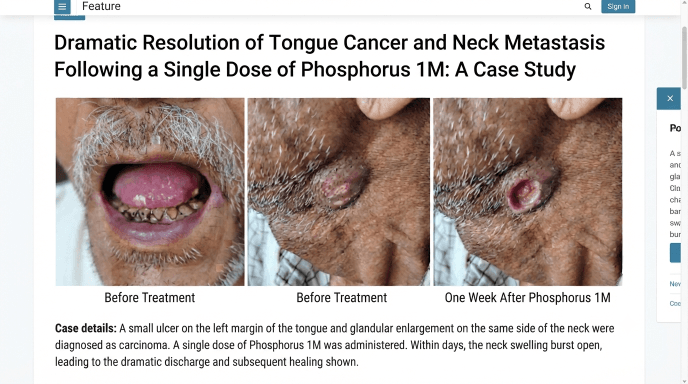
After one dose of Phosphorus 1M, the cancerous growth burst open, giving great relief to the patient. The most important change was that the patient, who had been unable to open the mouth because of the growth, was now able to do so. This improvement brought both physical comfort and emotional relief.
Such cases remind us that the physician’s role is to apply the law of similars with care and patience, allowing the remedy to show its natural action. The effect of Phosphorus here is a strong example of the lasting truth of Hahnemann’s principles.
This is a case of tongue cancer, diagnosed on the basis of symptomatology. A biopsy was not performed.
Chief Complaints:
A 70-year-old male patient presented at the clinic with the following complaints:
1. Tongue lesion – A small, white-colored ulcer located on the left margin of the tongue, associated with symptoms of tongue-tie (restricted tongue movement).
2. Neck growth – A large nodular swelling on the same side of the neck, without any signs of abscess formation and notably painless
Treatment:
1st prescription - Phosphorus - 1M (Single dose)
Outcome:
1st follow up - (Date 28/06/2026)
1.The cancerous growth on the left side of the neck burst within three days of the administration of Phosphorus 1M.
Case reception:
I received this case on 22/06/2026. The patient visited my morning clinic, seeking hope in Homoeopathy after refusing both biopsy and Allopathic treatment.
Previously, he had consulted an oncologist, who advised a biopsy before starting any treatment. The patient, however, declined the procedure and chose to consult me instead.
Clinical presentation of the case:
He had the following complaints
1. The patient had mouth and tongue ulcers on the left margin and under the tongue, persisting for six months. The condition worsened within three days.
2. The mouth ulcer was very painful, especially at night, forcing the patient to take painkillers. The ulcer was sensitive to cold water, but there were no complaints when drinking normal or warm water.
3. Neck – A large glandular swelling was present on the same side as the tongue lesion. The gland was slightly painful on pressure.
Other complaints:
1. The patient came to the clinic with a troubling complaint. For the past several weeks, he had been suffering from constipation. Passing stool was difficult, and he could only manage once in two days. This irregularity left him feeling heavy, uncomfortable, and anxious about his health. Each visit to the toilet became a struggle, and the relief was short-lived.
2. Recently, the patient noticed a change in his general condition. He had become thirstless, no longer feeling the usual desire to drink water. Even during the day, when most people naturally reach for fluids, he felt no need. This unusual absence of thirst added to his discomfort and gave a clearer picture of his declining health
Medical history:
1. The patient had a strong desire to drink cold water, especially icy or freezing water. However, each time he drank it, he developed coryza (running nose) and dyspnoea (difficulty in breathing). The craving for cold water was intense, yet it always left him feeling worse, with sneezing, nasal discharge, and shortness of breath
2. At present, the patient has no complaints related to cold. These symptoms disappeared after the development of the cancerous ulcer on the left side of the tongue and the associated glandular swelling.
Generalities:
1. Sleep: The patient was sleepless because of pain; otherwise, his condition was normal.
2. Appetite: The patient’s appetite showed an alternating nature, sometimes good and sometimes poor
3. Thirst: The patient’s thirst has recently decreased.
4. Desire: The patient has a strong desire for sweets, both in the past history and at present.
5. Perspiration – Not available (N.A.).
6. Urine – Not available (N.A.).
7. Stool – Constipation.
Live follow up:
Have a Question?
Ask Habib khan about "Phosphorus as a Remedy in Tongue Cancer: A Case Study" and get a personalized response directly to your email.
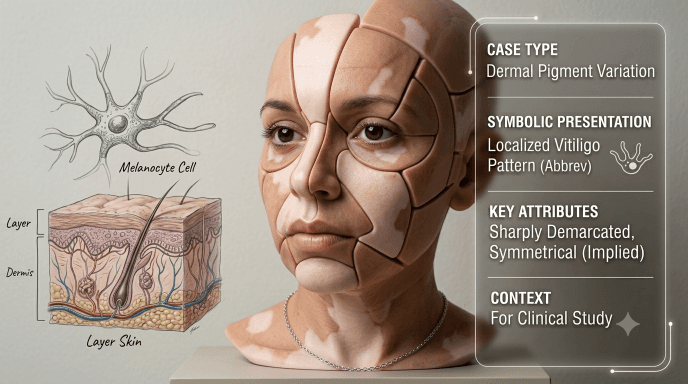
Vitiligo in pediatric patients often presents as localized depigmented patches with preserved sensation, occasionally accompanied by mild itching. In this case, a child presented with a small, depigmented area around the mouth, with normal tactile response and slight pruritus. The remedy Rhus tox was prescribed for one month. On follow‑up after three months, the lesion had to reduced up to great extent, demonstrating the curative potential of homoeopathic intervention in segmental vitiligo. This outcome highlights the importance of individualized remedy selection and supports the role of Rhus tox in cases where depigmentation is accompanied by itching and localized distribution.
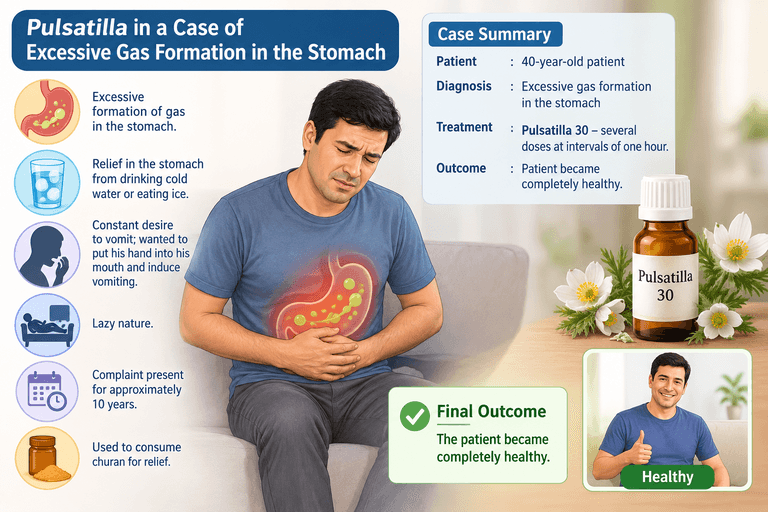
Generally, it is believed that Pulsatilla is only a medicine for women. However, this is a common misconception. It is true that Pulsatilla has provided relief to many women, and it suits complaints occurring in women that are aggravated by pregnancy. Yet, its therapeutic sphere is not confined to female constitutions alone. The remedy acts universally, provided the prescription is guided by the totality of symptoms rather than by gender stereotypes
A 40‑year‑old female presented with a constellation of chronic complaints reflecting both physical discomfort and constitutional imbalance. Urinary symptoms were marked by interrupted, scanty flow with burning, temporarily relieved by local oiling. Abdominal tympanites with frequent eructations failed to provide relief, while general soreness, laziness, and constipation added to her burden. Hair fall was noted, along with numbness and restlessness in the extremities (ameliorated by cold drinks), weakness and pain in the lower limbs, and monthly headaches beginning at the nape and settling at the vertex.
Medical history revealed a tendency toward typhoid fever. Generalities included alternating sleep, diminished appetite and thirst, craving for salt, aggravation from food, and sensitivity to both heat and cold. The peculiar modalities — relief by oiling and cold drinks — provided key individualizing features for remedy selection.
A male patient presented in a state of almost collapse, with profuse rectal haemorrhage of unknown origin. His appearance was almost cadaveric, with pallor and weakness so profound that life seemed to be ebbing away. Conventional measures offered no relief, and the urgency of the situation demanded immediate intervention. Mezereum was selected on the basis of its characteristic affinity for mucosal haemorrhage and profound exhaustion. A single dose was administered.
Within minutes, the bleeding ceased entirely, and the patient’s vitality began to return. The rapidity of the response was striking: from a state resembling near‑death, the patient revived, stabilized, and recovered without further recurrence. This case illustrates the remarkable power of the similimum, where one well‑chosen dose of Mezereum transformed a desperate situation into complete restoration.