
Case Reception:
On the evening of 28 January 2015, the patient’s elder son approached me with grave concern about his father’s deteriorating health. For the past fifteen days, the patient had been suffering from chill fever and had already undergone treatment from a reputed allopathic physician, who diagnosed malaria fever and prescribed anti‑malarial drugs. Despite this intervention, the patient’s condition worsened steadily. He was admitted to a hospital, where investigations revealed alarming pathology:
A large liver
abscess involving both right and left lobes.
Acute renal
failure, with markedly elevated urea and creatinine.
Leucocytosis
(TLC 32,000/dl).
Positive malaria
parasite test (FM method).
Blood urea:
140 mg/dl.
Serum creatinine:
3.40 mg/dl.
After prolonged allopathic treatment, the outlook was bleak. Abscess drainage was considered the only option, and renal failure was deemed incurable. At this desperate stage, the patient consulted me.
Clinical Presentation (28/01/2015):
On his first visit, the patient appeared extremely weak, barely able to walk. His complaints included:
Severe abdominal pain radiating to the right chest.
Constant ineffectual urging for vomiting.
Evening chill fever episodes.
Constipation, with no stool for seven days.
A detailed history revealed that the patient was a chronic drunkard with longstanding abdominal complaints.
Prescription:
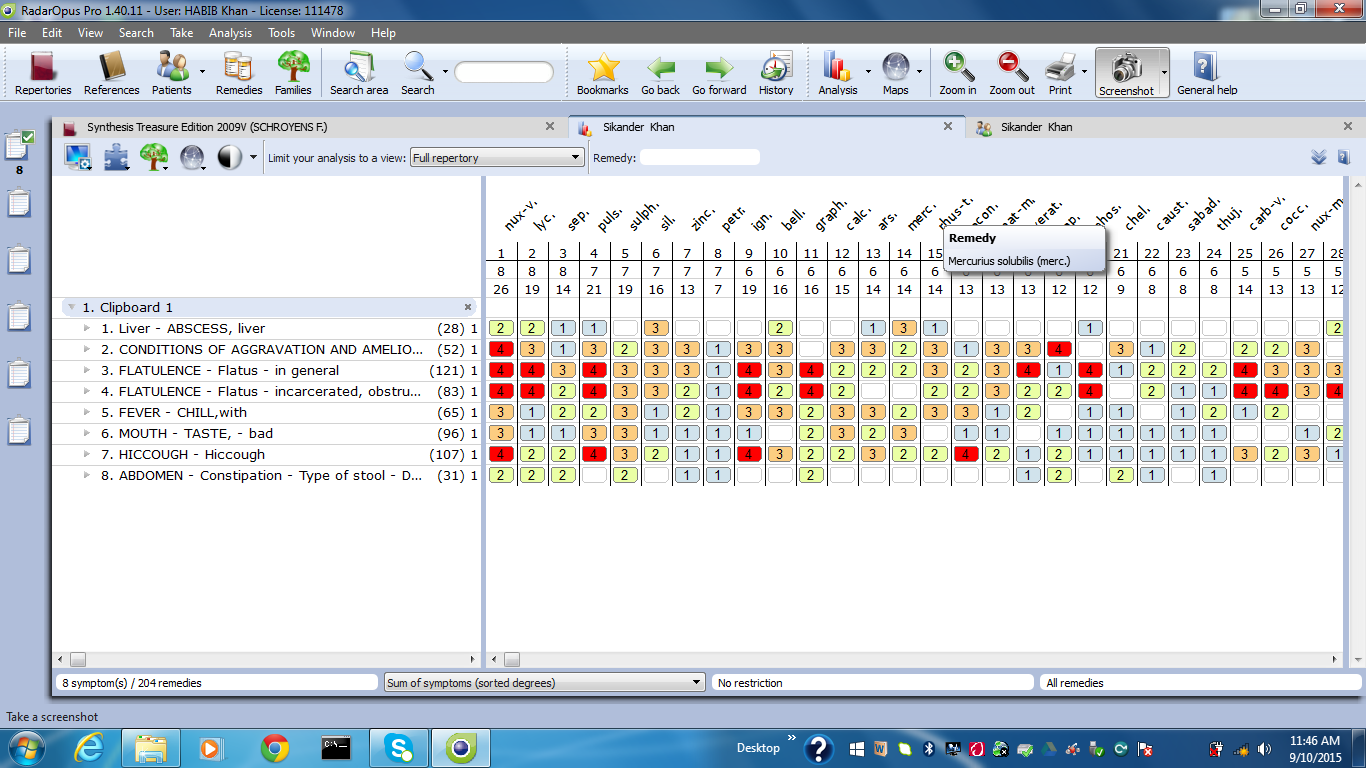
After thorough case analysis, I prescribed:
1. Nux Vomica 200 (single dose).
2. Placebo for seven days.
Follow‑Up (05/02/2015):
On review, the patient reported remarkable improvement. His only complaint was weakness. Clinical findings were:
Blood Pressure: 80/60 mmHg.
Blood Sugar (Fasting): 98 mg/dl.
Urination: Normal.
Defecation: Normal.
Thirst and appetite: Restored.
Investigations (11/02/2015):
Repeat investigations confirmed the transformation:
1. TLC count: Normalized to
11,800/cmm (previously 32,000/cmm).
2. Malaria parasite test:
Negative.
3. Blood urea: Reduced to 32.16
mg/dl (previously 140 mg/dl).
4. Serum creatinine: Reduced to
1.21 mg/dl (previously 3.40 mg/dl).
Outcome:
The liver abscess resolved spontaneously over six months. The patient was cured completely under the effect of Nux Vomica 200 and Mercurius Solubilis 30.
Conclusion:
This case illustrates the curative potential of Homoeopathic medicine in severe conditions traditionally regarded as surgical. The combined action of Nux Vomica and Mercurius Solubilis brought recovery in a patient with liver abscess and renal failure, compounded by chronic alcoholism. It stands as a testimony to the power of individualized homoeopathic prescribing in restoring vitality where conventional medicine offered little hope.