HomeoEra
Back to Blogs

Psoriasis as a Systemic Disease: Insights and Homeopathic Solutions

Psoriasis is more than a skin condition—it is a systemic autoimmune disorder that affects the skin, nails, joints, and overall well‑being. Conventional medicine views it as a chronic, incurable disease that can only be managed symptomatically. Homeopathy, however, offers a holistic approach, emphasizing treatment of the patient rather than isolated body parts. The condition commonly appears on the knees, elbows, scalp, and trunk, but can spread to other areas including the face and nails. Symptoms range from red, scaly patches and cracked skin to joint pain in psoriatic arthritis. Importantly, psoriasis is non‑contagious, though it creates a predisposition in those exposed to psoric tendencies. Homeopathic remedies such as Sulphur, Bryonia, Kalium Bichromicum, Calcarea Carbonica, and Rumex have shown promising results when prescribed according to individual symptoms. Alongside medical care, lifestyle management—balanced nutrition, stress reduction, and avoidance of triggers—plays a vital role in improving quality of life. Psoriasis challenges both body and mind, but with awareness, holistic treatment, and consistent care, patients can live fulfilling lives despite the condition

H

HomeoEra Journal Editorial Team

Updated 4 min read1730 views
Psoriasis as a Systemic Disease: Insights and Homeopathic Solutions

Psoriasis: An Overview:

Psoriasis is an autoimmune disease that cannot be permanently cured. In the allopathic system of medicine, it is considered a chronic condition that can only be managed symptomatically. Treatment focuses on controlling flare‑ups and reducing discomfort rather than achieving a complete cure.

In contrast, homeopathy offers a different perspective. According to homeopathic principles, there is no need to fear the name of the disease. If a physician carefully records all symptoms and identifies the correct similimum (the most suitable remedy), cure in cases of psoriasis is considered possible. In my own practice, I have witnessed successful outcomes in several cases.

Is Psoriasis Only a Skin Disease?

Psoriasis should not be regarded merely as a skin disorder. It can affect multiple tissues of the body, including hair, nails, bones, and the scalp. Therefore, it is wise for physicians to consider psoriasis as a systemic disease.

Dr. Samuel Hahnemann, the founder of homeopathy, emphasized: “It is the sick subject who requires treatment, not merely his organ or body parts.” This principle reminds us that medicine should be selected for the patient as a whole, not just for isolated symptoms.

Commonly Affected Areas:

  • Knees
  • Elbows
  • Scalp
  • Trunk
  • Lower back

Other regions such as the face, abdomen, genital area, and nails may also be affected.

Types of Psoriasis:

There are five major types of psoriasis:

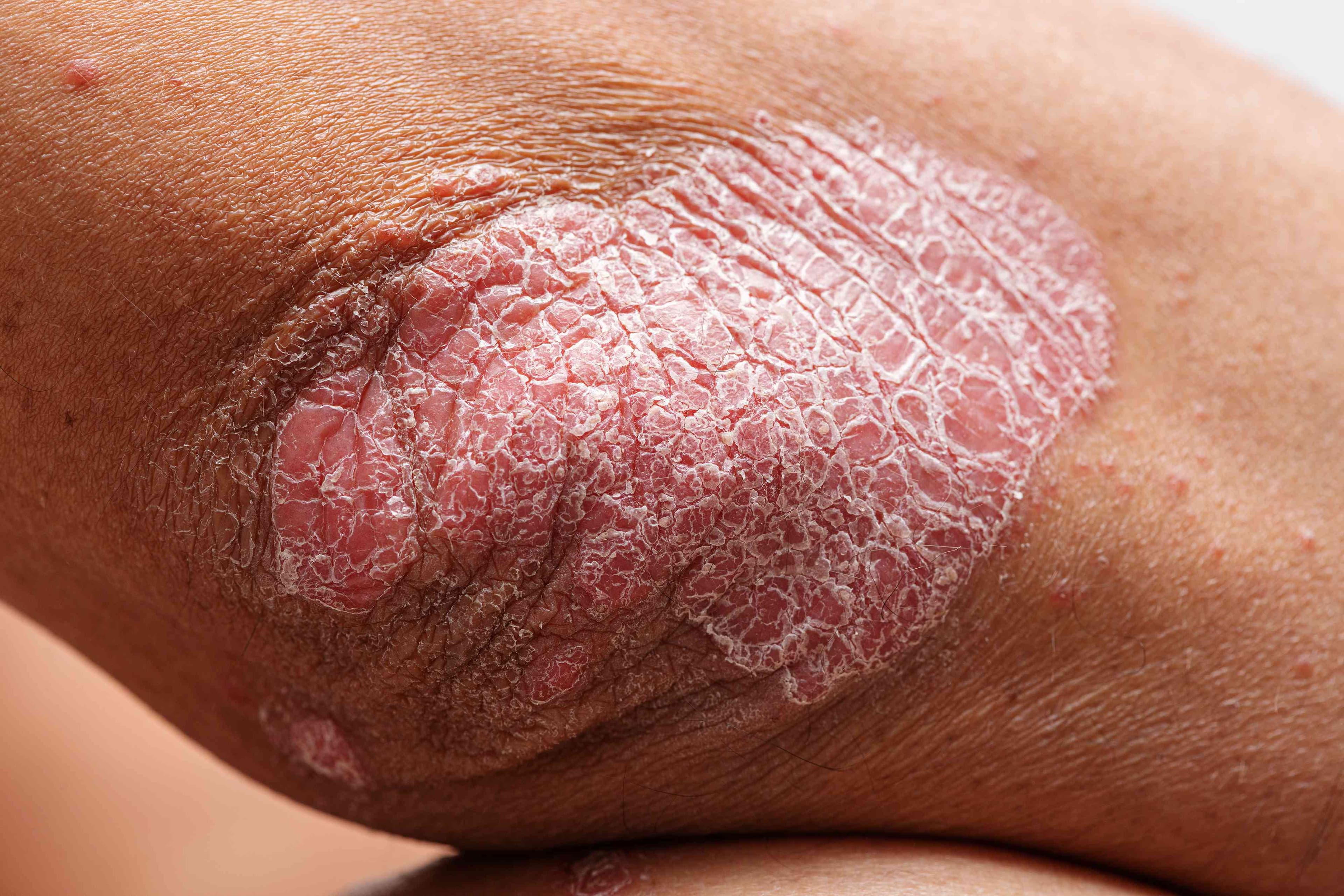
  1. Plaque Psoriasis – The most common form; raised, red patches covered with silvery‑white scales.
  2. Guttate Psoriasis – Small, drop‑shaped lesions, often triggered by infections.
  3. Inverse Psoriasis – Red, shiny lesions in skin folds such as the armpits, groin, and under the breasts.
  4. Pustular Psoriasis – White pustules (blisters filled with pus) surrounded by inflamed skin.
  5. Erythrodermic Psoriasis – Severe, widespread redness, scaling, and pain; potentially life‑threatening if untreated.

Symptoms:

  • Red patches of skin covered with thick scales
  • Dry, cracked skin that may bleed
  • Itching, burning, or soreness
  • Thickened or ridged nails
  • Joint pain (psoriatic arthritis in some cases)

Psoriasis is non‑contagious. It does not spread from person to person through touch. However, it may create a psoric predisposition in individuals who remain in close contact with those affected

Living with Psoriasis:

Managing psoriasis requires a holistic approach:

  • Maintain a healthy lifestyle with balanced nutrition and regular exercise.
  • Avoid smoking and excessive alcohol consumption.
  • Practice stress‑management techniques such as yoga or meditation.
  • Stay consistent with prescribed treatments.

Treatment Options:

Allopathic Approach

Conventional medicine focuses on symptomatic relief through topical creams, phototherapy, and systemic drugs. These treatments aim to reduce inflammation and scaling but rarely achieve permanent remission.

Homeopathic Approach

Homeopathy provides hope for patients who feel hopeless with conventional treatment. Remedies are selected based on the totality of symptoms and the patient’s constitution.

Commonly used remedies include

1.     Sulphur 200 – A single dose may provide long‑term relief in certain cases.

 2.     Bryonia 1M – Effective when eruptions worsen in winter; often requires only one dose.

 3.     Kalium Bichromicum – Useful for psoriasis that worsens during summer.

 4.     Calcarea Carbonica – Works well after Sulphur, especially when constitutional factors support its use.

 5.     Rumex – Beneficial in cases where Bryonia is insufficient

6.      Graphites - Psoriasis over entire body, with dry-cracked skin, 

7.      Petroleum - Psoriasis in chilly patient with burning feet, Psoriasis get worse in winter. 

Topical Care

Topical treatments are generally discouraged in homeopathy. However, if the patient’s skin is excessively dry and uncomfortable, coconut oil may be used as a natural moisturizer.

Lifestyle Management:

  • Stress reduction
  • Healthy diet
  • Avoiding known triggers
  • Regular moisturizing
Conclusion

Psoriasis is more than just a skin condition—it is a systemic autoimmune disorder that can affect overall health and emotional well‑being. While conventional medicine offers symptomatic management, homeopathy provides a holistic approach that considers the patient as a whole. With proper medical care, lifestyle adjustments, and awareness of triggers, individuals can lead fulfilling lives despite the challenges of psoriasis
Have a Question?
Ask HomeoEra Journal Editorial Team about "Psoriasis as a Systemic Disease: Insights and Homeopathic Solutions" and get a personalized response directly to your email.

0/500 characters

0 characters (minimum 10 required)

🔒 Privacy Notice: Your information will only be used to respond to your query and won't be shared with third parties.

Aphorism - 14, Health as Harmony: Absence of Morbid Signs and Need for Cure.
Organon & Philosophy

Aphorism - 14, Health as Harmony: Absence of Morbid Signs and Need for Cure.

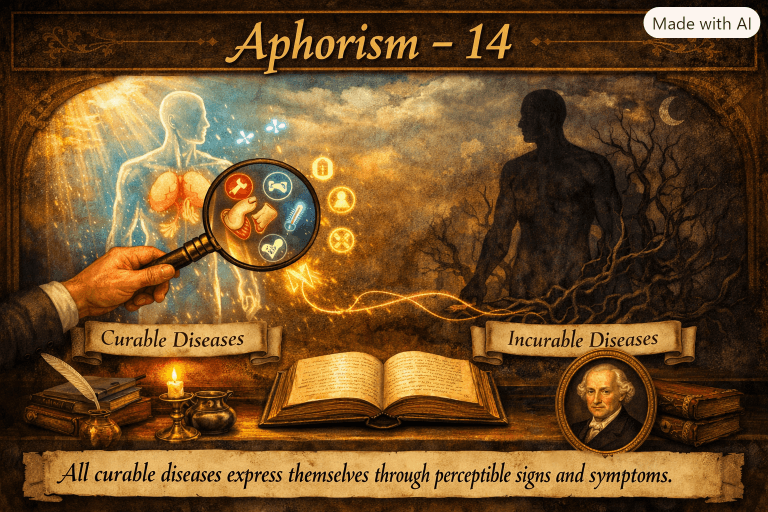
In this aphorism, Dr. Samuel Hahnemann elucidates a fundamental law of observation in medicine: that every curable disorder within the human organism necessarily reveals itself through perceptible signs and symptoms. Nothing curable remains hidden from the discerning physician, for the divine order has ordained that disease must express its presence outwardly to invite cure. Thus, the physician’s art depends entirely upon the faithful interpretation of these manifestations. The morbid phenomena are not mere disturbances but the visible language of Nature, guiding the healer toward restoration. Those affections that grow silently within, without perceptible symptoms, belong to the realm of the incurable; for where no sign is given, no curative response can be awakened. In essence, Hahnemann reminds us that symptoms are the thread of cure—the only bridge between the inner disorder and the physician’s understanding. To grasp that thread is to hold the possibility of healing; to lose it is to stand before disease without remedy.

HHomeoEra Journal Editorial Team
2m158
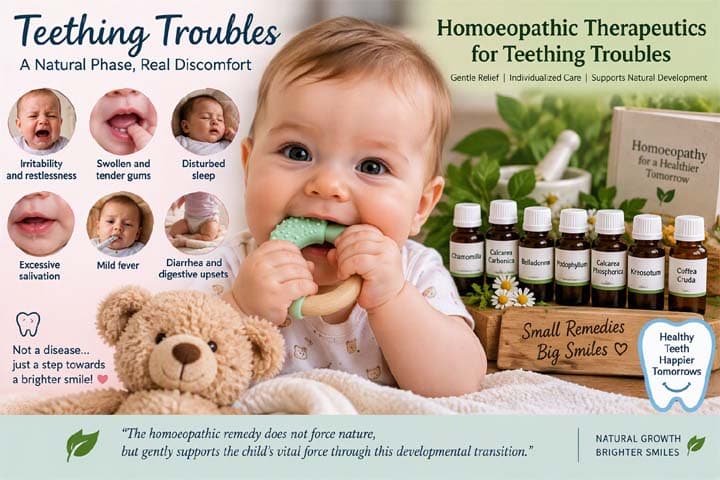
Teething Troubles in Children: Etiology, Consequences, and Homoeopathic Therapeutics.
Chronic Diseases

Teething Troubles in Children: Etiology, Consequences, and Homoeopathic Therapeutics.

Teething, though a physiological milestone, often becomes a source of systemic disturbance in susceptible children. The etiology lies not in infection but in the irritability of the gums and the heightened excitability of the nervous system, which in certain constitutions manifests as diarrhoea, fever, or even convulsions. The consequences extend beyond local discomfort, revealing deeper constitutional susceptibilities and miasmatic tendencies. Homoeopathy interprets these troubles as expressions of the disturbed vital force and prescribes remedies that correspond to the child’s individuality. Chamomilla suits the irritable, inconsolable child; Belladonna addresses febrile states with cerebral irritation; Calcarea carbonica aids delayed dentition in flabby, perspiring children; and Silicea supports delicate constitutions with poor assimilation. Thus, homoeopathic therapeutics aim not merely at palliation but at harmonizing the child’s systemic balance during this natural developmental passage

HHabib khan
8m220
Doctrine of Homoeopathy: From Vitalism to Healing
Organon & Philosophy

Doctrine of Homoeopathy: From Vitalism to Healing

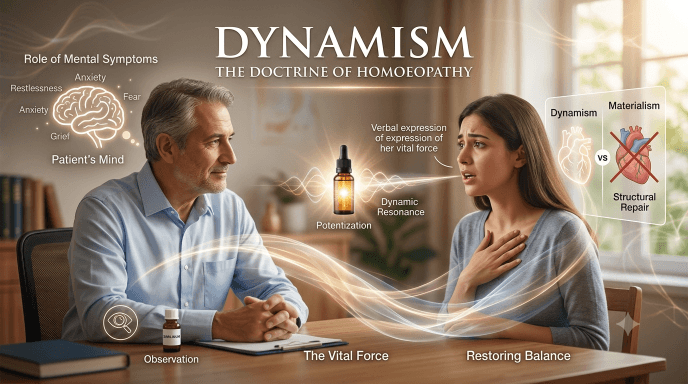
The doctrine of Homoeopathy is inseparably bound with the principle of dynamism. It does not aim at repairing the material body in isolation, but rather seeks to restore the vital force—the dynamic essence that animates life. Disease, in this philosophy, is not merely a structural defect or chemical imbalance; it is a disturbance on the dynamic plane, a disharmony of the spirit‑like energy that governs sensation and function. Homoeopathic medicine, therefore, is not material in its curative action. Prepared through potentization, it transcends crude substance and becomes a dynamic remedy, capable of resonating with the disturbed vital force. Cure is achieved not by suppressing symptoms or altering tissues directly, but by stimulating the inner harmony, allowing the body to reorganize itself from within outward. Thus, the true aim of Homoeopathy is not to treat the corporeal frame, but to re‑establish balance in the living dynamis, from which health naturally flows into the material body.

HHomeoEra Journal Editorial Team
7m295
Surgical Intervention in Homoeopathy: Necessity, Limits, and Integration
Organon & Philosophy

Surgical Intervention in Homoeopathy: Necessity, Limits, and Integration

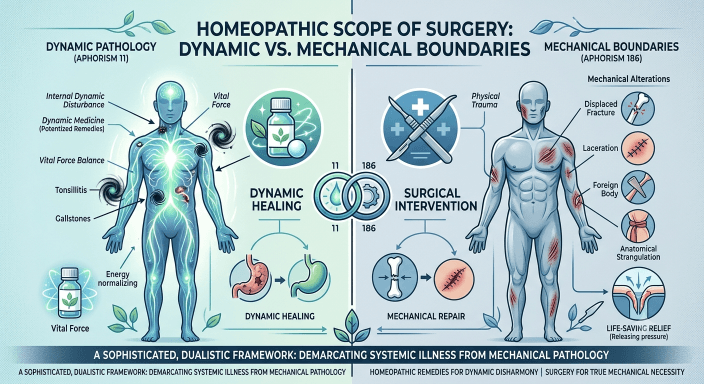
Surgery represents one of the most decisive acts in medical practice—an intervention that seeks immediate relief by removing or altering diseased tissue. Yet, within the philosophy of homoeopathy, surgery is not regarded as a primary mode of cure but rather as a necessary measure when the natural laws of healing cannot be invoked. Homoeopathy emphasizes restoration through the vital force, aiming to correct internal imbalance rather than mechanically excising its manifestations. The scope of surgery in homoeopathy lies in emergencies, irreparable structural damage, or conditions where mechanical obstruction threatens life. Its limitations, however, are evident when surgery is employed as a substitute for true cure, ignoring the deeper dynamic disturbance that gave rise to pathology. Thus, surgery may save life or prevent immediate danger, but it cannot address the underlying susceptibility that homoeopathy seeks to harmonize. In this way, surgery and homoeopathy are not adversaries but complementary disciplines. Surgery provides mechanical aid where necessary, while homoeopathy ensures the restoration of health by addressing the vital force. The ethical challenge lies in discerning when surgical intervention is indispensable and when reliance on the body’s healing potential, guided by homoeopathic remedies, is sufficient.

HHomeoEra Journal Editorial Team
4m227

Comments (0)

Sign in or sign up to join the discussion

No comments yet. Be the first to share your thoughts!

Newsletter

Stay Updated with Latest Research

Get weekly digests of new articles, case studies, and homeopathic insights delivered to your inbox

By subscribing, you agree to our Privacy Policy. Unsubscribe anytime.