HomeoEra
Back to Blogs

Heels Pain: A Disorder of Modern Lifestyle, Rooted in the Sycotic Miasm

Heel pain is a common complaint often attributed to faulty lifestyle habits such as prolonged standing, obesity, sedentary living, and inappropriate footwear. Consequently, conventional treatment mainly focuses on lifestyle modification and footwear correction. However, the condition is not always as simple as it appears. Heel pain is essentially a rheumatic affection of the calcaneus and its surrounding tissues. Its characteristic aggravation on first motion after rest, especially on rising in the morning, strongly suggests Rhus toxicodendron. Yet, despite this apparent similarity, Rhus tox frequently fails to produce the desired curative effect. This illustrates the teaching of Aphorism 7 of the Organon, that symptoms are merely the outward manifestations of internal disease and do not always reveal the true derangement of the vital force. Therefore, successful treatment of heel pain often requires looking beyond the symptom picture to the deeper constitutional and miasmatic background of the case

H

HomeoEra Journal Editorial Team

Updated 4 min read16 views
Heels Pain: A Disorder of Modern Lifestyle, Rooted in the Sycotic Miasm

Cause and effect:

It is noteworthy that heel pain, a condition widely prevalent in society, is frequently associated with faulty lifestyle habits. Both males and females are equally susceptible to this malady. According to the conventional medical system, prolonged standing, obesity, sedentary habits, inappropriate footwear, and excessive strain on the plantar fascia are regarded as the principal etiological factors responsible for heel pain. Consequently, conventional management places considerable emphasis on correcting these predisposing factors, with particular attention given to appropriate footwear and lifestyle modification.

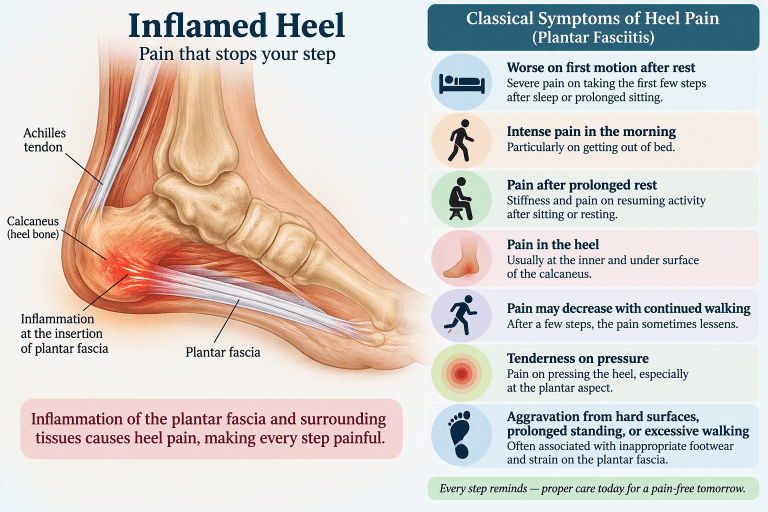
However, the underlying reality is not as simple as we may assume. In fact, heel pain is essentially a rheumatic affection of the calcaneus and its surrounding tissues. The classical symptom of heel pain, namely that the pain is aggravated on first motion after rest or sleep, or that there is intense pain on attempting to walk after prolonged rest, especially in the morning after sleep, corresponds closely to the well-known modality of Rhus toxicodendron. Nevertheless, Rhus tox often fails to bring the desired relief in many cases. 

This is a classic example illustrating Aphorism 7 of the Organon, which teaches that the symptoms are merely the outward manifestations of the internal disease. Symptoms do not always faithfully represent the actual derangement of the vital force. In cases of heel pain, Rhus toxicodendron appears to be indicated in almost every instance on the basis of the characteristic symptomatology, particularly the aggravation on first motion after rest. However, despite its apparent similarity on symptomatic grounds, Rhus tox frequently fails to produce the desired curative effect. This suggests that the physician must look beyond the superficial symptom picture and perceive the deeper nature of the disease.

Underlying Miasm:

It may reasonably be inferred that the sycotic miasm, supported by an underlying psoric foundation, constitutes a fundamental factor in the development of chronic heel pain. From a homoeopathic standpoint, the condition is frequently associated with a disturbance in the body's thermal economy, characterized by heat in the upper parts and coldness in the lower extremities, particularly the soles and heels. This altered temperature distribution may create a predisposition to rheumatic affections of the calcaneus and its surrounding tissues, ultimately manifesting as persistent heel pain. hence there are several factors that can worsen your heel pain. 

Trigging cause:

 Following are the trigging factor that can worse heel pain. 

1. Frequent walking barefoot on cold surfaces, particularly marble floors. 

2. Frequent washing of the feet, particularly in individuals who suffer from excessive perspiration of the feet.

3. Excessive indulgence may lead to a disturbance of the energy balance of the genito-urinary sphere, which, in susceptible individuals, is believed to contribute to the development of heel pain. 

4. Occasionally, diabetes mellitus is found to be associated with heel pain.

5. Increased uric acid levels may be found in association with heel pain and can be considered a secondary cause.

Common medicines.

Pulsatilla → Medorrhinum → Colchicum → Calc. fluor. → Aranea diadema → Sabina → Cyclamen → Ferrum metallicum → Agaricus muscarius → Ledum palustre → Rhododendron → Laurocerasus → Ammonium muriaticum → Berberis vulgaris → Manganum aceticum → Natrum carbonicum → Rhus tox → Valeriana → Causticum → Phytolacca → Kali carbonica → Cinnabaris → Natrum sulphuricum → Calcarea phosphorica → Borax → Chelidonium → Kalium iodatum → Thuja → Eupatorium perfoliatum → Spongia → Lycopodium → 

Brief description:

1. Heel pain burning with (Cycl., Nat-s.,)

2. Heel pain cold being amelioration (Sabin.,)

3. Heel pain with coldness of feet and legs (Sep.,)

4. Heel pain evening aggravation (Puls.,)

5. Heel pain standing on (Amm-c., Agar., Ber-v., Cycl.,)

6. Heel pain ulcerative (Amm-m., Ber-v.,)

7. Heel pain walking aggravation (Rhus-t., Cycl., Kali-c., Zinc., Colch., Kali-bi.,)

8. Heel pain walking in the open air (Cycl., Agar., Caus., Valer., Phty.,)

Note: - Heel pain is a rheumatic pain, must be treat as Rheumatism. 
Have a Question?
Ask HomeoEra Journal Editorial Team about "Heels Pain: A Disorder of Modern Lifestyle, Rooted in the Sycotic Miasm" and get a personalized response directly to your email.

0/500 characters

0 characters (minimum 10 required)

🔒 Privacy Notice: Your information will only be used to respond to your query and won't be shared with third parties.

Fever: A Broad-Spectrum Therapeutic in Homoeopathy.
General Homeopathy

Fever: A Broad-Spectrum Therapeutic in Homoeopathy.

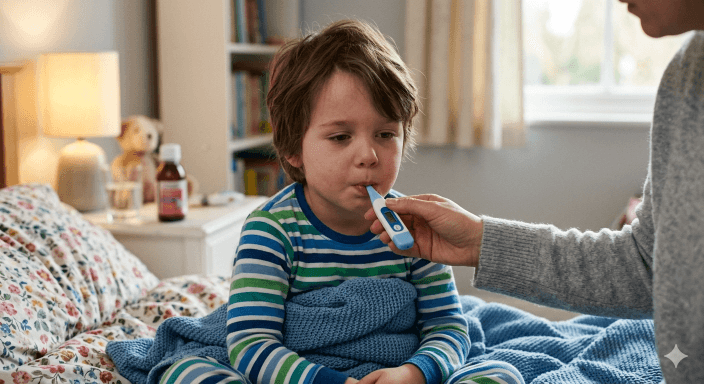
Homoeopathy is applicable in all curable cases; the real challenge, however, is in its application. This timeless statement by Dr. J.T. Kent is very true, and this is especially true in case of fever. Managing a case of fever is always challenging for a Homoeopathic physician, need patience and accuracy in the selection of medicine. Thermal symptoms are very prominent in the case of fever, require physician attention. like thirst pattern, heat distribution, sweating pattern, desire and Averion, urination and defecation etc. causative modality is also playing important role in the selection of medicine, therefore essentially must be considered. Managing fever is easy for true practitioner of healing art, under the guidance of Organon of medicine.

HHomeoEra Journal Editorial Team
5m863
Aphorism 16: The Law of Corresponding Planes, Dynamic to Dynamic and Material to Material.
Organon & Philosophy

Aphorism 16: The Law of Corresponding Planes, Dynamic to Dynamic and Material to Material.

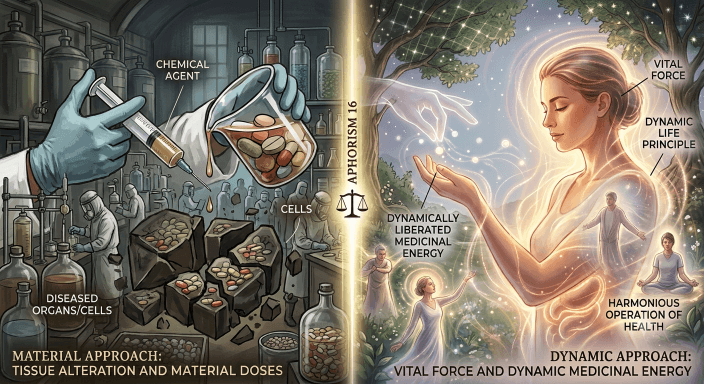
According to Dr. Hahnemann, man is an indivisible unity of the material body and the dynamic vital force, the latter being the invisible principle that animates and governs the organism. Disease originates as a disturbance of this dynamic life force and only subsequently manifests through the material body as symptoms and structural changes. Therefore, a dynamic disorder can be cured only by a dynamic medicinal influence acting upon the same plane of existence. While conventional medicine generally views disease as a material alteration of organs, tissues, or molecules and consequently employs material interventions, Homoeopathy seeks to address the underlying dynamic cause through potentized remedies. Thus, Aphorism 16 establishes the fundamental principle that the dynamic can be overcome only by the dynamic, just as the material can be influenced only by material means.

HHomeoEra Journal Editorial Team
5m13
Aphorism 15: The Unity of the Material Body and the Dynamic Vital Force.
Organon & Philosophy

Aphorism 15: The Unity of the Material Body and the Dynamic Vital Force.

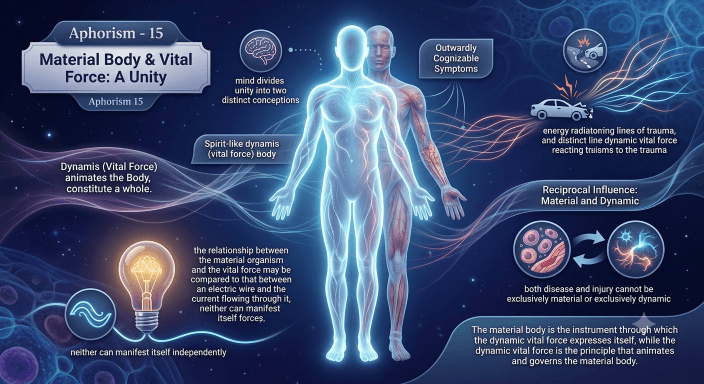
Aphorism 15 reveals the profound relationship between the material organism and the dynamic vital force. Although distinct in conception, they are so intimately united that neither can manifest itself independently of the other. The material body serves as the vehicle through which the vital force expresses itself, while the vital force animates and governs the organism. Consequently, disease often appears to originate in the physical body, whereas its true seat lies in the dynamic plane, the observable symptoms being merely the outward reflections of an internal derangement of the vital force. Likewise, when the body sustains a physical injury, such as in a road accident, the effect is not confined to the material tissues alone, but also extends to the dynamic sphere. Thus, the relationship between the body and the vital force is reciprocal and inseparable, demonstrating that every dynamic disturbance finds expression in the organism, and every profound bodily affection influences the vital force, affirming Hahnemann's doctrine of the unity of life and organism

HHomeoEra Journal Editorial Team
4m14
Badiaga in Clinical Practice: Addressing Headache and Fever Accompanied by Eye Pain.
Homeopathic Medicine

Badiaga in Clinical Practice: Addressing Headache and Fever Accompanied by Eye Pain.

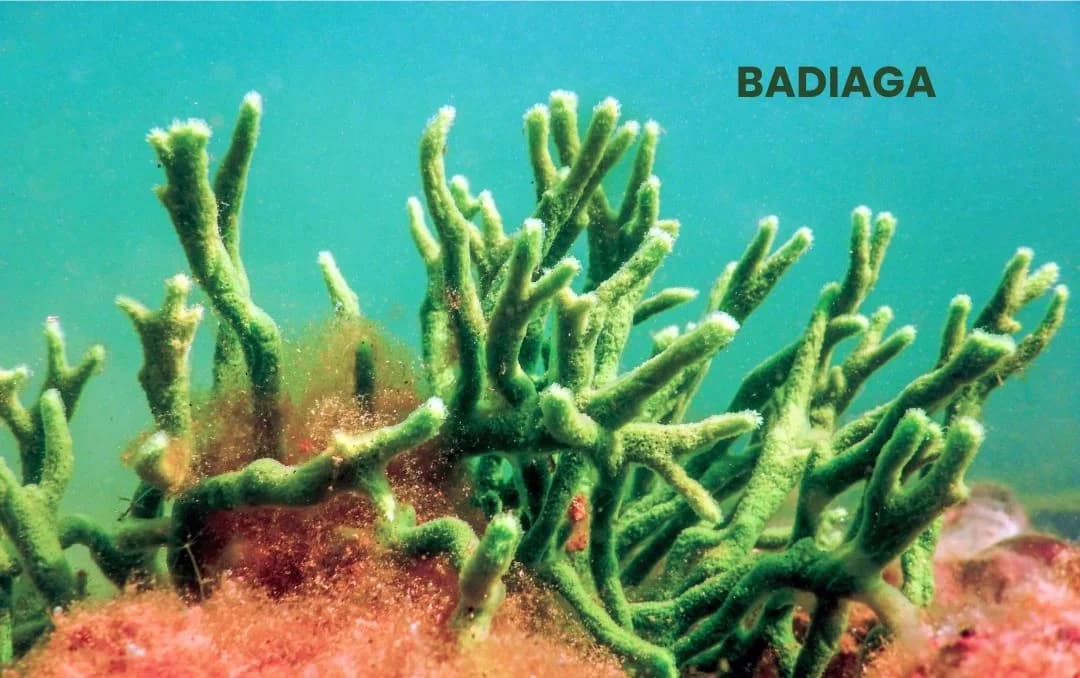
Every medicine in homoeopathic proving yields numerous symptoms, yet their value is unequal. Some are decisive and characteristic, others incidental. A symptom may be highly significant in one patient but negligible in another; the physician’s art lies in discerning those that truly individualize the case. Proving itself is not the isolated action of the drug, but the dynamic interplay between substance and prover’s constitution, producing a composite symptom‑picture. Because medicines manifest differently in different provers, separate evaluation in male and female subjects is essential, as constitutional distinctions influence expression. In practice, the same principle applies: a symptom may carry different weight in male and female patients. Hence arises the gradation of symptoms—highest rank to those repeatedly observed and clinically confirmed; lower grades to those fewer but consistent; the least to occasional or weakly verified signs. Beyond proving‑derived symptoms stand clinical symptoms: not elicited in provings, but repeatedly cured in practice. Through therapeutic verification they acquire practical value, enriching the materia medica. Thus, homoeopathy rests upon both provings and bedside confirmation, weaving together drug action and clinical experience into a reliable portrait of each remedy.

HHabib khan
5m52

Comments (0)

Sign in or sign up to join the discussion

No comments yet. Be the first to share your thoughts!

Newsletter

Stay Updated with Latest Research

Get weekly digests of new articles, case studies, and homeopathic insights delivered to your inbox

By subscribing, you agree to our Privacy Policy. Unsubscribe anytime.