
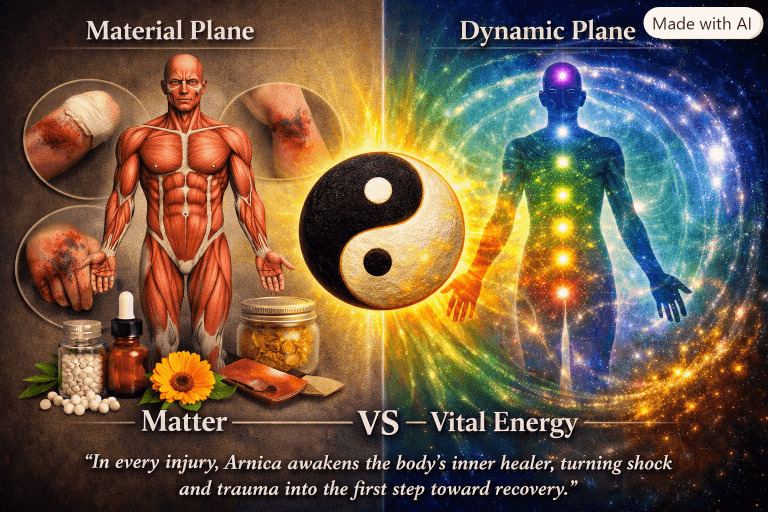
Material v/s Dynamic plane:
Our body is composed of both matter and energy. Matter provides the physical structure, while energy drives the processes that sustain life. Together, they form the foundation of our existence. Homoeopathy operates on the vital plane, yet this does not mean its effectiveness is absent on the material plane. Its influence on energy and vitality ultimately manifests in physical health and recovery.
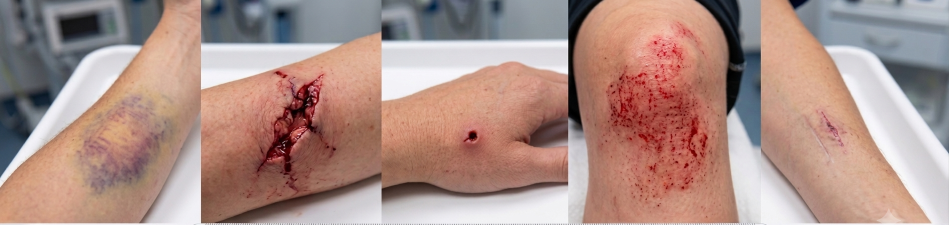
Homoeopathy is truly curative for dynamic diseases, yet it is equally effective in material conditions such as injuries and burns. By working from within outward, it stimulates the vital force to produce healing effects on external wounds, ruptured muscles, and damaged tissues. Homoeopathic medicine that are used for injurious effect of the body are broadly classified into two group. 1. Short acting local medicines and deep acting constitutional medicines.
Short Acting local medicines:
These are acute remedies that act specifically in the acute phase of injuries, burns, or any other mechanical derangement of tissue. The medicines included in this group are as follows:
1.. Arnica Montana: Undoubtedly, Arnica stands as the foremost remedy in cases of injury. Its action extends far beyond mere pain relief, addressing shock, bruising, and trauma to tissues, thereby initiating the healing process from within. It is applicable in both minor and major injuries, including head trauma. When a patient falls and sustains a head injury—with or without external bleeding—and remains in an unconscious state, Arnica is the first remedy that should come to the mind of the homoeopathic physician. Subsequently, for consequent complaints such as giddiness, nausea, or impaired vision and hearing, other homoeopathic medicines like Natrum Sulphuricum or Cicuta Virosa may prove useful.
2.
Calendula officinalis: Calendula proves to be a very useful remedy for abrasions of the skin and friction injuries, such as those commonly sustained from falling on the road or from bike accidents. Its healing action promotes rapid recovery of superficial wounds, reduces inflammation, and prevents suppuration, making it an indispensable medicine in cases of skin trauma.
Calendula officinalis (local application): The medicine should be mixed with distilled water and applied directly to the affected area. Used topically, Calendula promotes rapid healing of wounds, abrasions, and friction injuries, while reducing inflammation and preventing infection. Although it is a common notion among homoeopaths that Calendula is primarily useful in septic wounds, it is equally effective in fresh bleeding wounds. It quickly alleviates the pain of abrasion injuries and helps to restrict septic conditions.
3.
Allium cepa: Most homoeopathic physicians are not fully aware of the usefulness of this remedy in the field of injury. Beyond its well‑known action on catarrhal conditions, Allium cepa also plays a role in managing certain traumatic complaints, particularly those involving nerve irritation and lacerated wounds where sharp, cutting pain predominates. It is especially effective in cases of watery blisters caused by friction, such as those from tight shoes, and is valuable for nerve pain that arises after cutting injuries or even following amputation of extremities.
4.
Bryonia & Phytolacca: For a newly trained homoeopathic physician, it may seem dramatic to consider remedies like Bryonia or Phytolacca in the context of injury. Yet, it is indeed true. Both remedies, though classically associated with systemic or glandular affections, can play a significant role in certain traumatic conditions. Bryonia, with its keynote of aggravation from motion and relief from pressure, may be indicated in injuries involving serous membranes or musculoskeletal strain. Phytolacca, on the other hand, extends its usefulness to injuries where glandular involvement, deep tissue soreness, or inflammatory processes are prominent.
Bryonia: Bryonia is indeed useful in cases of breast injury. For example, when an infant accidentally strikes the mother’s breast during feeding, the breast may become swollen, hot, and red. In such situations, the characteristic symptoms of Bryonia—aggravation from the slightest motion and relief from rest—are clearly present. With these indications, Bryonia truly works, reducing inflammation and promoting recovery. Bryonia: Bryonia is indeed useful in cases of breast injury. For example, when an infant accidentally strikes the mother’s breast during feeding, the breast may become swollen, hot, and red. In such situations, the characteristic symptoms of Bryonia—aggravation from the slightest motion and relief from rest—are clearly present. With these indications, Bryonia truly works, reducing inflammation and promoting recovery.
5. Phytolacca: Phytolacca is equally useful in breast injuries, particularly in chronic conditions. When the breast becomes indurated and hard—almost like a cake—Phytolacca demonstrates its curative power. Its keynote indications include deep glandular involvement, hardness, soreness, and inflammation that persists beyond the acute phase. In such cases, Phytolacca complements Bryonia by addressing the chronic, glandular pathology and promoting resolution of the hardness and pain.
6. Rhus toxicodendron: The role of Rhus tox begins in cases of stretch injuries. When contusion is present, Arnica is the first remedy to be considered; however, once the bruising has been addressed, Rhus tox becomes valuable for managing the residual strain and sprain. In situations where a stretch injury occurs without contusion, Rhus tox should be prescribed as the primary remedy. Its keynote indications include pain and stiffness that improve with continued motion, soreness of ligaments and tendons, and aggravation during rest
7. Ruta graveolens: Ruta is another highly valuable remedy in cases of stretch injuries, often used alongside Rhus toxicodendron. While Rhus tox is indicated for ligament and tendon strain aggravated by rest and relieved by motion, Ruta should be thought of first when the injury involves deeper structures—particularly the periosteum and bones. Its sphere of action includes bruised soreness of bones, joints, and tendons, making it indispensable in traumatic conditions where bone injury or periosteal involvement is present.
8. Ledum palustre: Ledum is a highly valuable remedy in the field of injury, particularly for punctured wounds, bites, and stings. Its keynote indication is the peculiar modality: cold applications relieve, while warmth aggravates. This makes it distinct from many other trauma remedies. Ledum is especially useful in cases of deep puncture wounds from sharp instruments, animal bites, or insect stings, where the affected part becomes swollen, painful, and cold to the touch. It also plays a role in preventing septic conditions and is often considered when injuries show a tendency to ascend (pain moving upward along the limb).
9. Hypericum perforatum: Hypericum is one of the foremost remedies for injuries involving nerves. Its sphere of action is marked by lacerated wounds, crushed fingers or toes, and injuries where nerve‑rich tissues are affected. The keynote symptom is intense, shooting, or radiating pain disproportionate to the visible injury. It is particularly valuable in puncture wounds, spinal injuries, and trauma to areas rich in nerve endings (such as fingertips, lips, and genitals). Hypericum not only alleviates severe neuralgic pain but also helps prevent complications like tetanus
2. Deep acting constitutional medicine:
Nitric Acid → Conium Maculatum → Bellis Perennis → Calcarea Carbonica → Carbo Animalis → Calc flour → Arsenic → Calc sulph → Camphor → Causticum → Acetic Acid → Acid sulph → Amm mur → Symphytum → Millefolium → Anguestura → Staphisagria → Phosphorus →