
Fever Management in Homoeopathy: The Art of Remedy Differentiation between Eupatorium perfoliatum and Ipecacuanha
Both Eupatorium perfoliatum and Ipecacuanha are valuable remedies in bilious and intermittent fevers, sharing many similar clinical features. In both the remedies the liver appears to be an important seat of action. The fever is commonly accompanied by chilliness and headache, often making their differentiation a matter of careful observation. Nausea may also occur in Eupatorium perfoliatum, but it is far more prominent and characteristic of Ipecacuanha. Indeed, the persistent and distressing nausea of Ipecacuanha frequently serves as a key guiding symptom in distinguishing it from Eupatorium, despite their otherwise similar febrile manifestations.
In a similar manner, bone pain is a leading characteristic of Eupatorium perfoliatum and constitutes one of its most prominent guiding symptoms. Although Ipecacuanha may also present with pains in the bones and back during fever, these symptoms are much less marked and do not attain the same degree of intensity or clinical importance as they do in Eupatorium. Thus, while nausea points strongly toward Ipecacuanha, severe aching and soreness of the bones favor Eupatorium perfoliatum. This illustrates that, in remedy selection, the mere presence of a symptom is not sufficient; its intensity, prominence, and relative importance must also be carefully considered.
1. Heat pattern:
Ipecac:
Generally, Ipecacuanha is regarded as a chilly remedy. Every chilly remedy possesses a characteristic pattern of heat and thermal reaction, and the same principle applies to remedies that are classified as hot. Thus, the distinction between chilly and hot medicines does not imply an absolute absence of the opposite thermal state; rather, each remedy exhibits its own characteristic relationship to heat and cold. In other words, no remedy is strictly or entirely hot or chilly. Each medicine manifests a characteristic balance of thermal states, although one tendency may predominate over the other.
Although Ipecacuanha is generally classified as a chilly remedy, it exhibits a distinct pattern of heat manifestations during febrile conditions. Its heat appears to be concentrated internally, extending from the gastric region toward the head, a tendency reflected by the characteristic perspiration of the head during fever. Photophobia is frequently a prominent concomitant symptom in such cases. Moreover, when diarrhoea occurs in association with the fever, it is usually aggravated by the heat of summer, further illustrating the remedy's characteristic thermal reactivity.
Eupatorium perf:
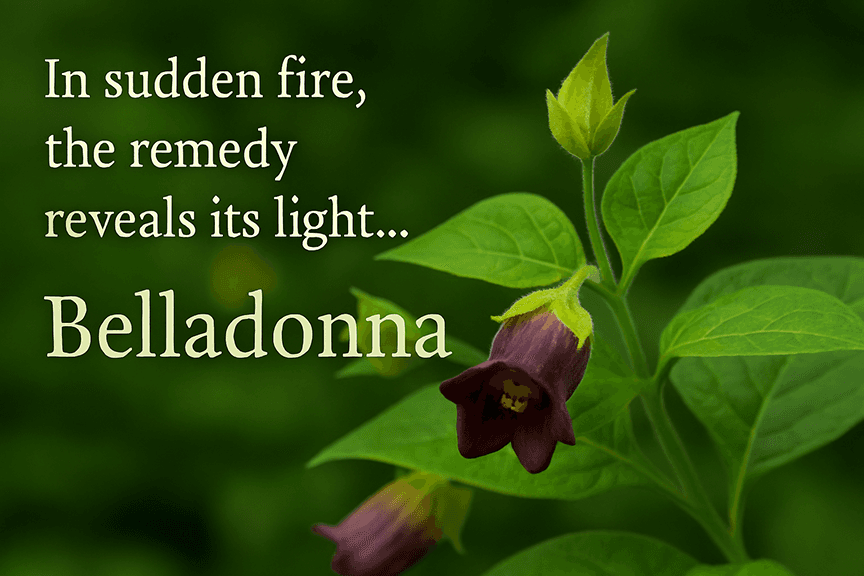
Intense heat is accompanied by severe headache and marked photophobia. The febrile heat persists throughout the day, showing some remission only in the morning. The heat may become as intense as that observed in Belladonna, characterized by dry, burning heat with an absence of perspiration.
Thirst: There is an intense thirst for cold water, resembling the thirst observed in Arsenicum album and Apocynum cannabinum. However, despite the strong desire for cold drinks, the water is not well tolerated and is soon vomited after ingestion. Vomiting commonly occurs toward the end of the chill stage, providing a distinctive characteristic of the remedy.
2. Chill stage:
Ipecac:
As we know, Ipecacuanha is an important remedy for intermittent fever. Chilliness is an essential feature of this type of fever. The ears may be cold while the rest of the body remains warm. The chill commonly begins in the morning, between 9 and 11 a.m. Another characteristic feature is that the chilliness may be aggravated in a warm room.
Thirst: Ipecac is a thirstless medicine, but its thirst becomes prominent in the condition of abortion and during chillness. During abortion ipecac show the symptoms of great thirst with the symptoms of pain in the region of heart and dryness of mouth, here Ipecac shows its relationship with Arsenic album. similarly, Ipecac shows the symptoms of intense thirst during chillness that get worse by external heat or in a warm room.
Eupatorium perf:
Chill: The chill generally occurs in the morning and may be accompanied by slight perspiration. After the chill subsides, the body remains hot for the rest of the day. During the chill stage, there is a marked desire to be warmly covered, a feature reminiscent of Nux vomica. Vomiting commonly occurs toward the end of the chill stage, just as the heat stage begins, forming a characteristic transition in the fever paroxysm
3. Sweat stage:
Ipecac:
Sweat: Perspiration does not relieve the patient. Even its chief guiding symptom, nausea, remains completely unchanged after sweating. Unlike the usual fever pattern, in which perspiration follows the heat stage, sweat in Ipecac often appears during the heat stage itself. The perspiration is generally scanty and insufficient, having little or no power to lessen the intensity of the fever or modify the heat stage.
Eupatorium perf:
Sweat: Perspiration is generally absent during the fever. When it does occur, it relieves nearly all the accompanying symptoms, with the notable exception of the headache, which often persists. This feature sharply contrasts with Ipecacuanha, where perspiration affords little or no relief. In Ipecac, the characteristic nausea remains unchanged despite sweating, whereas in the present remedy the bone pains are often relieved by perspiration, although the headache continues unabated.
Key differenciating point Ipecac and Eupatorium perf.
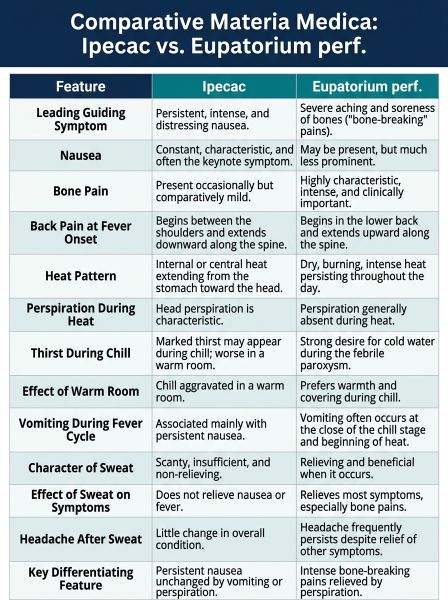
Other related medicine with Ipecac & Eupatorium in case of fever.
Arsenic, Natrum mur, Bryonia, Rhus-tox, Arnica, Pyrogenum. Gelsimium, Aloe, Sulphur,
Clinical Note: Eupatorium perfoliatum should also be compared with Bryonia alba, particularly in cases of bilious fever. Both remedies share key characteristics, including headache, bilious vomiting, and a slow, lingering fever accompanied by yellow urine. Additionally, nearly all complaints—especially the headache and cough—are aggravated by motion. Natrum mur and Sepia are the natural complementary and chronic of Eupatorium in case of fever.