HomeoEra
Back to Blogs

Aphorism - 3, (Ascertaining Power of the Physician, Must Ensure the Cure)

In this aphorism, Dr. Hahnemann addresses the physician, emphasizing the essential qualities required to ensure a permanent cure. The physician must possess the ability to perceive what is curative in the sick individual (knowledge of disease indications). He must also understand the curative power of medicines, grasp how this healing power should be adapted to the specific sickness, and finally, remain aware of the possible hindrances to cure.

H

HomeoEra Journal Editorial Team

Updated 4 min read1194 views
Aphorism - 3, (Ascertaining Power of the Physician, Must Ensure the Cure)

A true healer is one who perceives disease, understands medicine, applies it with precision, and removes obstacles to lasting recovery.

Aphorism - 3,

“ if the physician clearly perceives what is to be cured in disease, that is to say, in every individual case of disease, (knowledge of disease, indication), if he clearly perceives what is curative in medicine, that is to say, in each individual medicine (Knowledge of medicinal powers), and if he knows how to adapt, according to clearly defined principles, what is curative in medicines to what he has discovered to be undoubtedly morbid in the patient, so that the recovery must ensue – to adapt it, as well in respect to the suitability of the medicine most appropriate according to its mode of action to the case before him (choice of the remedy, the medicine indicated), as also in respect to the exact mode of preparation and quantity of a required (proper dose), and the proper period for repeating the dose; - if, finally, he knows the obstacles to recovery in each case and is aware how to remove them, so that the restoration may be permanent, then he understand how to treat judiciously and rationally, and he is a true practitioner of the healing art.”

Or

(in the simplest way)

Everything those are observed in the patient by Physician are not the subject of treatment, if the physician has the enough power of perception, there is something that must be pointed out. And that one is different for every sick individual. In the same manner, same fact is true about the medicine, every medicine has its own hidden curative power, and physician must be aware about the true curative power of the medicine.  He must be aware about the principle (law of Similia) and its adaptation to the sickness. He also knows about the preparation of medicine, dose selection and repetition and the causes that are producing hindrance in the cure. So, cure must be ensured. Now he is the true physician of healing art.

Word meaning and explanation:

perceives - the word is derived from the word perception, infect perception is not a term, but it is a process, by which an individual, interpret, organize sensory information to give their meaning. power of perception is different by person to person. every person has its unique power of perception. 

Morbid - something apart from the normal, always the subject of treatment, object of perception by physician, which is undoubtedly morbid have to search by the physician in the bunch of symptomatology. 

Obstacles - hindrance or resistant. there is some dynamic power, that produce hindrance or resistant during the action of medicine, physician must be aware about that hindrance or resistance and that is nothing but the fundamental and maintaining cause.  

Explanation of Aphorism - 3 (Story form)

In this aphorism, Dr. Hahnemann spoke about the qualities of a physician. One of the most important qualities of a physician is the power of perception. While we are concerned with the symptomatology of the patient and the medicine, not every symptom is useful for the selection of medicine. The concept of the evolution of symptoms originated here. Physicians must use their power of perception to choose the correct medicine. They have to pick out which symptoms are useful and which are useless, as these differ from patient to patient and from medicine to medicine. In fact, we need to individualize both the patient and the medicine. That is why Homoeopathy has no specific medicine for a specific disease.

The physician must be aware of the natural law of cure, which is the law of similia. He must also understand the principle of how to adapt the curative power of medicine to sick individuals. Finally, he must have knowledge about the hindrances in the procedure of cure, including the fundamental and maintaining causes of disease. A physician must also have knowledge about the preparation of medicine, dose selection, and repetition.

These qualities transform an ordinary physician into a true physician of the healing art—a soldier of the Hahnemannian Army.
Have a Question?
Ask HomeoEra Journal Editorial Team about "Aphorism - 3, (Ascertaining Power of the Physician, Must Ensure the Cure)" and get a personalized response directly to your email.

0/500 characters

0 characters (minimum 10 required)

🔒 Privacy Notice: Your information will only be used to respond to your query and won't be shared with third parties.

Aphorism 18: The Totality of Symptoms as the Fundamental Basis for Remedy Selection
Organon & Philosophy

Aphorism 18: The Totality of Symptoms as the Fundamental Basis for Remedy Selection

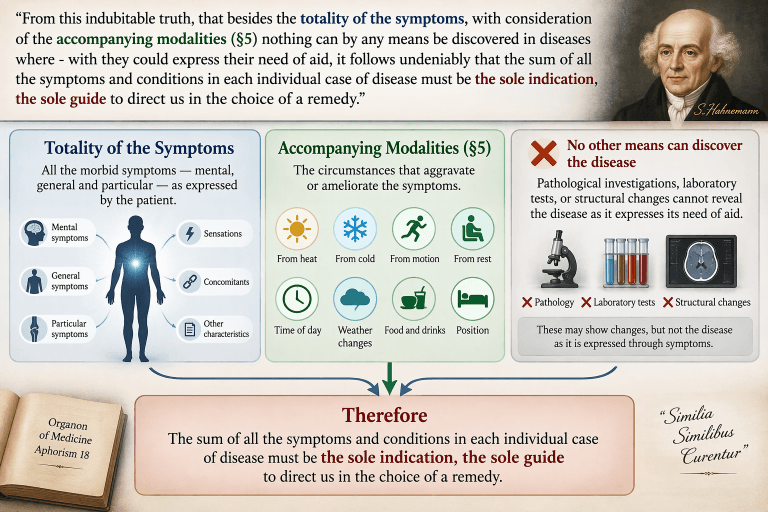
Aphorism 18 establishes that the totality of symptoms, together with their accompanying modalities, is the only reliable means of understanding disease and selecting the appropriate remedy. According to Hahnemann, disease cannot be perceived directly; it is known only through the signs and symptoms by which the disturbed vital force expresses itself. Therefore, every deviation from health has diagnostic and therapeutic significance.The physician must consider not only the symptoms themselves but also the circumstances that modify them, such as aggravations and ameliorations from motion, rest, weather, time, position, food, and other conditions. These modalities individualize the case and help distinguish one remedy from another.Hahnemann further teaches that pathological findings and structural changes may reveal the effects of disease, but they do not disclose the dynamic disturbance as clearly as the symptom totality. Consequently, the complete symptom-picture of the patient, rather than the disease name alone, must guide treatment.Thus, Aphorism 18 conveys two central truths: the totality of symptoms is the sole means of perceiving disease, and the same totality is the sole guide for selecting the curative remedy. It remains the foundation of individualization and successful homoeopathic prescribing.

HHomeoEra Journal Editorial Team
2m21
The Role of Autopsy in Investigating the Cause of Disease: A Homoeopathic Perspective
Organon & Philosophy

The Role of Autopsy in Investigating the Cause of Disease: A Homoeopathic Perspective

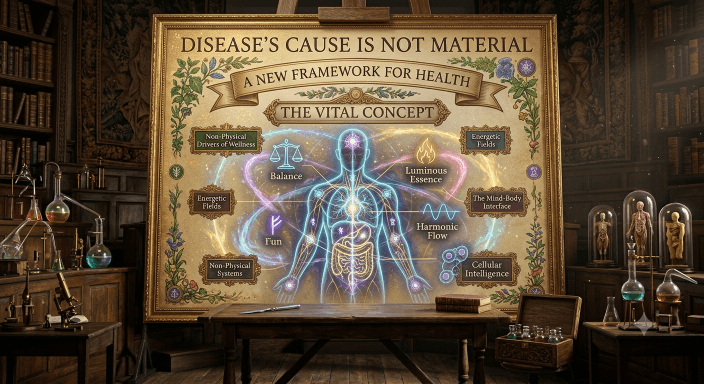
If disease originates primarily in the dynamic sphere of the living organism, then the true beginning of the disease process lies beyond the reach of post-mortem examination. An autopsy is performed upon the material body after the departure of the vital principle; therefore, it can reveal only the structural changes left behind by the disease and not the original dynamic disturbance that gave rise to them. It may demonstrate the location, extent, and pathological consequences of disease, but it cannot directly disclose the nature of the vital derangement from which those changes arose. In this sense, autopsy is invaluable for understanding the material effects and terminal expressions of disease, yet it remains limited as a means of investigating the primary dynamic cause. It informs us about the footprints of disease rather than the invisible force that first set the pathological process in motion

HHomeoEra Journal Editorial Team
6m18
Concomitant Symptoms: A Conceptual Perspective and Practical Utility - A Broad-Spectrum Analysis
Organon & Philosophy

Concomitant Symptoms: A Conceptual Perspective and Practical Utility - A Broad-Spectrum Analysis

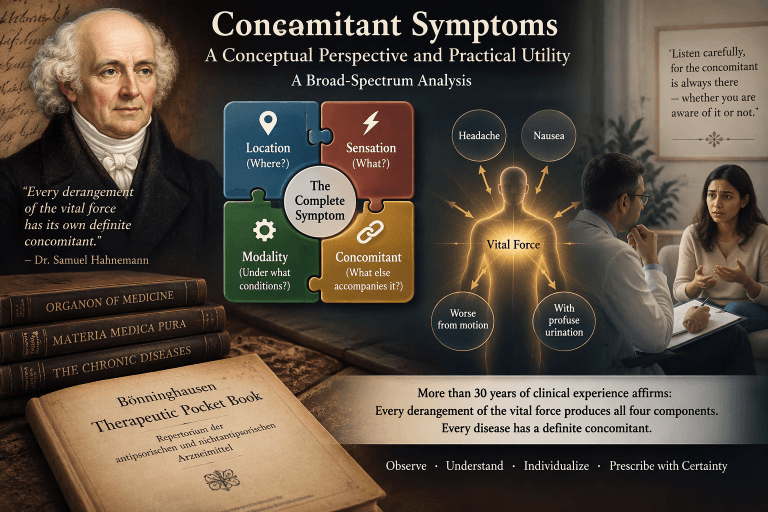
Concomitant symptoms occupy a unique position in homoeopathic philosophy and practice. While Bönninghausen regarded concomitants as the fourth indispensable element of the complete symptom, their practical application has often been misunderstood. A careful study reveals that concomitants are not merely incidental symptoms accompanying a chief complaint, nor can they be identified by a simple linguistic cue such as the word “with.” Rather, they represent definite manifestations arising from the same underlying derangement of the vital force. Drawing upon both Bönninghausen's theoretical framework and decades of clinical observation, this analysis explores the conceptual foundation, practical utility, and philosophical significance of concomitant symptoms. It argues that every genuine disease state possesses its own definite concomitant, whether readily recognized or not, and that the accurate perception of these accompanying symptoms remains one of the most important keys to individualization and successful remedy selection.

HHomeoEra Journal Editorial Team
7m22
Aphorism - 17, mission of the physician, continuation of the first aphorism: exclusion of the totality of disease.
Organon & Philosophy

Aphorism - 17, mission of the physician, continuation of the first aphorism: exclusion of the totality of disease.

Aphorism 17 emphasizes that disease can only be known through the totality of its perceptible signs and symptoms. Since the inner nature of disease is hidden from direct observation, the physician must carefully study the outward manifestations presented by the patient. These symptoms constitute the only reliable guide to understanding the disorder and selecting the appropriate remedy. Thus, successful treatment depends not upon speculative theories regarding the nature of disease, but upon an accurate appreciation of the complete symptom picture.

HHomeoEra Journal Editorial Team
6m25

Comments (1)

Sign in or sign up to join the discussion

H
Habib khanApr 26, 2026

I'am a soldier of Hahnemanian Army, are you?

Newsletter

Stay Updated with Latest Research

Get weekly digests of new articles, case studies, and homeopathic insights delivered to your inbox

By subscribing, you agree to our Privacy Policy. Unsubscribe anytime.