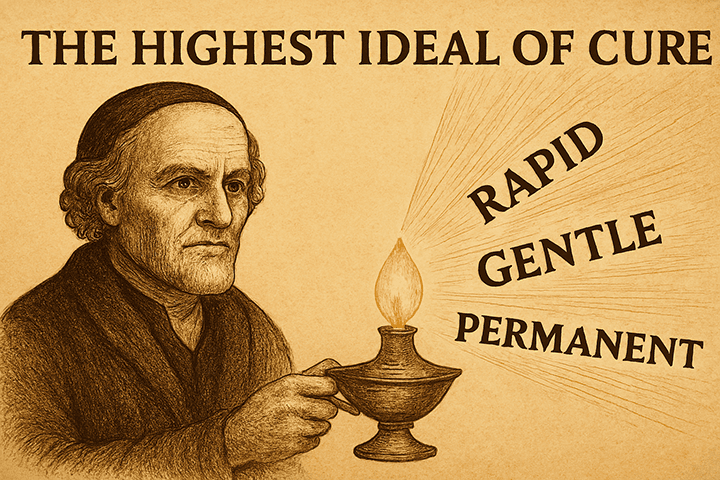
Aphorism - 2
“The highest ideal of cure is rapid, gentle and permanent
restoration of the health, or removal and annihilation of the disease in its
whole extent, in the shortest, most reliable and most harmless way, on easily
comprehensive principles”
Or
(In the simplest way)
"Cure should be rapid,
gentle, and lasting. The disease must be removed in its entirety, within the
shortest possible time, in a reliable manner, and without causing harm to the
patient—guided always by principles that are clear and easy to understand."
Highest Ideal:
Aphorism 2 is closely related to Aphorism 1. In Aphorism 1, Dr. Hahnemann discusses the mission of the physician, which is to obtain a cure. In Aphorism 2, he explains the nature and quality of the cure that should be achieved.
Rapid (Fast):
The cure should be quick. The common statement in the present era that “homeopathy acts slowly” is completely denied by Dr. Hahnemann in this aphorism, as he clearly states that the cure must be rapid.
Gentle (Without Pain or Suffering):
In modern homeopathic practice, many patients complain that after taking Homoeopathic medicine their symptoms worsen or new complaints appear. Physicians often reassure them that this is normal in homeopathy. It was Dr. Kent who first advocated such aggravations, describing 12 types of medicinal actions in his “Kent’s 12 Observations.” However, Dr. Hahnemann never discussed such aggravations in the Organon of Medicine. He only referred to the “slightest aggravation of presenting symptoms” due to an overpower dose of the homeopathic medicine.
Prolonged aggravations, the appearance of new symptoms, or the development of new diseases should not be considered gentle cures. These occur only due to improper selection of medicine.
Permanent:
This term is often misunderstood by both physicians and patients. Permanent does not mean that the disease will never return or that the patient will never fall sick again. If the same dynamic cause reappears, the individual will certainly become ill once more.
Here, “permanent” means that in the absence of a returning cause, the patient’s symptoms must not recur. Dr. Hahnemann provides a criterion to ascertain permanence: if the physician is able to remove all signs and symptoms of the patient completely (from head to foot), he may be assured that the cure is permanent.
In the Shortest, Most Reliable, Most Harmless Way:
In the series on gentleness, Dr. Hahnemann further emphasizes that the cure must be obtained within a short span of time, guided by clearly defined principles, without causing suffering. Such a cure can only be achieved through a simple and comprehensible principle—namely, the Law of Similia, as mentioned in Aphorism 26 of the Organon of Medicine.
Long ago, in a quiet study lit by candlelight, Dr. Samuel Hahnemann sat reflecting on the mission of the physician. He had already declared in Aphorism 1 that the physician’s duty is to cure. But now, he asked himself: What kind of cure should it be?
He imagined a suffering patient—a man worn down by illness, longing for relief. The physician approaches, not with harsh instruments or painful remedies, but with wisdom and compassion.
“The cure,” Hahnemann thought, “must be three things: rapid, gentle, and permanent.”
- Rapid: The patient should not wait endlessly for relief. Just as a thirsty traveler long for water immediately, so too must the cure act swiftly. Hahnemann rejected the notion that homeopathy is slow. To him, a true cure must come with speed.
- Gentle: The physician must heal without adding suffering. Hahnemann envisioned a treatment that soothed rather than tormented. He did not accept prolonged aggravations or the appearance of new diseases as part of healing. If such things occurred, it was not gentleness—it was error in prescribing.
Permanent: The cure must last. Hahnemann explained that “permanent” does not mean the patient will never fall ill again. Life’s dynamic causes may return. But if the physician has truly removed all signs and symptoms from head to foot, then the cure of that illness is complete and enduring.Finally, Hahnemann added a guiding principle: the cure must be achieved.
in the shortest, most reliable, and most harmless way. No complicated theories, no unnecessary suffering—only the clear and simple law of Similia, “like cures like,” as he would later describe in Aphorism 26. And so, Aphorism- 2 became not just a definition, but a vision—a story of the physician’s highest ideal. A cure that is swift as the wind, gentle as a mother’s touch, and lasting as truth itself.