HomeoEra
Back to Cases

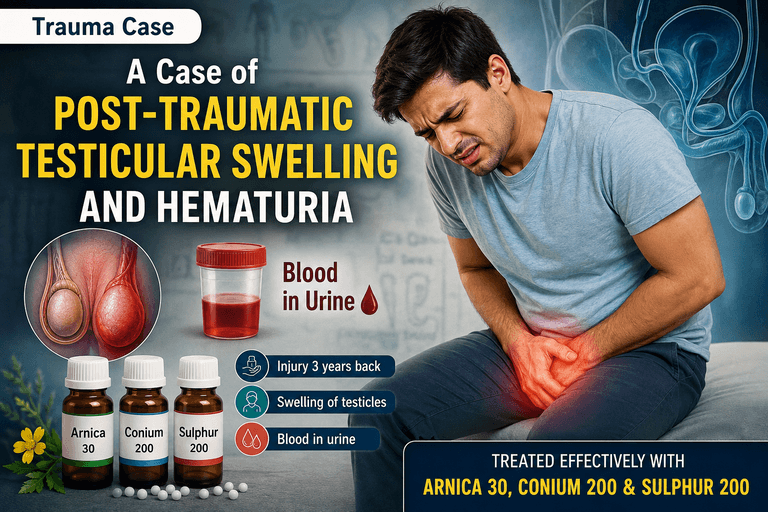
Traumatic Testicular Swelling and Hematuria

This case describes a 20–21-year-old male who developed swelling of the testicles and blood in the urine three years after an injury to the testicles. The case was managed with Arnica 30, Conium 200, and Sulphur 200 at different stages. The swelling subsided after a single dose of Conium 200, while the complaint of blood in the urine was subsequently managed with Arnica.

H

HomeoEra Journal Editorial Team

Updated 4 min read556 views
Traumatic Testicular Swelling and Hematuria
Case Summary
Patient: 21, male
Diagnosis:

Testicular injury

Chief Complaints:

Swelling of the testicles and blood in the urine

Treatment:

Arnica 30, Conium 200, Sulphur 200

Outcome:

Testicular swelling subsided after a single dose of Conium 200. After Sulphur 200 showed no benefit, Arnica was given again and the patient did not return with the complaint.

Case story:

The patient was a 20–21-year-old male who had sustained an injury to the testicles approximately three years earlier. At that time, he had received allopathic treatment. The condition was suppressed through treatment with tubes and injections. Three years after he had recovered, swelling again developed at the same site, and blood started appearing in his urine. The same type of swelling appeared on the testicles as had been present at the time of the injury. Based on the symptoms associated with the injury, I prescribed Arnica 30, four doses at intervals of one hour. The very next day, the patient informed me that the amount of blood had decreased. I again prescribed Arnica 30, four doses in the same manner. With this treatment, the blood in the urine stopped within three days. However, there was no improvement in the swelling of the testicles. For the swelling, I prescribed Conium 200, a single dose. By the very next day, the swelling had completely subsided.

Follow-up:

According to me, the patient had recovered, so I stopped giving him the medicine. After approximately four days, the patient returned and again complained of blood in the urine. At this stage, I prescribed Sulphur 200, a single dose. Sulphur provided no benefit. After this, Arnica was administered once more, after which the patient reported no further complaints, indicating complete recovery. 

Prescription in sequence:

Arnica 30 – Four doses at 1-hour intervals.

Arnica 30 – Four doses in the same manner.

Conium 200 – Single dose for testicular swelling.

Sulphur 200 – Single dose.

Arnica – Given again after Sulphur cured the patient.

Miasmatic interpretation:

This case exemplifies the existence and persistence of miasm within the human organism.

Three years ago, the patient sustained an injury that was treated through allopathic intervention. The visible pathology was removed, and the patient was considered “cured.” Yet, in reality, the cure was only superficial. The underlying miasmatic susceptibility remained untouched. In a favorable atmosphere, the slumbering miasm reawakened, and the same pathology reappeared after three years—accompanied by the recurrence of symptoms. This phenomenon compels us to reflect. If disease were confined merely to the physical body at the tissue level, how could pathology reappear after such a long interval, with identical symptoms resurfacing? The answer lies in the latent Psora, the hidden miasm responsible for the reappearance of disease.

Therapeutic Sequence:

1. Arnica was initially prescribed, which produced only a prompt, temporary effect, alleviating acute trauma but leaving behind lingering swelling of the testes.

2. Conium was then administered, successfully removing the local symptoms of swollen testes.

3. Yet, the miasmatic root (Psora) persisted within the patient.

4. A single dose of Sulphur 200 acted deeply, addressing the miasmatic substratum and subduing Psora.

5. Finally, the repetition of Arnica completed the cure, as the susceptibility had been neutralized at its source.

Philosophical Insight:

This case demonstrates that true cure in homeopathy is not merely the removal of visible pathology, but the eradication of the underlying miasmatic disturbance. The interplay of remedies—Arnica for trauma, Conium for local manifestations, and Sulphur for the miasmatic root—illustrates the layered approach required to achieve lasting recovery.

The patient developed swelling of the testicles and blood in the urine at the same site, three years after an injury to the testicles. Arnica 30 was given initially, following which the blood in the urine stopped within three days. However, there was no improvement in the swelling, for which Conium 200 was prescribed as a single dose, and the swelling subsided by the next day.

After the patient later returned with a complaint of blood in the urine, Sulphur 200 prescribed, but it provided no benefit. Arnica was subsequently given again, after which the patient did not return.
Have a Question?
Ask HomeoEra Journal Editorial Team about "Traumatic Testicular Swelling and Hematuria" and get a personalized response directly to your email.

0/500 characters

0 characters (minimum 10 required)

🔒 Privacy Notice: Your information will only be used to respond to your query and won't be shared with third parties.

Rhus tox in Segmental Vitiligo: Localized Depigmented Lesions in a Pediatric Patient.
Skin Disorders

Rhus tox in Segmental Vitiligo: Localized Depigmented Lesions in a Pediatric Patient.

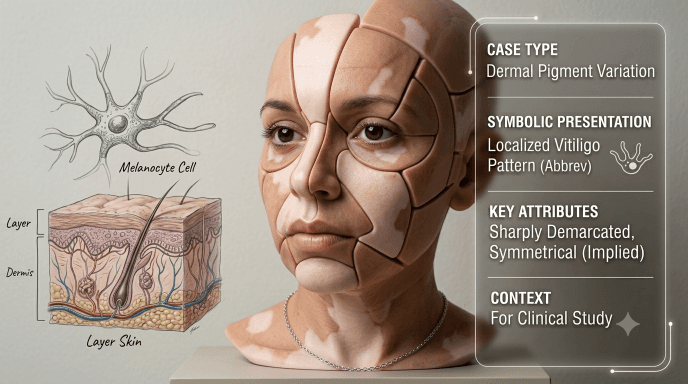
Vitiligo in pediatric patients often presents as localized depigmented patches with preserved sensation, occasionally accompanied by mild itching. In this case, a child presented with a small, depigmented area around the mouth, with normal tactile response and slight pruritus. The remedy Rhus tox was prescribed for one month. On follow‑up after three months, the lesion had to reduced up to great extent, demonstrating the curative potential of homoeopathic intervention in segmental vitiligo. This outcome highlights the importance of individualized remedy selection and supports the role of Rhus tox in cases where depigmentation is accompanied by itching and localized distribution.

HHabib khan
6m225
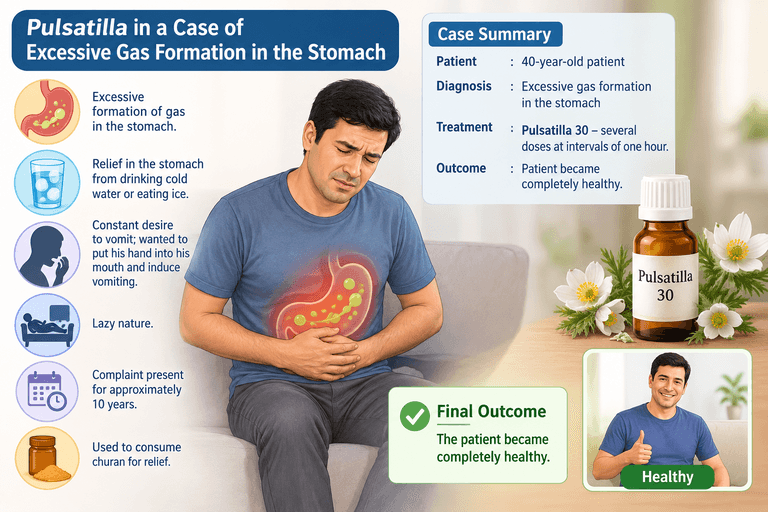
Pulsatilla in a Case of Excessive Gas Formation in the Stomach
Gastro-intestinal disorder

Pulsatilla in a Case of Excessive Gas Formation in the Stomach

Generally, it is believed that Pulsatilla is only a medicine for women. However, this is a common misconception. It is true that Pulsatilla has provided relief to many women, and it suits complaints occurring in women that are aggravated by pregnancy. Yet, its therapeutic sphere is not confined to female constitutions alone. The remedy acts universally, provided the prescription is guided by the totality of symptoms rather than by gender stereotypes

HHomeoEra Journal Editorial Team
3m360
Aphorism 6 in Practice: The Physician Beyond Prejudice.
Gastro-intestinal disorder

Aphorism 6 in Practice: The Physician Beyond Prejudice.

A 40‑year‑old female presented with a constellation of chronic complaints reflecting both physical discomfort and constitutional imbalance. Urinary symptoms were marked by interrupted, scanty flow with burning, temporarily relieved by local oiling. Abdominal tympanites with frequent eructations failed to provide relief, while general soreness, laziness, and constipation added to her burden. Hair fall was noted, along with numbness and restlessness in the extremities (ameliorated by cold drinks), weakness and pain in the lower limbs, and monthly headaches beginning at the nape and settling at the vertex. Medical history revealed a tendency toward typhoid fever. Generalities included alternating sleep, diminished appetite and thirst, craving for salt, aggravation from food, and sensitivity to both heat and cold. The peculiar modalities — relief by oiling and cold drinks — provided key individualizing features for remedy selection.

HHomeoEra Journal Editorial Team
4m253
Unexpected Haemorrhage, Unexpected Cure: Mezereum’s Swift Action.
Acute Emergency

Unexpected Haemorrhage, Unexpected Cure: Mezereum’s Swift Action.

A male patient presented in a state of almost collapse, with profuse rectal haemorrhage of unknown origin. His appearance was almost cadaveric, with pallor and weakness so profound that life seemed to be ebbing away. Conventional measures offered no relief, and the urgency of the situation demanded immediate intervention. Mezereum was selected on the basis of its characteristic affinity for mucosal haemorrhage and profound exhaustion. A single dose was administered. Within minutes, the bleeding ceased entirely, and the patient’s vitality began to return. The rapidity of the response was striking: from a state resembling near‑death, the patient revived, stabilized, and recovered without further recurrence. This case illustrates the remarkable power of the similimum, where one well‑chosen dose of Mezereum transformed a desperate situation into complete restoration.

HHabib khan
4m335

Comments (0)

Sign in or sign up to join the discussion

No comments yet. Be the first to share your thoughts!

Newsletter

Stay Updated with Latest Research

Get weekly digests of new articles, case studies, and homeopathic insights delivered to your inbox

By subscribing, you agree to our Privacy Policy. Unsubscribe anytime.