Case Description
The patient presented with the following symptoms:
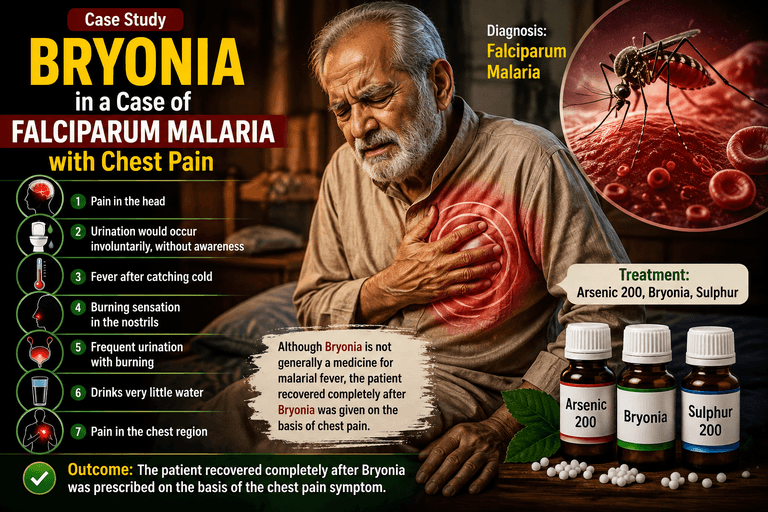
- Pain in the head.
- Urination would occur involuntarily, and the patient would not even know that he had passed urine.
- Fever would occur after catching cold.
- Burning sensation in the nostrils.
- Frequent urination with burning in the urine.
- He would drink very little water.
- There was pain in the chest region.
Based on the above symptoms, I prescribed Arsenic 200 to the patient.
Arsenic provided only limited benefit. It reduced the burning in the nostrils and the burning during urination, but the burning sensation returned.
I also gave him several other medicines, including Dulcamara, but he received no benefit from them.
Finally, I prescribed Bryonia on the basis of the symptom of pain in the chest region.
According to my observation, apart from the pain in the chest region, there were no other symptoms in this patient that specifically indicated Bryonia.
Special Observation
The above-mentioned disease was falciparum malaria. At that time, it had spread in the form of an epidemic.
Chloroquine injections were not proving effective in this disease, and allopathic treatment was troubled by this condition.
Although Bryonia is not considered a medicine for malarial fever, and the symptoms of malaria were not present in the patient at the time, Bryonia was prescribed on the basis of the symptom of pain in the chest region.
Bryonia then demonstrated a remarkable healing effect in this case, and the patient recovered completely.
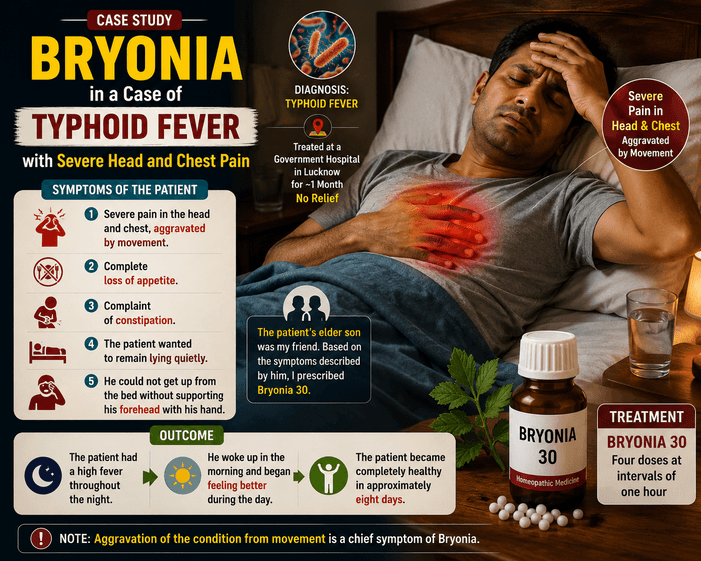
It is generally said that Bryonia is used for typhoid fever, particularly for typhoid fever that develops slowly. However, in this case, its use on the basis of the chest-pain symptom resulted in complete recovery.
Conclusion
This case of falciparum malaria showed complete recovery after Bryonia was prescribed on the basis of the symptom of pain in the chest region. Although the patient did not have the usual symptoms associated with Bryonia in malaria, and Bryonia is not generally considered a medicine for malarial fever, the remedy demonstrated a remarkable healing effect in this case.
The case also highlights the importance, according to the author's observation, of the symptom of pain in the chest region in selecting Bryonia, even though the disease was falciparum malaria.