HomeoEra
Back to Cases

Alcohol Sensitivity and Homoeopathic Therapeutics: A Case‑Based Approach

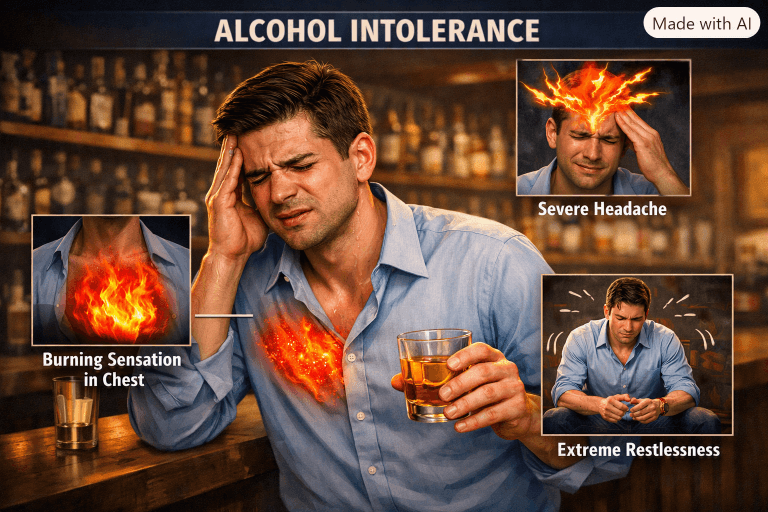
A 31‑year‑old male, professionally engaged as an event organizer, presented with marked intolerance to alcohol. Though not a habitual drinker, the demands of his profession occasionally compelled him to consume small quantities, yet each exposure produced disproportionate dynamic disturbances far beyond what the material dose could explain. He described his suffering in vivid terms, stating that there was intense heat inside his chest as if boiling water were present, that he suffered a severe headache as though his head would burst, and that he felt extreme restlessness with no effort bringing relief. On thorough investigation, the symptoms revealed a prominent left‑sided seat of action, which guided remedy selection. After fifteen days of treatment, the patient reported consuming alcohol on three occasions; twice he experienced no complaints, and on one occasion only mild restlessness. A one‑month supply of medicine was provided with instructions for use. The remedy Kreosote offered significant support in managing professional obligations, though not a curative solution. The patient was advised of two possible paths: either continued alcohol consumption with ongoing medication, or withdrawal from the profession to avoid further dynamic derangement

H

HomeoEra Journal Editorial Team

Updated 4 min read693 views
Alcohol Sensitivity and Homoeopathic Therapeutics: A Case‑Based Approach
Case Summary
Patient: 31 Years, male
Diagnosis:

Alcoholic intolerance

Chief Complaints:

“There is intense heat inside my chest, as if boiling water were present there.” “I suffer a severe headache, as though my head would burst.” “I feel extreme restlessness, and no effort brings me relief.”

Treatment:

Kresote - 30 (Repeated dose)

Outcome:

Improvement recorded within 15 days.

Allergy a dynamic derangement of vital force:

Certain substances possess the remarkable ability to produce a dynamic derangement of the vital force, even when administered in the slightest quantity. Beyond this, some substances are capable of exerting such influence merely through their odor, without direct ingestion. This phenomenon illustrates the extreme sensitivity of the vital force to dynamic impressions.

Allergic diseases, in particular, fall under this category. They represent conditions in which the vital force reacts disproportionately to minute stimuli, such as pollen, dust, or specific odors. These reactions are not mechanical or material in nature but are dynamic disturbances, manifesting as hypersensitivity of the organism. Hence, allergic diseases are rightly classified as dynamic disorders, reflecting the profound susceptibility of the vital force to subtle influences

Case Description:

Today, I am presenting a case of Alcohol Intolerance, which may be considered a type of allergic reaction manifesting through dynamic disturbance of the vital force.

The patient was a 31‑year‑old man, professionally engaged as an event organizer. He was not a habitual drinker by choice or inclination. However, owing to the demands of his profession—where social gatherings and professional networking often required him to consume alcohol—he was occasionally compelled to partake.

Despite minimal exposure, he developed marked intolerance to alcohol, with symptoms suggestive of hypersensitivity. This intolerance was not merely a physical aversion but represented a deeper dynamic disturbance, aligning with the concept of allergic reactions as subtle yet profound derangements of the vital force.


Although the patient consistently attempted to refuse alcoholic drinks, professional obligations often left him with little choice. On those occasions when he consumed even a small quantity, he experienced intense internal turmoil. This reaction was not limited to mild discomfort; rather, it manifested as a profound disturbance within his system, suggestive of a dynamic derangement of the vital force.

Such sensitivity highlights the paradox of alcohol intolerance: the patient’s constitution reacted disproportionately to minute exposure, producing symptoms far beyond what the material quantity of alcohol could explain. This underscores the dynamic nature of allergic reactions, where the vital force responds to subtle stimuli with exaggerated manifestations.

Patient’s Statement

The patient described his distress in the following words:

“Doctor, whenever I consume even a little quantity of alcohol, I face great trouble inside me. I feel as if.
1. There is intense heat within my chest, as though boiling water were present there.
2. I suffer from a severe headache, as if my head would burst.
3. I experience extreme restlessness, and no effort of mine brings any relief.”
All these trouble remains persistent up to 24-to-48-hour, if consume Alcohol onece. 

Totality exclusion & type of prescription:
The prescription was totally Artistic; medicine was selected without any help of repertory. based on the percept totality, I prescribed him Kresote - 30, repeated dose. 4 piles of 40 number globules 4 to 5 time in a day, alter every 2 to 3 hours. 

Outcomes:

After 15 days, the patient reported his experience as follows: during this period, he consumed alcohol on three occasions. On two occasions, he experienced no complaints whatsoever. On the third occasion, he felt only mild restlessness, which subsided without major distress.

In response, I provided him with a one‑month supply of medicine and gave clear instructions regarding its use. The remedy Kreosote proved helpful in enabling him to manage the professional demands of his occupation. However, it must be emphasized that this was not a curative solution, but rather a supportive measure.

At this stage, the patient was presented with two options:

1. If he continued to consume alcohol regularly, he would need to take the medicine continuously to manage his symptoms.

2. Alternatively, he could consider withdrawal from the profession, thereby avoiding exposure to alcohol altogether and eliminating the need for ongoing medication.
Other medicines for Alcoholic Abuse:

1. Nux vomica: Chill fever with liver abscess due to excessive alcoholic abuse. 
2. Ranunculus bulbosus: Hiccough after Alcoholic drinks. 
3. Pulsatilla: Diarrhoea after Alcohol abuse.
4. Kresote : Urine flow scanty or obstructed (Retention of urine) 
5. Nux vomica: Sleeplessness after drinking too much wine. 
6. Aloe: Haemorrhoid after drinking wine.  
7. Agaricus: Vertigo and vomiting after taking too much wine. 
8. Aphomorphium: constipation after taking too much alcohol. 
9. Causticum: Indulging in the habit of Alcoholism after grief. 
10 Rumx: jaundice after using alcohol. 
Have a Question?
Ask HomeoEra Journal Editorial Team about "Alcohol Sensitivity and Homoeopathic Therapeutics: A Case‑Based Approach" and get a personalized response directly to your email.

0/500 characters

0 characters (minimum 10 required)

🔒 Privacy Notice: Your information will only be used to respond to your query and won't be shared with third parties.

Rhus tox in Segmental Vitiligo: Localized Depigmented Lesions in a Pediatric Patient.
Skin Disorders

Rhus tox in Segmental Vitiligo: Localized Depigmented Lesions in a Pediatric Patient.

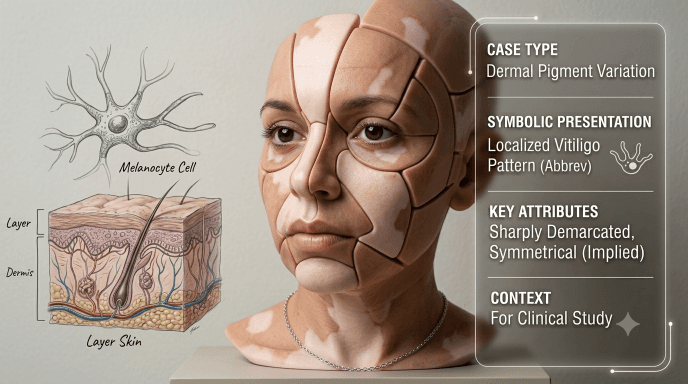
Vitiligo in pediatric patients often presents as localized depigmented patches with preserved sensation, occasionally accompanied by mild itching. In this case, a child presented with a small, depigmented area around the mouth, with normal tactile response and slight pruritus. The remedy Rhus tox was prescribed for one month. On follow‑up after three months, the lesion had to reduced up to great extent, demonstrating the curative potential of homoeopathic intervention in segmental vitiligo. This outcome highlights the importance of individualized remedy selection and supports the role of Rhus tox in cases where depigmentation is accompanied by itching and localized distribution.

HHabib khan
6m225
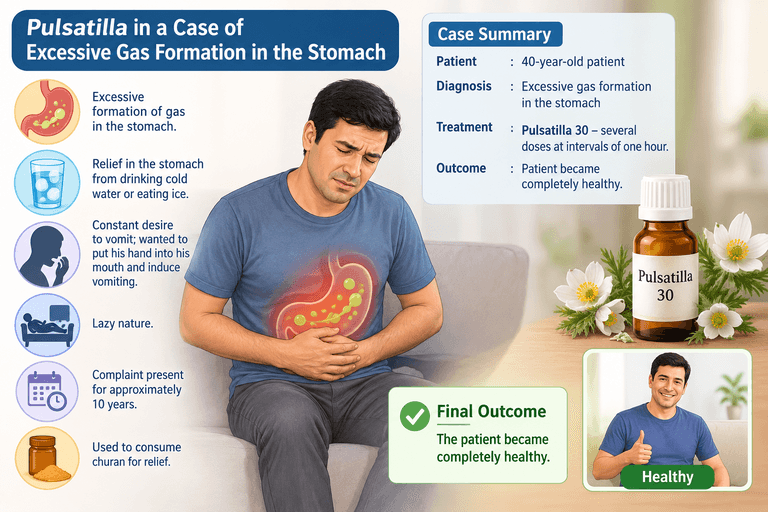
Pulsatilla in a Case of Excessive Gas Formation in the Stomach
Gastro-intestinal disorder

Pulsatilla in a Case of Excessive Gas Formation in the Stomach

Generally, it is believed that Pulsatilla is only a medicine for women. However, this is a common misconception. It is true that Pulsatilla has provided relief to many women, and it suits complaints occurring in women that are aggravated by pregnancy. Yet, its therapeutic sphere is not confined to female constitutions alone. The remedy acts universally, provided the prescription is guided by the totality of symptoms rather than by gender stereotypes

HHomeoEra Journal Editorial Team
3m360
Aphorism 6 in Practice: The Physician Beyond Prejudice.
Gastro-intestinal disorder

Aphorism 6 in Practice: The Physician Beyond Prejudice.

A 40‑year‑old female presented with a constellation of chronic complaints reflecting both physical discomfort and constitutional imbalance. Urinary symptoms were marked by interrupted, scanty flow with burning, temporarily relieved by local oiling. Abdominal tympanites with frequent eructations failed to provide relief, while general soreness, laziness, and constipation added to her burden. Hair fall was noted, along with numbness and restlessness in the extremities (ameliorated by cold drinks), weakness and pain in the lower limbs, and monthly headaches beginning at the nape and settling at the vertex. Medical history revealed a tendency toward typhoid fever. Generalities included alternating sleep, diminished appetite and thirst, craving for salt, aggravation from food, and sensitivity to both heat and cold. The peculiar modalities — relief by oiling and cold drinks — provided key individualizing features for remedy selection.

HHomeoEra Journal Editorial Team
4m253
Unexpected Haemorrhage, Unexpected Cure: Mezereum’s Swift Action.
Acute Emergency

Unexpected Haemorrhage, Unexpected Cure: Mezereum’s Swift Action.

A male patient presented in a state of almost collapse, with profuse rectal haemorrhage of unknown origin. His appearance was almost cadaveric, with pallor and weakness so profound that life seemed to be ebbing away. Conventional measures offered no relief, and the urgency of the situation demanded immediate intervention. Mezereum was selected on the basis of its characteristic affinity for mucosal haemorrhage and profound exhaustion. A single dose was administered. Within minutes, the bleeding ceased entirely, and the patient’s vitality began to return. The rapidity of the response was striking: from a state resembling near‑death, the patient revived, stabilized, and recovered without further recurrence. This case illustrates the remarkable power of the similimum, where one well‑chosen dose of Mezereum transformed a desperate situation into complete restoration.

HHabib khan
4m335

Comments (2)

Sign in or sign up to join the discussion

S
Shivam DubeyOct 5, 2026(edited)

Hey, Shivam Dubey here. I am a student, and about a year ago I started suffering from a condition called alcohol intolerance. I took many allopathic medicines, but in the end, the doctors could not understand what was actually happening to me. However, in homeopathy, Dr. Habib khan's principles helped identify my condition properly. The homeopathic doctor investigated my case thoroughly and prescribed medicines that actually worked for me.

A
Admin UserOct 10, 2026(edited)

Homoeopathy does not limit its curative action merely to alcohol sensitivity; it extends its therapeutic reach to a wide spectrum of allergic conditions. From dust allergy to complex disorders such as coeliac disease, Homoeopathy offers gentle yet profound avenues of cure, addressing both the susceptibility of the vital force and the underlying miasmatic tendencies that predispose individuals to such hypersensitivities.

Newsletter

Stay Updated with Latest Research

Get weekly digests of new articles, case studies, and homeopathic insights delivered to your inbox

By subscribing, you agree to our Privacy Policy. Unsubscribe anytime.