HomeoEra
Back to Blogs

Why Do Homoeopathic Medicines Have No Side Effects? A Reason-Based Analysis

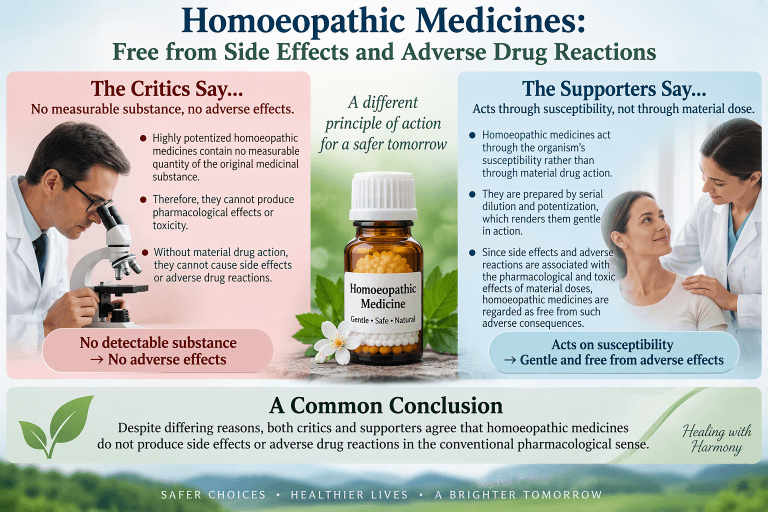
It is frequently asserted that homoeopathic medicines are free from side effects and adverse drug reactions. Interestingly, both supporters and critics of homoeopathy often arrive at this conclusion, although for entirely different reasons. Critics contend that highly potentized remedies contain no measurable quantity of the original medicinal substance and therefore cannot produce pharmacological effects or toxicity. Homoeopathic practitioners, on the other hand, maintain that remedies act through the organism's susceptibility rather than through material drug action. Since side effects and adverse reactions are generally associated with the pharmacological and toxic effects of material doses, homoeopathic medicines are regarded as free from such conventional adverse consequences. Consequently, it may be argued that homoeopathic remedies do not produce side effects or adverse drug reactions in the conventional pharmacological sense

H

HomeoEra Journal Editorial Team

4 min read13 views
Why Do Homoeopathic Medicines Have No Side Effects? A Reason-Based Analysis

Why Do Homoeopathic Medicines Not Produce Side Effects or Adverse Drug Reactions?

It is often said that homoeopathic medicines are completely safe and that their use neither produces side effects nor gives rise to adverse drug reactions. Across the world, opinions on homoeopathy remain sharply divided. One group strongly supports homoeopathy and considers it an effective therapeutic system, while the other rejects the very notion that homoeopathic medicines possess any specific medicinal action beyond a placebo effect. Yet, on this particular issue, both sides appear to be in agreement: homoeopathic medicines do not produce conventional side effects or adverse drug reactions.

However, the reasoning behind this conclusion differs markedly between the two groups. Critics argue that highly potentized homoeopathic medicines contain no detectable trace of the original medicinal substance and, therefore, cannot exert any pharmacological action; consequently, they cannot produce adverse reactions. Supporters, on the other hand, maintain that homoeopathic medicines are prepared through a process of serial dilution and potentization, which renders them gentle in action and largely free from the side effects and adverse drug reactions commonly associated with conventional pharmacological agents. 

What Are Side Effects and Adverse Reactions?

Side Effect: A side effect is an unintended secondary effect of a drug that occurs in addition to its primary therapeutic effect and arises from the same pharmacological action of the drug. For instance, if opium is administered to treat sleeplessness, it may simultaneously produce constipation. In such a case, sleep induction represents the desired therapeutic effect, whereas constipation is considered a side effect of the drug.

Another example, an antihistamine may relieve allergy symptoms (its intended effect) but also cause drowsiness (a side effect). Both effects result from the medicine's action on the body.

Thus, it may be concluded that side effects arise from the pharmacological action of a crude drug substance containing measurable quantities of the original medicinal material. "Homoeopathic medicines, on the other hand, are administered in highly diluted and potentized forms; therefore, they are often considered free from side effects." 

An adverse effect: is a harmful, unintended, and undesirable response to a medicinal substance that occurs during its use, resulting in injury, discomfort, or impairment to the patient. Such effects are commonly associated with the material action of a drug and may arise from its toxic properties, excessive dosage, individual susceptibility, or hypersensitivity reactions. The nature and severity of adverse effects vary considerably among individuals and are often influenced by the dose administered. A substance that produces toxic or adverse effects in one person may be well tolerated by another, reflecting differences in individual sensitivity and biological response. 

Homoeopathic medicines are believed to act through a specific susceptibility or receptivity within the living organism. According to this view, a remedy can produce a curative effect only when a corresponding susceptibility exists in the patient. If such susceptibility is present, the remedy acts therapeutically; if it is absent, the medicine exerts no specific medicinal action. Consequently, homoeopathy is often regarded as free from adverse effects arising from material drug action. In this sense, the action of the homoeopathic remedy may be considered an "all-or-none" phenomenon: either it finds a responsive susceptibility and acts, or, in its absence, it produces no specific effect beyond a possible placebo response.

This may partly explain why homoeopathy is frequently criticized as a placebo system. Homoeopathic medicines are intended to act through a specific correspondence between the remedy and the patient's individual susceptibility. When the physician is unable to accurately perceive and prescribe according to this susceptibility, the remedy may fail to evoke any specific therapeutic response. In such circumstances, any apparent improvement may be attributed to placebo effects rather than to the action of the prescribed remedy itself

Consequently, it may be argued that homoeopathic medicines do not produce side effects or adverse drug reactions in the conventional pharmacological sense, as their action is considered to depend upon the presence of a corresponding susceptibility within the individual rather than upon material drug action. 
Do Homoeopathic Medicines Cause Harm in Any way?


Have a Question?
Ask HomeoEra Journal Editorial Team about "Why Do Homoeopathic Medicines Have No Side Effects? A Reason-Based Analysis" and get a personalized response directly to your email.

0/500 characters

0 characters (minimum 10 required)

🔒 Privacy Notice: Your information will only be used to respond to your query and won't be shared with third parties.

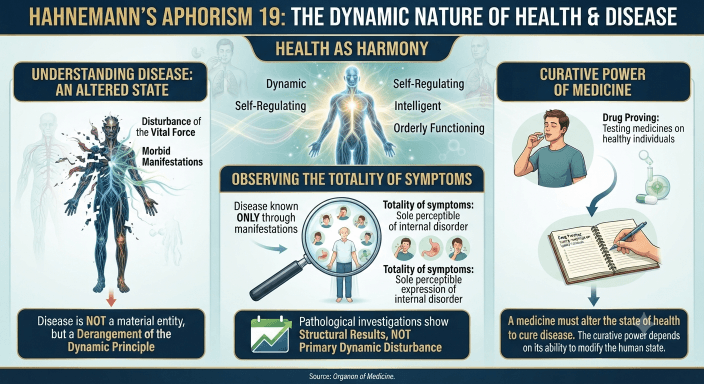
Aphorism 19: Disease is nothing but the morbid alteration of Dynamic vital force.
Organon & Philosophy

Aphorism 19: Disease is nothing but the morbid alteration of Dynamic vital force.

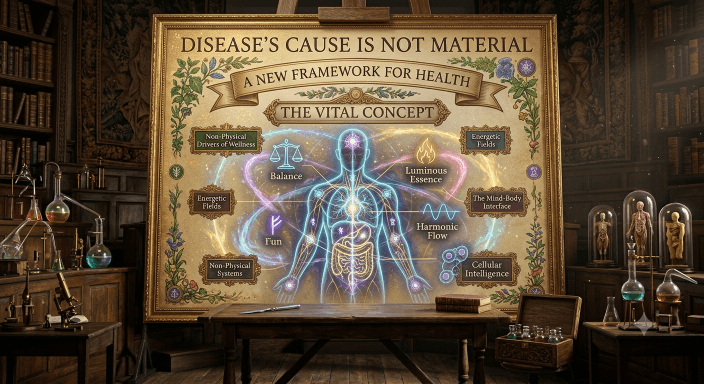
Disease is nothing more than an alteration of the healthy state of the individual, manifested through signs and symptoms. Since cure is the restoration of this altered state to health, medicines can cure only because they possess the power to alter the human state of health. Therefore, the curative power of a medicine depends entirely upon its ability to produce definite changes in sensations and functions within the living organism. This fundamental truth forms the basis for discovering the therapeutic action of medicines through their effects on healthy individuals

HHomeoEra Journal Editorial Team
3m14
Aphorism 18: The Totality of Symptoms as the Fundamental Basis for Remedy Selection
Organon & Philosophy

Aphorism 18: The Totality of Symptoms as the Fundamental Basis for Remedy Selection

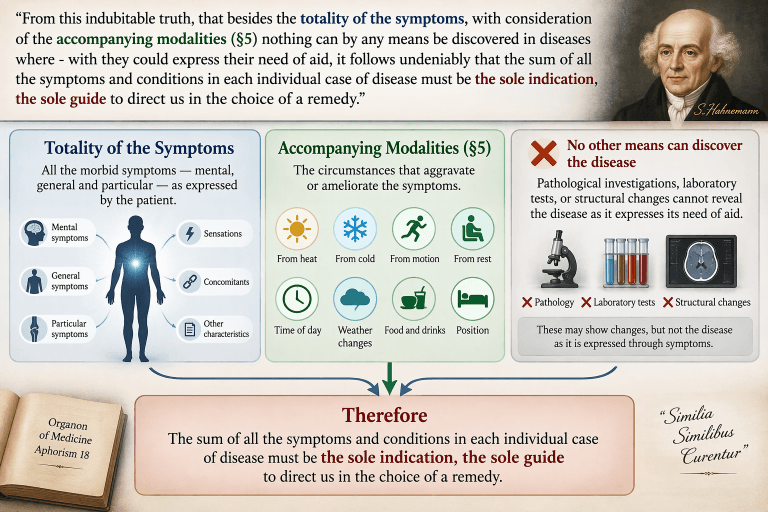
Aphorism 18 establishes that the totality of symptoms, together with their accompanying modalities, is the only reliable means of understanding disease and selecting the appropriate remedy. According to Hahnemann, disease cannot be perceived directly; it is known only through the signs and symptoms by which the disturbed vital force expresses itself. Therefore, every deviation from health has diagnostic and therapeutic significance.The physician must consider not only the symptoms themselves but also the circumstances that modify them, such as aggravations and ameliorations from motion, rest, weather, time, position, food, and other conditions. These modalities individualize the case and help distinguish one remedy from another.Hahnemann further teaches that pathological findings and structural changes may reveal the effects of disease, but they do not disclose the dynamic disturbance as clearly as the symptom totality. Consequently, the complete symptom-picture of the patient, rather than the disease name alone, must guide treatment.Thus, Aphorism 18 conveys two central truths: the totality of symptoms is the sole means of perceiving disease, and the same totality is the sole guide for selecting the curative remedy. It remains the foundation of individualization and successful homoeopathic prescribing.

HHomeoEra Journal Editorial Team
2m25
The Role of Autopsy in Investigating the Cause of Disease: A Homoeopathic Perspective
Organon & Philosophy

The Role of Autopsy in Investigating the Cause of Disease: A Homoeopathic Perspective

If disease originates primarily in the dynamic sphere of the living organism, then the true beginning of the disease process lies beyond the reach of post-mortem examination. An autopsy is performed upon the material body after the departure of the vital principle; therefore, it can reveal only the structural changes left behind by the disease and not the original dynamic disturbance that gave rise to them. It may demonstrate the location, extent, and pathological consequences of disease, but it cannot directly disclose the nature of the vital derangement from which those changes arose. In this sense, autopsy is invaluable for understanding the material effects and terminal expressions of disease, yet it remains limited as a means of investigating the primary dynamic cause. It informs us about the footprints of disease rather than the invisible force that first set the pathological process in motion

HHomeoEra Journal Editorial Team
6m22
Concomitant Symptoms: A Conceptual Perspective and Practical Utility - A Broad-Spectrum Analysis
Organon & Philosophy

Concomitant Symptoms: A Conceptual Perspective and Practical Utility - A Broad-Spectrum Analysis

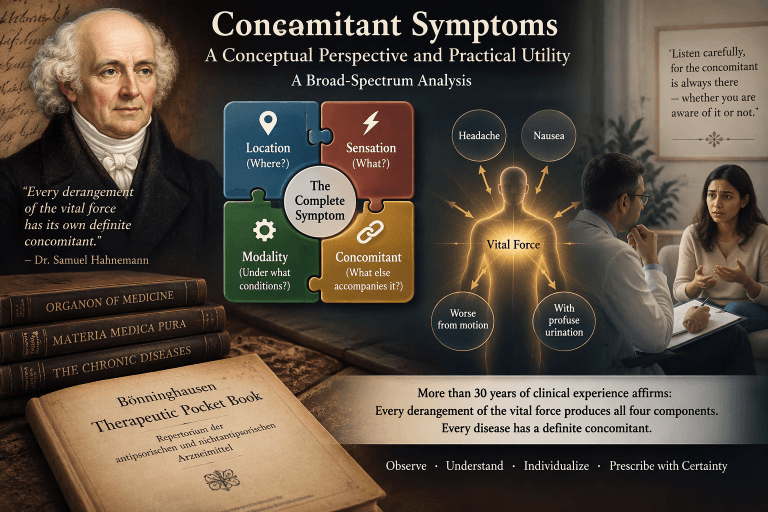
Concomitant symptoms occupy a unique position in homoeopathic philosophy and practice. While Bönninghausen regarded concomitants as the fourth indispensable element of the complete symptom, their practical application has often been misunderstood. A careful study reveals that concomitants are not merely incidental symptoms accompanying a chief complaint, nor can they be identified by a simple linguistic cue such as the word “with.” Rather, they represent definite manifestations arising from the same underlying derangement of the vital force. Drawing upon both Bönninghausen's theoretical framework and decades of clinical observation, this analysis explores the conceptual foundation, practical utility, and philosophical significance of concomitant symptoms. It argues that every genuine disease state possesses its own definite concomitant, whether readily recognized or not, and that the accurate perception of these accompanying symptoms remains one of the most important keys to individualization and successful remedy selection.

HHomeoEra Journal Editorial Team
7m25

Comments (0)

Sign in or sign up to join the discussion

No comments yet. Be the first to share your thoughts!

Newsletter

Stay Updated with Latest Research

Get weekly digests of new articles, case studies, and homeopathic insights delivered to your inbox

By subscribing, you agree to our Privacy Policy. Unsubscribe anytime.