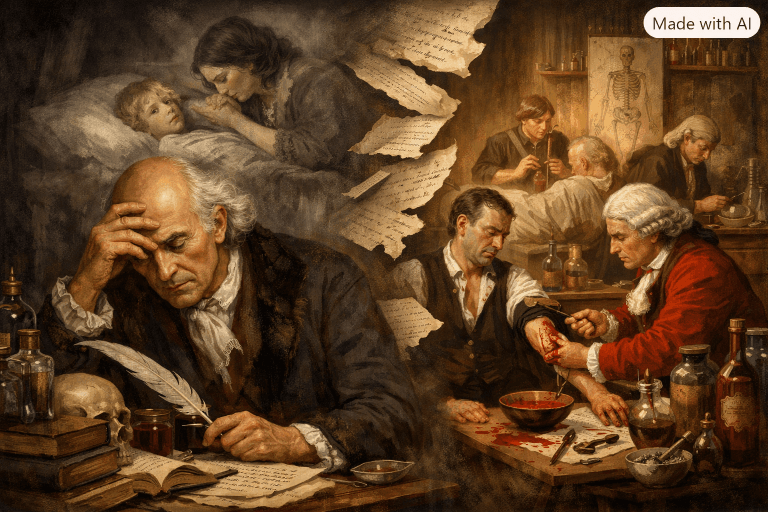
Homoeopathy is a holistic system of medicine founded at the beginning of the 19th century by Dr. Samuel Hahnemann, who sought a gentler alternative to the aggressive medical practices of his era. At its core, Homoeopathy is based on the principle of Similia Similibus Curentur — “like cures like” — which means that a substance capable of producing symptoms in a healthy person can, when administered in a highly diluted and potentized form, stimulate healing in a sick individual with similar symptoms. Remedies are prepared through a unique process of successive dilutions and succussions, known as potentization, which is believed to release the dynamic energy of the substance while eliminating toxicity. Unlike conventional medicine, which often targets disease at the material level of organs and tissues, Homoeopathy works on the vital force — the subtle energy that governs health and balance in the living organism. It emphasizes individualization, tailoring treatment to the patient’s unique physical, emotional, and mental symptom picture rather than merely addressing the disease name. Thus, Homoeopathy is not only a therapeutic method but also a philosophy of healing, aiming to restore harmony between body, mind, and spirit, and offering what Hahnemann himself described as “the great gift of God” to humanity.
Dr. Hahnemann did not originate the principle of Similia Similibus Curentur (“like cures like”) but rather adopted and evolved it. The concept was first articulated by Hippocrates, the father of medicine. In a similar manner, the principle of Contraria Contrariis Curentur (“opposites cure opposites”), which later became the foundation of Allopathy, was also introduced by Hippocrates and subsequently systematized by Galen. Hence, Allopathy is often referred to as Galenopathy. Dr. Hahnemann, however, built upon the principle of similars, refined it through systematic experimentation, and developed Homoeopathy into a complete medical system. Through rigorous drug provings, clinical observations, and philosophical evaluation, he transformed an ancient idea into a scientific discipline that emphasized individualization, minimum dose, and potentization, thereby establishing Homoeopathy as a distinct and enduring school of healing.
Dr. Samuel Hahnemann began his career as an allopathic physician, trained in the conventional medical practices of the late 18th century. However, he grew increasingly disillusioned with the prevailing methods, which often relied on bloodletting, purgatives, and large doses of toxic drugs. These treatments, in his view, caused more harm than healing. His dissatisfaction led him to abandon medical practice temporarily and devote himself to scholarly work, particularly the translation of medical texts.
During his translation of Cullen’s Materia Medica, Hahnemann encountered a passage on cinchona bark, used to treat malaria. Curious, he ingested the bark himself and observed that it produced symptoms similar to malaria in his healthy body. This experiment marked a turning point: he realized that medicines could cure diseases by producing similar symptoms in healthy individuals — the principle of Similia Similibus Curentur. Though this principle had been mentioned centuries earlier by Hippocrates, Hahnemann was the first to rigorously test, refine, and systematize it into a complete medical science.
Rejecting the contraria principle of Allopathy (later systematized by Galen, hence called Galenopathy), Hahnemann embraced the law of similars and began conducting systematic drug provings on healthy volunteers. He meticulously recorded the symptoms produced by various substances, thereby building a new materia medica based on direct observation rather than speculation. Through this process, he established Homoeopathy as a distinct discipline, governed by clear principles: the law of similars, the minimum dose, potentization, and individualization.
Thus, Hahnemann’s transformation was not a sudden rejection of Allopathy, but a gradual evolution born of dissatisfaction, experimentation, and philosophical reflection. He moved from a system that sought to suppress symptoms to one that sought to stimulate the body’s vital force, thereby restoring harmony and health. His journey represents a profound shift from empirical medicine to a principle‑based, holistic science — a transformation that gave birth to Homoeopathy and reshaped the philosophy of healing for generations to come.
Dr. Samuel Hahnemann’s dissatisfaction with allopathy was shaped by personal tragedies (including the illness and death of his children), his moral struggle with the harmful effects of conventional medicine, and his intellectual rejection of speculative medical theories. These milestones pushed him to renounce allopathic practice and ultimately develop homeopathy
1. Early Disillusionment with Allopathy
a. After earning his medical degree in 1779, Hahnemann practiced medicine but quickly became deeply dissatisfied with the speculative and dangerous methods of allopathy.
b. He described the agony of prescribing medicines based on arbitrary hypotheses, fearing he might “become the murderer or tormentor of my brethren” due to the toxic effects of drugs.
2. Family Tragedies
a. Hahnemann’s dissatisfaction intensified when serious diseases threatened his own children. He admitted that his scruples “redoubled when I saw that I could afford them no certain relief.
b. Several of his children suffered illnesses, and the death of one of his sons (historically noted though details are sparse) reinforced his conviction that allopathy was unreliable and even harmful. This personal grief became a turning point in his search for a safer, more rational system of healing.
3. Renunciation of Medical Practice
a. Soon after marriage, Hahnemann renounced active medical practice to avoid harming patients. He turned instead to chemistry and translation work, which gave him financial stability and intellectual freedom
4. Translation of Cullen’s Materia Medica (1790)
a. While translating William Cullen’s Materia Medica, Hahnemann questioned Cullen’s claim that cinchona bark cured malaria due to its bitterness
b. He experimented on himself, ingesting cinchona and developing malaria-like symptoms. This observation led him to formulate the principle of “like cures like”, the foundation of homeopathy
5. Public Criticism of Allopathy
a. In essays and letters (notably to Dr. Hufeland), Hahnemann condemned allopathy as “fantasy, arbitrary speculation, and pernicious illusion”, contrasting it with his vision of a rational, observation-based system
1. Hahnemann’s
dissatisfaction was not just intellectual but
deeply moral and personal.
2. His
son’s death and inability to cure his own children symbolized the failure of allopathy to provide certainty and
safety.
3. This drove him to seek a divinely
ordained, natural law of healing—culminating in homeopathy.
Hahnemann mission and selflessness: In the preface, Dr. Samuel Hahnemann reveals his profound sense of purpose: he believed he was placed on earth not only to improve himself but also to uplift humanity. He could have kept his discovery secret for personal gain, yet he chose to share it openly for the common good. This act of selflessness underscores his conviction that homoeopathy was not merely a personal achievement, but a divine trust meant for all mankind.
The Struggle Against Prejudice: Hahnemann laments that his contemporaries often rejected his teachings, particularly the principle of small, attenuated doses. Despite his repeated demonstrations and logical reasoning, physicians clung to large doses, thereby prolonging suffering and delaying cures. His frustration reflects the timeless struggle of innovators: truth is often resisted before it is accepted. Yet, he remained steadfast, convinced that posterity would eventually recognize the divine wisdom embedded in homoeopathy.
The Principle of Dynamic Healing: Central to his teaching is the idea that dilution and potentization do not weaken medicines but rather release their dynamic power. This insight was revolutionary. It shifted medicine from a materialistic view of drugs to a recognition of their energetic, vital force. For Hahnemann, this was not simply a scientific breakthrough—it was a spiritual revelation. The ability of infinitesimal doses to heal without harm mirrored divine compassion, offering humanity a gentler path to recovery.
Homoeopathy as a Divine Boon: Hahnemann explicitly frames homoeopathy as a “great discovery” entrusted to him by Providence. He believed its harmony with nature and its capacity to cure without injury reflected God’s benevolence. By delivering mankind from “numberless torments” of chronic diseases, homoeopathy became more than a medical system—it was a sacred gift, a channel through which divine mercy flowed into human suffering.
The Hope for Posterity: Though doubtful of immediate acceptance, Hahnemann expressed hope that future generations, more conscientious and intelligent, would embrace homoeopathy faithfully. His vision was prophetic: he foresaw that the true benefits of his discovery would unfold gradually, as humanity matured in understanding. This long view reinforces the idea that homoeopathy is timeless, destined to serve as a beacon of healing across ages.
The preface to The Chronic Diseases is not merely an introduction to a medical text; it is a philosophical testament. Hahnemann presents homoeopathy as a divine mission, a compassionate science, and a moral responsibility. His words remind us that homoeopathy is indeed “the great gift of God”—a system that unites science with spirituality, offering cures that are gentle, profound, and enduring.