HomeoEra
Back to Blogs

Aphorism 20: The Curative Power of Medicines as a Dynamic, Spirit-Like Force.

Aphorism 20 of the Organon of Medicine centers on drug proving as the essential way to uncover the hidden, spirit-like curative power of a medicine. Dr. Hahnemann explains that this dynamic power cannot be discovered through mere intellectual reasoning or chemical/structural analysis alone, nor can it be seen from a substance's outward appearance, taste, weight, or physical makeup. Instead, it becomes recognizable only through practical experience—by observing how the medicine acts upon the living human organism and alters health, sensations, functions, and symptoms. This lays down a core homoeopathic principle: remedy selection must rest strictly on symptom similarity revealed through proving, rather than guesswork, theory, or subjective assumption.

H

HomeoEra Journal Editorial Team

Updated 2 min read10 views
Aphorism 20: The Curative Power of Medicines as a Dynamic, Spirit-Like Force.

Aphorism 20:

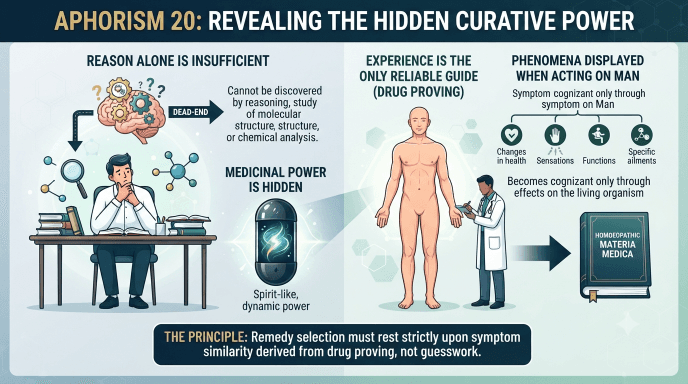
This spirit-like power to alter man's state of health which lies hidden in the inner nature of medicine can in itself never be discovered by us by a mere effort of reason; it is only by experience of the phenomena it displays when acting on the state of health of man that we can become clearly cognizant of it. 

Explanatory note:

This Aphorism 20 of the Organon of Medicine is devoted entirely to drug proving and its exploratory role in revealing the hidden curative power of medicines. Here, Dr. Hahnemann explains that the curative power of a medicine, being spirit-like and dynamic in nature, much like the vital force itself, cannot be known by any means other than experience gained through drug proving, that is, by observing its ability to alter the state of human health. This power cannot be discovered through mere reasoning, the study of molecular structure, or an examination of chemical properties, for it lies concealed within the inner nature of the medicinal substance and reveals itself only through its effects on the living organism.

A very important point emphasized by Dr. Hahnemann in this aphorism is that the true curative power of a medicine, as employed in homoeopathy, is distinct from its mere chemical action. According to him, this curative power is a dynamic, spirit-like influence that cannot be understood through material analysis alone but must be recognized through its observable effects on the living organism.

In this aphorism Dr. Hahnemann is emphasizing three key points:

  1. Medicinal power is hidden.

    • The curative action does not reveal itself merely by looking at the substance, its appearance, taste, weight, chemical composition, or physical structure.
  2. Reason alone is insufficient.

    • One cannot sit in a laboratory or study and deduce the therapeutic effects of a medicine through intellectual reasoning alone.
  3. Experience is the only reliable guide.

    • The medicinal power becomes known only when the medicine acts upon the living human organism and produces observable changes in health, sensations, functions, and symptoms. Drug proving is therefore the means by which this hidden power is revealed.

👉 This aphorism lays down a fundamental and unequivocal principle for the homoeopathic physician: the selection of the remedy must rest strictly upon symptom similarity, rather than upon guesswork, theoretical assumptions, or subjective judgment.
Word meaning and explanation:

Have a Question?
Ask HomeoEra Journal Editorial Team about "Aphorism 20: The Curative Power of Medicines as a Dynamic, Spirit-Like Force." and get a personalized response directly to your email.

0/500 characters

0 characters (minimum 10 required)

🔒 Privacy Notice: Your information will only be used to respond to your query and won't be shared with third parties.

Aphorism 19: Disease is nothing but the morbid alteration of Dynamic vital force.
Organon & Philosophy

Aphorism 19: Disease is nothing but the morbid alteration of Dynamic vital force.

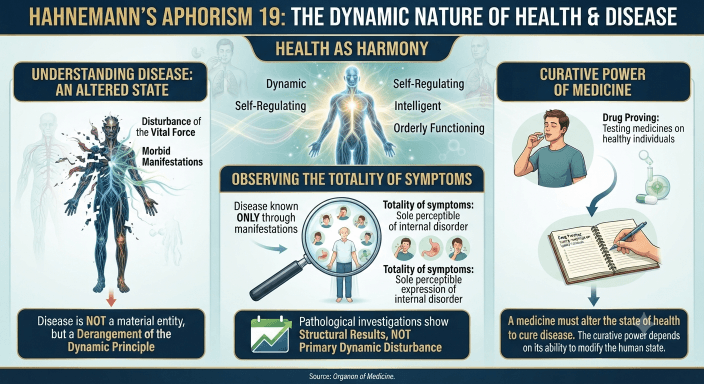
Disease is nothing more than an alteration of the healthy state of the individual, manifested through signs and symptoms. Since cure is the restoration of this altered state to health, medicines can cure only because they possess the power to alter the human state of health. Therefore, the curative power of a medicine depends entirely upon its ability to produce definite changes in sensations and functions within the living organism. This fundamental truth forms the basis for discovering the therapeutic action of medicines through their effects on healthy individuals

HHomeoEra Journal Editorial Team
3m20
Why Do Homoeopathic Medicines Have No Side Effects? A Reason-Based Analysis
Organon & Philosophy

Why Do Homoeopathic Medicines Have No Side Effects? A Reason-Based Analysis

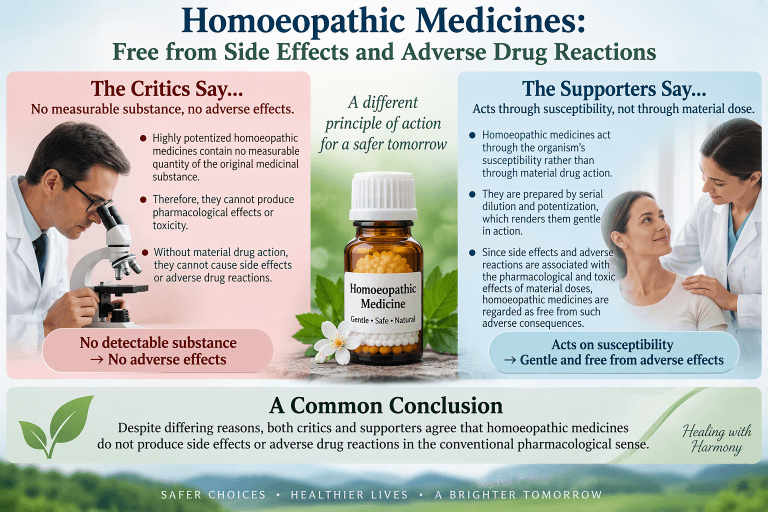
It is frequently asserted that homoeopathic medicines are free from side effects and adverse drug reactions. Interestingly, both supporters and critics of homoeopathy often arrive at this conclusion, although for entirely different reasons. Critics contend that highly potentized remedies contain no measurable quantity of the original medicinal substance and therefore cannot produce pharmacological effects or toxicity. Homoeopathic practitioners, on the other hand, maintain that remedies act through the organism's susceptibility rather than through material drug action. Since side effects and adverse reactions are generally associated with the pharmacological and toxic effects of material doses, homoeopathic medicines are regarded as free from such conventional adverse consequences. Consequently, it may be argued that homoeopathic remedies do not produce side effects or adverse drug reactions in the conventional pharmacological sense

HHomeoEra Journal Editorial Team
6m19
Aphorism 18: The Totality of Symptoms as the Fundamental Basis for Remedy Selection
Organon & Philosophy

Aphorism 18: The Totality of Symptoms as the Fundamental Basis for Remedy Selection

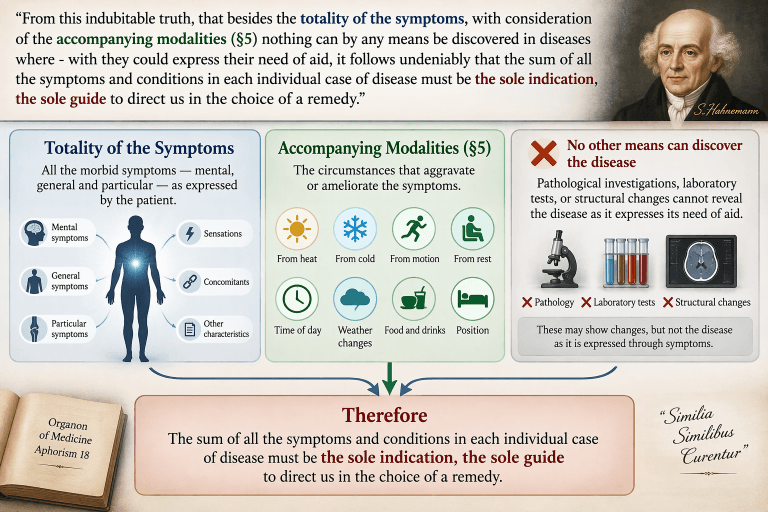
Aphorism 18 establishes that the totality of symptoms, together with their accompanying modalities, is the only reliable means of understanding disease and selecting the appropriate remedy. According to Hahnemann, disease cannot be perceived directly; it is known only through the signs and symptoms by which the disturbed vital force expresses itself. Therefore, every deviation from health has diagnostic and therapeutic significance.The physician must consider not only the symptoms themselves but also the circumstances that modify them, such as aggravations and ameliorations from motion, rest, weather, time, position, food, and other conditions. These modalities individualize the case and help distinguish one remedy from another.Hahnemann further teaches that pathological findings and structural changes may reveal the effects of disease, but they do not disclose the dynamic disturbance as clearly as the symptom totality. Consequently, the complete symptom-picture of the patient, rather than the disease name alone, must guide treatment.Thus, Aphorism 18 conveys two central truths: the totality of symptoms is the sole means of perceiving disease, and the same totality is the sole guide for selecting the curative remedy. It remains the foundation of individualization and successful homoeopathic prescribing.

HHomeoEra Journal Editorial Team
2m31
The Role of Autopsy in Investigating the Cause of Disease: A Homoeopathic Perspective
Organon & Philosophy

The Role of Autopsy in Investigating the Cause of Disease: A Homoeopathic Perspective

If disease originates primarily in the dynamic sphere of the living organism, then the true beginning of the disease process lies beyond the reach of post-mortem examination. An autopsy is performed upon the material body after the departure of the vital principle; therefore, it can reveal only the structural changes left behind by the disease and not the original dynamic disturbance that gave rise to them. It may demonstrate the location, extent, and pathological consequences of disease, but it cannot directly disclose the nature of the vital derangement from which those changes arose. In this sense, autopsy is invaluable for understanding the material effects and terminal expressions of disease, yet it remains limited as a means of investigating the primary dynamic cause. It informs us about the footprints of disease rather than the invisible force that first set the pathological process in motion

HHomeoEra Journal Editorial Team
6m28

Comments (0)

Sign in or sign up to join the discussion

No comments yet. Be the first to share your thoughts!

Newsletter

Stay Updated with Latest Research

Get weekly digests of new articles, case studies, and homeopathic insights delivered to your inbox

By subscribing, you agree to our Privacy Policy. Unsubscribe anytime.