Utility of Lachesis in various disease conditions with characteristic urinary concomitant.
Utility of Lachesis in urinary trouble:
Homoeopathic medicines are not only valuable because they can cure diseases, but also because they have helped us understand many important truths about health, disease, and healing. Drug proving was carried out not only to discover the healing effects of medicines, but also to learn how diseases act in the human body and how medicines influence the living organism. From this, we can understand that the full healing power of many homoeopathic medicines described in the Materia Medica is still not completely known. We must also recognize that the only reliable ways to discover the complete curative power of a medicine are careful proving and clinical experience. No other method can reveal its full range of action. All homoeopathic medicines possess many hidden properties that have not yet been recorded in the Materia Medica.
Today, I shall discuss the curative action of Lachesis in urinary disorders associated with various other pathological conditions. The following text explores numerous urinary symptoms that occur in connection with different health complaints, where they serve as important concomitant symptoms. These associated urinary manifestations frequently provide valuable indications for the selection of Lachesis. Although Cantharis is classically renowned for urinary complaints characterized by intense burning during urination, Lachesis also occupies an important place in such conditions. Its therapeutic value in urinary disorders accompanied by burning is often comparable to that of Cantharis, particularly when the characteristic concomitant symptoms of Lachesis are present that are skin remain hot during kidney disease.
Common urinary symptoms:
1. Stitching pain in the kidney region, running down through the ureters.
2. Sensation as if ball rolling about in bladder or abdomen, when turning over.
3. Discharge of offensive mucus during urination (Catarrhal condition of urinary bladder.)
4. Ineffectual urging to urinate, burning micturition.
5. Urgent desire to urinate with passes of much urine.
6. Frequent urination, urine scanty, dark, brown, turbid.
7. Violent burning when passing urine. (Angina syphilitica)
8. Painful pressing and burning when making water.
9. Urine dribbling even after urination.
10. Constant cutting and sticking pain in forepart of urethra.
11. Urine of strong ammoniacal odor, involuntary urination particularly when lying on back.
12. Urine almost black, frequent, foamy, dark.
13. Urine like coffee ground.
14. Urine heavy loaded with albumin.
15. No urine, no stool.
Pathology Relevant to Cure:
Cystitis: Stitches pain in the region of kidney, pain runs down along the urethra. pressive pain over bladder, dull pain.
Uterine displacement: Sensation as if ball rolling, in urinary bladder or in abdomen when turning over.
Catarrh of the bladder: Discharge of offensive mucus during urination. Urine, scanty, dark, offensive.
Gastric nervous fever: Urine of strong ammoniacal odor, involuntary urination particularly when lying on back.
Diphtheria: high coloured urine of strong smell.
Scarlatina: urine like coffee ground colour:
Typhoid: Dark scanty urine.
Oedema: Black scanty urine
Albuminuria: with dropsical condition or hydrothorax with enlargement of left side and leg.
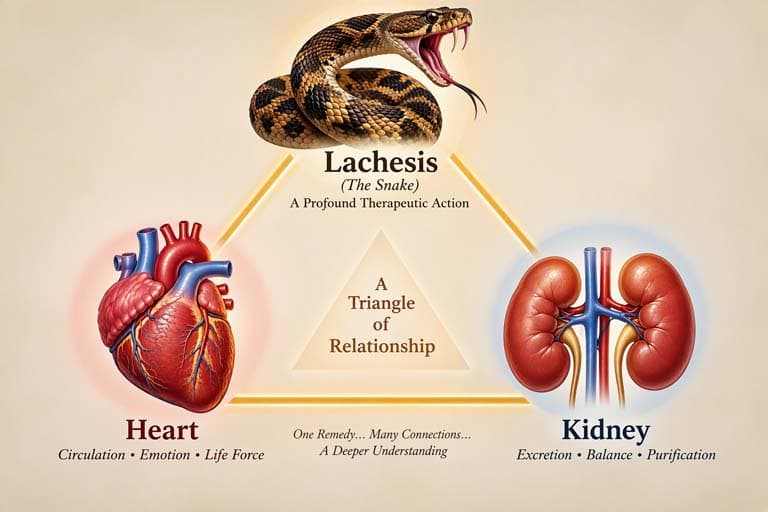
👉 In the pathogenesis of Lachesis, urinary symptoms frequently appear as concomitants of various pathological conditions rather than as isolated manifestations. The urinary system occupies an important place in the sphere of Lachesis pathology and often provides valuable corroborative evidence for remedy selection. Lachesis bears a profound relationship to cardiac disorders and is an important remedy in heart diseases, particularly when they are associated with characteristic urinary disturbances. In such cases, the urinary symptoms serve as complementary or concomitant symptoms, helping to complete the totality of the case and guiding the physician toward a more accurate prescription. Lachesis also cures renal failure and albuminuria.