An overview:
From time to time, human society encounters various diseases and manifestations influenced by variations in atmospheric temperature and humidity. Conventional medicine often terms such conditions as viral infections. In India, six distinct seasons occur, and each season expresses itself through a unique pattern of disease. If, for a moment, we assume diseases to be entirely weather‑borne, then their number must strictly correspond to the six seasons; yet the matter is not so simple. Theoretically, if one begins collecting data on temperature, humidity, and other factors responsible for weather regulation, it becomes evident that all these variables—even when measured on the same date and time across different years—are never identical.
For example, at 12 o’clock on 1 January 2025, the seasonal data recorded at that exact time will differ from the data collected at 12 o’clock on 1 January 2026. Logically, it becomes clear that every day is unique with respect to temperature and humidity.
Microbiological study reveals that viruses and bacteria exhibit distinct responses to variations in temperature and humidity. Now, let us turn our attention to the human body. The human organism is iso-thermic, meaning it maintains a stable internal temperature of approximately 37 °C, a physiological pH of about 7.4, and a water content of roughly 70%. here are the list of Bacterium and viruses that can produce infection even on healthy biological data.
List of viruses and Bacteria:
1. Escherichia coli (E. coli) – thrives at 37 °C; part of gut microbiota but pathogenic strains cause diarrhea.
2. Staphylococcus aureus – grows optimally at body temperature; causes skin infections, pneumonia, and sepsis.
3. Streptococcus pneumoniae – survives in respiratory tract; responsible for pneumonia and meningitis.
4. Listeria monocytogenes – tolerates 37 °C; causes listeriosis, especially dangerous in pregnancy.
5. Salmonella spp. – grows in intestines; causes food poisoning and typhoid fever.
6. Proteus vulgaris – urinary tract pathogen adapted to body conditions.
7. Haemophilus influenzae – colonizes respiratory tract; causes meningitis and respiratory infections.
8. Staphylococcus epidermidis – commensal on skin, but at 37 °C can form biofilms on medical devices
Considering the above data, if we assume that disease is produced solely by bacteria and viruses, then logically the entire human community should be sick. Yet this is not the case. This indicates that the true cause of disease is not merely reflected in the external world but lies within the organism itself—including human beings—where internal susceptibility, immune balance, and vital force determine whether illness manifests.
Now, let us recall the timeless statement of Dr. Hahnemann, mentioned in the Organon of Medicine—particularly in Aphorisms 5, 6, 12, 16, and beyond—that disease is produced by the derangement of the vital force. This makes it clear that the true cause of disease lies within the vital force itself. Of course, bacteria, viruses, and other microorganisms may serve as carriers of dynamic influences, but they are not the primary cause. Rather, they are secondary products or agents that act upon a susceptible vital force.
Microorganisms: Morden scientific view.
Modern science recognizes bacteria and viruses as agents of disease, but even here, illness depends on host susceptibility, immune balance, and environmental conditions. This aligns with Hahnemann’s view that the internal dynamis (vital force) is the true seat of disease. (An Artificial intelligence)
Fact: On philosophical and Scientific Dimensions
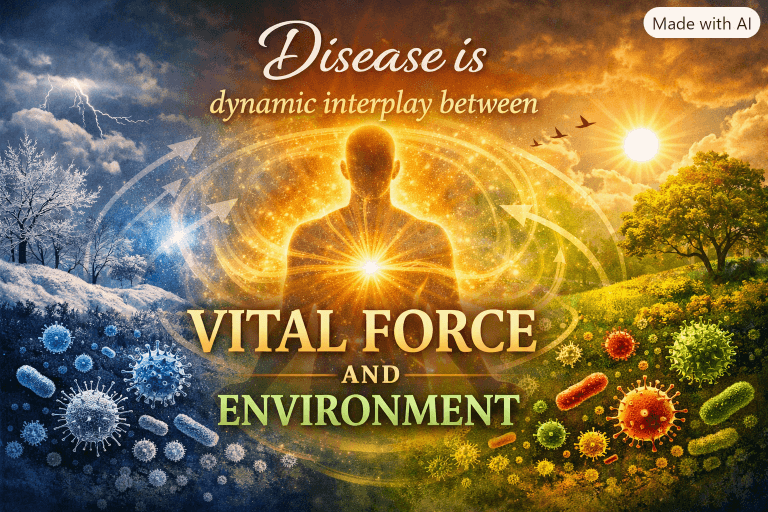
Disease may be understood as the dynamic interplay between the vital force and environmental influences, where internal susceptibility meets external conditions to produce illness. This explains why epidemic diseases change their nature from year to year and even from season to season, since no two days are ever climatically identical—even when observed at the same date and time. Therefore, every spell of disease requires a different group of medicines, which may vary from person to person, and must be selected entirely on the basis of the nature and totality of symptoms.
7th month epidemic year 2026
On date 15/08/2026, Region, Gwalior, M.P. India.
I am writing this post. from the last month I encounter the common symptoms in society and in the patient visiting on my clinic. that most of my patients are suffering from the common complaints of
1. Fever with pain in lower back, fever generally attending with chill. and general soreness, accompanied with throat pain, headache, and common influenza-like symptoms. likewise running nose, sneezing, lachrymation and itching in the eyes and ear. this this the acute outworst of latent Psora, triggered by environmental factor. the common medicine that helping me to fight against such maladies are.
1. Eupatorium perf: chill fever with pain in lower back and headache.
2. Rhustox: Extreme pain in the extremities alongside pain in the back with stiffness.
3. Eupharasia: Influenza-like symptoms with running nose and lachrymation.
4. Phytollca - Throat pain alongside sore extremities.
5. Lac can: Metastatic swelling around neck, with soreness and intense fever that worse at night,
6. Bryonia: fever with constipation, backache and sore extremities, aversion for motion.
Conclusion:
"Of course, many other medicines may be possible, for the portrait of disease is a resonance of the patient’s constitution, underlying miasm, and the environmental forces acting upon them. The concept of individuality thus becomes the physician’s guiding principle, enabling a deeper understanding of each patient’s unique susceptibility and facilitating the selection of the most appropriate remedy. In this way, the physician perceives disease not as a uniform entity, but as a dynamic expression of the interplay between the vital force, inherited predispositions, and external influences—each case demanding its own individualized approach to cure."