
HomeoEra
Back to Blogs

Navigating COVID-19 Vaccines: Understanding Risks and Homeopathic Support

COVID-19 has affected millions of people worldwide, leaving behind not only the illness itself but also long-term health problems. Vaccines have been introduced to reduce the risk of severe disease, hospitalization, and death. While they play an important role in prevention, some people still experience side effects or lingering symptoms after recovery. Homeopathy looks at health in a different way. Instead of focusing on the name of the disease, homeopathy pays attention to the symptoms each person experiences. Every patient is unique, and remedies are chosen based on their specific complaints—whether it is sore throat, cough, chest pain, or weakness. For example, a sore throat with general soreness may be helped by Phytolacca, while joint stiffness with fever and cough may respond to Causticum. Post-COVID problems such as weakness of the heart, persistent cough, or hearing difficulties are also treated symptomatically, with remedies like Iberis amara, Antimonium arsenicosum, or Gelsemium. The goal of homeopathy is to support recovery in a gentle, holistic way—helping patients regain strength and balance after the challenges of COVID-19.

H

HomeoEra Journal Editorial Team

Updated 4 min read1444 views
Navigating COVID-19 Vaccines: Understanding Risks and Homeopathic Support

An overview of covid – 19

Recently, the world has faced a new epidemic known as Covid-19. From the homeopathic perspective, it makes no difference whether a disease arises naturally or is artificially induced—homeopathic medicines remain equally valid and applicable in both cases. This pandemic has claimed thousands of lives worldwide, and countless others continue to suffer from its lasting effects. Among the complications reported are paralysis and heart attacks, which highlight the severity of the disease’s impact on human health.

Governments across the globe have emphasized vaccination as the primary solution, citing strong evidence that vaccines reduce the risk of severe illness, hospitalization, and death. At the same time, some observers have raised concerns about side effects and breakthrough cases, noting that challenges remain even after vaccination. While mainstream medicine views vaccination as the cornerstone of prevention, homeopathy offers an alternative perspective, aiming to support patients holistically and address both acute symptoms and long-term consequences.

If we look closely at the symptomatology produced by this epidemic disease, certain features resemble those seen in sarcoidosis. Sarcoidosis is an inflammatory condition characterized by granuloma formation, most often affecting the lungs and lymph nodes. Similarly, COVID-19 can trigger immune dysregulation, persistent inflammation, and multi-organ involvement. This overlap has led some researchers to explore whether the two conditions share common pathogenetic mechanisms, particularly in relation to immune system activation and inflammatory cascades

Sarcoidosis is due to the production of Sarcolactic acid, produced in the hyper stimulated muscle during contraction and relaxation, weather this stimulation may be by mechanical, physical, biological, or electrical way.

Symptoms of covid – 19 with homoeopathic treatment.

1.     Sore throat with general soreness (Phytollaca)

2.     Sore throat with general soreness and backache with mild chill (Rhustox)

3.     Sore thrat with general soreness and cough and cold with mild or severe chillness (Rhustox)

4.     Chest pain coughing while with general soreness, cough Strock in the head (Rhustox., Bryonia)

5.     Stiffness in the joint with fever, tickling in the throat and cough with high fever (Causticum)

6.     Severe pain in the back sensation as if it would breck, severe weakness and heat flushes. (Acid sulph)

7.     Persistent cough even after recovery of fever and fatigue (Pyrogenum)

8.     Weakness after influenza while other elements recover (Kali phos, Conium, Pyrogenum, Abrotanum.,)

9.     Hypoxia, falling of O2 can be cured with Borex, Bapticea, Pyrogenum, Carbo veg, 

10.   Sleeplessness can be cured with Carbo veg.  

 Post covid complication and treatment.

When seeking homoeopathic treatment, the name of the disease does not matter; symptoms are always our top priority. Following are the post covid complication and their Homeopathic treatment. Because covid is a type of influenza, hence treatment given below are accordingly.

1.     Kidney: Nephritis influenza after (Ars., Eucal.,)

2.     Lungs: persistent pneumonia influenza after (Ant-ars.,)

3.     Heart: weakness of the heart influenza after (Iberis amara.,)

4.     Ear: hearing loss, or deafness influenza after (Gels, kali mur., )

5.     Fever – hectic fever influenza after (Abrot.,)

6.     Eyes – Retinitis influenza after (Acid -sulph.,)

Conclusion:

The COVID-19 pandemic has underscored the importance of both preventive and supportive approaches to health. Vaccination remains the cornerstone of mainstream medical strategy, offering strong protection against severe illness and death. At the same time, homeopathy emphasizes individualized care, focusing on symptom patterns and holistic recovery, particularly in managing acute presentations and post-COVID complications.

The overlap between COVID-19’s inflammatory effects and conditions like sarcoidosis highlights the complexity of immune dysregulation, reminding us that no single approach can fully address the diverse consequences of this disease. While conventional medicine prioritizes vaccines and evidence-based interventions, homeopathy seeks to complement recovery by alleviating lingering symptoms and supporting overall vitality.

Ultimately, navigating COVID-19 requires a balanced perspective: recognizing the proven benefits of vaccination while also valuing supportive therapies that aim to restore health and resilience. This integrated outlook encourages patients and practitioners alike to consider both prevention and long-term well-being in the face of evolving challenges

Have a Question?
Ask HomeoEra Journal Editorial Team about "Navigating COVID-19 Vaccines: Understanding Risks and Homeopathic Support" and get a personalized response directly to your email.

0/500 characters

0 characters (minimum 10 required)

🔒 Privacy Notice: Your information will only be used to respond to your query and won't be shared with third parties.

Influenza as an Epidemic Disease: Cough, Cardiac, and Renal Sequelae in the 2026 Outbreak.
Epidemic disease

Influenza as an Epidemic Disease: Cough, Cardiac, and Renal Sequelae in the 2026 Outbreak.

Influenza, distinct from simple coryza, exemplifies the dynamic nature of disease through its highly contagious and epidemic character. Unlike localized ailments, influenza spreads rapidly across populations, exerting a profound impact on society. Its complications extend beyond the acute febrile stage, with post‑influenzas cough being a common sequela. More significantly, influenza may leave deeper imprints on vital organs, manifesting as renal and cardiac involvement in the aftermath of infection. Thus, influenza stands not merely as a transient respiratory illness but as an epidemic disease with wide‑ranging consequences for individual health and collective well‑being.

HHomeoEra Journal Editorial Team
9m539
Epidemic disease, an acute out worst of latent psora: Cyclic Maladies and Their Changing Symptomatology out worst rainy season 2026.
Epidemic disease

Epidemic disease, an acute out worst of latent psora: Cyclic Maladies and Their Changing Symptomatology out worst rainy season 2026.

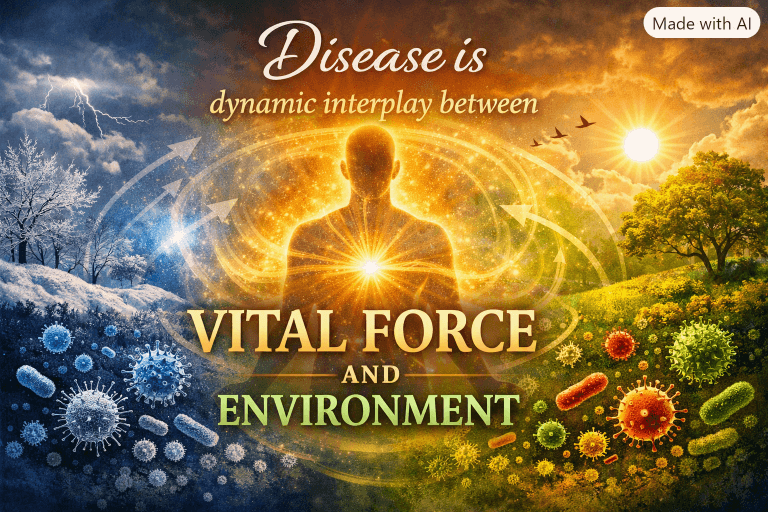
Seasonal epidemic diseases often emerge as acute manifestations of latent psora, revealing themselves in cyclic patterns that shift with environmental changes. The rainy season of 2026 has once again brought forth a collective outbreak, yet the symptomatology differs from previous years—demonstrating the dynamic nature of such maladies. Each cycle presents a new portrait of suffering: fever, respiratory affections, gastrointestinal disturbances, or dermatological eruptions, all woven into the fabric of a single epidemic expression. This variability underscores the philosophical truth that disease is not a static entity but a living process, shaped by the interplay of constitutional susceptibility and external influences. To the homeopathic physician, these shifting symptoms are not contradictions but clues, guiding the search for the similimum that resonates with the totality of the patient’s condition. Thus, epidemic disease becomes both a challenge and an opportunity—an acute outburst of psoric miasm that demands careful observation, cyclic understanding, and individualized therapeutic response.

HHomeoEra Journal Editorial Team
5m449
Vaccination: Mechanism, History, Principles, Risks, and Prevention — A Homoeopathic Perspective
Epidemic disease

Vaccination: Mechanism, History, Principles, Risks, and Prevention — A Homoeopathic Perspective

In contemporary discourse, vaccination is often presented as the sole solution for the prevention of disease. Yet it is important to pause and examine what vaccination truly represents. From a homoeopathic perspective, vaccination may be regarded as either an imperfect application of homoeopathy or as a practice more closely aligned with the principle of isopathy. Homoeopathy, founded on the law of similia similibus curentur (“like cures like”), requires a remedy to be prescribed on the basis of symptom similarity, tailored to the individual’s dynamic state. Vaccination, however, does not follow this individualized approach. Instead, it introduces a disease product or attenuated pathogen into the body with the aim of stimulating immunity. This method resembles isopathy, where the very substance causing disease is used in a modified form to prevent or treat it. The distinction is crucial: * Homoeopathy emphasizes individualized prescription, dynamic resonance, and symptom similarity. * Isopathy relies on the direct use of disease products or their derivatives, without the nuanced matching of symptoms. Thus, vaccination may be seen as a crude or partial reflection of homoeopathic principles, lacking the refinement of individualized remedy selection. While it seeks to protect populations, it does so by imposing a uniform solution, whereas homoeopathy insists upon the uniqueness of each patient’s constitution and symptom totality.

HHomeoEra Journal Editorial Team
7m838
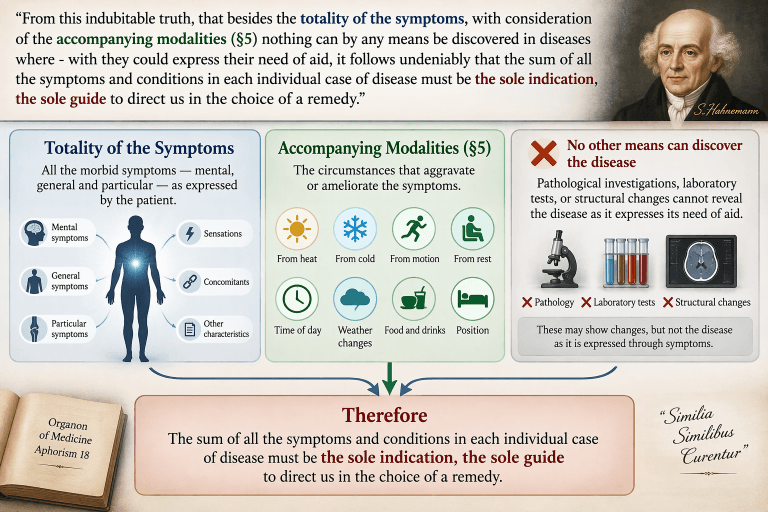
Aphorism 18: The Totality of Symptoms as the Fundamental Basis for Remedy Selection
Organon & Philosophy

Aphorism 18: The Totality of Symptoms as the Fundamental Basis for Remedy Selection

Aphorism 18 establishes that the totality of symptoms, together with their accompanying modalities, is the only reliable means of understanding disease and selecting the appropriate remedy. According to Hahnemann, disease cannot be perceived directly; it is known only through the signs and symptoms by which the disturbed vital force expresses itself. Therefore, every deviation from health has diagnostic and therapeutic significance.The physician must consider not only the symptoms themselves but also the circumstances that modify them, such as aggravations and ameliorations from motion, rest, weather, time, position, food, and other conditions. These modalities individualize the case and help distinguish one remedy from another.Hahnemann further teaches that pathological findings and structural changes may reveal the effects of disease, but they do not disclose the dynamic disturbance as clearly as the symptom totality. Consequently, the complete symptom-picture of the patient, rather than the disease name alone, must guide treatment.Thus, Aphorism 18 conveys two central truths: the totality of symptoms is the sole means of perceiving disease, and the same totality is the sole guide for selecting the curative remedy. It remains the foundation of individualization and successful homoeopathic prescribing.

HHomeoEra Journal Editorial Team
2m21

Comments (0)

Sign in or sign up to join the discussion

No comments yet. Be the first to share your thoughts!

Newsletter

Stay Updated with Latest Research

Get weekly digests of new articles, case studies, and homeopathic insights delivered to your inbox

By subscribing, you agree to our Privacy Policy. Unsubscribe anytime.