
Kali Phosphoric as Complementary to Oxalic Acid: in Tubercular Affection of the Left Scapular Region
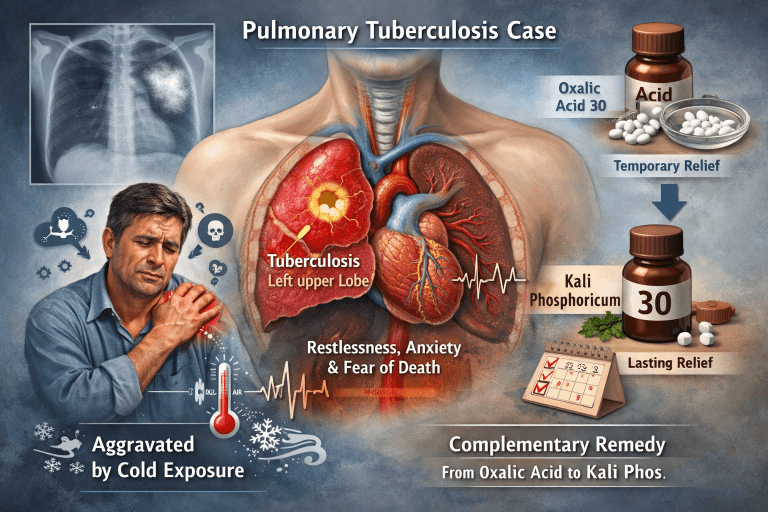
This case illustrates the dynamic role of complementary remedies in homoeopathy. A patient with pulmonary tuberculosis of the left upper lobe, complicated by pleural effusion, initially responded to Calcarea Carbonica and later obtained temporary relief from Oxalic Acid. However, the persistence of pain, restlessness, anxiety, and fear of death—aggravated by cold exposure—necessitated deeper exploration. Guided by Hering’s Guiding Symptoms, Kali Phosphoricum was identified as a complementary and chronic remedy to Oxalic Acid. Its administration provided lasting relief, with sustained improvement even after discontinuation. This outcome highlights the importance of contextual complementarity, where Kali Phos not only complemented Oxalic Acid but also addressed the chronic dimension of cardiac‑pulmonary involvement.
Admin User
KALIUM PHOSPHORICUM AS THE COMPLEMENTARY OF OXALIC ACIDUM
Introduction:
Complementary medicines in homoeopathy are those that extend or complete the action of a previously prescribed remedy. Classical examples include:
1. Sepia as complementary to Natrum Muriaticum
2. Rhus Toxicodendron as complementary to Bryonia
3. Phosphorus as complementary to Arsenicum Album
However, complementarity is not absolute. It varies according to location, organ involvement, and symptom totality. This case illustrates how Kali Phosphoricum acted as a complementary and chronic remedy to Oxalic Acid in pulmonary tuberculosis affecting the left upper lobe.
Case history:
Acute episode and diagnosis:
The case was initially misdiagnosed. One day, while riding his motorcycle, the patient was exposed to cold air, which aggravated his pre‑existing pain in the left shoulder. Since it was winter, he sought warmth and applied oil to the affected area, followed by intense local heating. This excessive application of heat precipitated a severe left‑sided pleural effusion, with nearly 75% of the left lung submerged in fluid. His pulse rate escalated to 185 beats per minute, and he became critically ill.
This acute condition of pleural effusion was successfully managed with a single dose of Calcarea Carbonica 1M. Following treatment, his pulse normalized and chest pain subsided. A subsequent chest X‑ray revealed underlying chronic bronchitis along with tuberculosis localized to the left upper lobe.
Although radiological and investigative findings diagnosed the condition as a localized lung disease, I strongly perceived that the pain was closely aligned with the heart, given the presence of restlessness, anxiety, and fear of death—symptoms often associated with cardiac involvement.
Even after the resolution of the pleural effusion, the patient continued to suffer from the same persistent pain. For this complaint, I prescribed Oxalic Acid 30, administered in repeated doses at two‑hour intervals. Oxalic Acid provided instant relief, but the effect was not permanent.
In an effort to secure lasting improvement, I attempted several homoeopathic medicines as complementary and chronic supports to Oxalic Acid. However, none of these remedies produced the desired sustained effect.
With no other viable option, I continued prescribing Oxalic Acid for the persistent pain. However, during an in‑depth study of Hering’s Guiding Symptoms, I encountered the indications of Kali Phosphoricum, particularly its relevance to pulmonary symptoms. This study led me to the insight that Kali Phos might act as a complementary remedy to Oxalic Acid, especially in cases involving the heart and left lung, accompanied by restlessness, anxiety, and fear of death.
Guided by this understanding, I substituted Oxalic Acid with Kali Phos 30, administered in the same repeated manner. The patient responded favorably, confirming the complementary and chronic role of Kali Phos in this clinical context
Kali Phosphoricum provided the patient with lasting relief. It has now been over three months since discontinuation of Kali Phos, yet the pain has not returned. This sustained improvement highlights its role not only as a complementary remedy to Oxalic Acid, but also as a chronic medicine in conditions involving the heart and left lung, particularly when accompanied by restlessness, anxiety, and fear of death, and when pain is aggravated by exposure to cold air or cold environments.
Conclusion:
About Admin User
HomeoEra: A Global Platform for Doctors Our mission is to build the largest database of homoeopathic knowledge for future generations. With a special focus on teaching Materia Medica and the Organon of Medicine, we aim to strengthen the foundation of classical homoeopathy worldwide. We invite you to share your cured cases on this platform, contribute to collective learning, and support fellow practitioners. Together, let us take a decisive step toward establishing world-class homoeopathy. Join hands with HomeoEra—where knowledge meets cure.
Comments (0)
No comments yet. Be the first to share your thoughts!